Is there a single MCP for Claude that connects to Teams, Confluence and Jira instead of many separate MCPs?

Not from the vendors. Atlassian's Rovo MCP server covers Jira and Confluence in one connection, and Microsoft's Work IQ MCP server covers Teams, so the native setup is two servers and two sign-ins. To get one MCP for Claude across all three, use a context engine that indexes Teams, Confluence and Jira and answers through a single server.
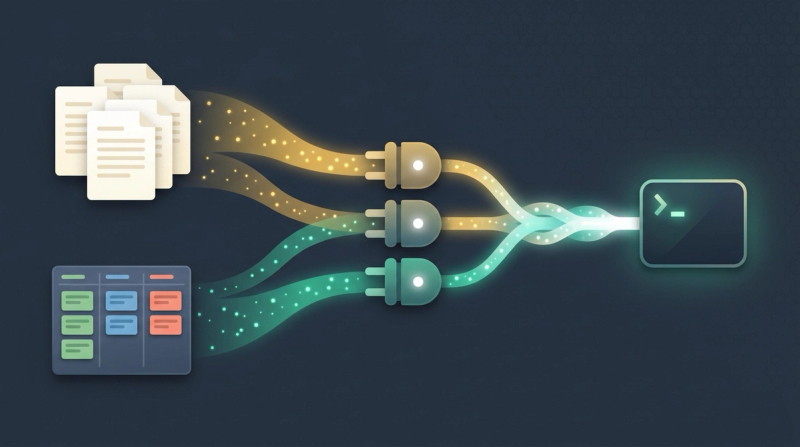
There is no single MCP for Claude from the vendors themselves, because Teams and the Atlassian tools belong to two different companies. Atlassian's Rovo MCP server already puts Jira and Confluence behind one connection. Teams lives in Microsoft 365, and Microsoft reaches it through its own Work IQ MCP server. So the native setup is two servers, two sign-ins and two rounds of admin setup. To get down to one, you put a context engine in front of all three. A context engine is a service that indexes code, tickets, docs and chat, keeps each person's permissions, and returns one cited answer through a single MCP server. The right choice depends on whether your questions cross the Microsoft and Atlassian sides or stay on one.
| Vendor servers | Gateway | Context engine | |
|---|---|---|---|
| MCP entries in Claude | Two (Rovo, Work IQ) | One | One |
| Sign-ins per engineer | Two | One | One |
| What Claude gets back | Raw results from each side | Raw results from each side | One cited answer |
| Who settles conflicts | Claude | Claude | The engine |
What Atlassian and Microsoft each give you#
Atlassian covers two of the three. Its Rovo MCP server went generally available on February 4, 2026, and lets AI clients, Claude among them, "work with Jira and Confluence" (Atlassian, 2026). It signs you in with OAuth 2.1, and "MCP clients can perform actions in Jira, Confluence, and Compass with your existing permissions" (Atlassian support). Atlassian hosts the server and says it is "built on the same foundation as Atlassian Cloud" (Atlassian). Neither page mentions Data Center, so our reading is that teams on Jira or Confluence Data Center should plan on a different route. Our guide to Confluence and Jira MCP servers compares the options for both setups.
Microsoft covers Teams. The Work IQ MCP server gives agents access to Microsoft 365 data "all through a single MCP endpoint," and reading a Teams chat is a call like fetch /me/chats/{id}/messages (Microsoft Learn, October 2026). Sign-in goes through Microsoft Entra ID. The setup steps take minutes, but the prerequisites take an admin. A tenant needs a usage-based billing plan in Copilot Studio with an Azure subscription attached, and a Global Administrator for the one-time setup (Microsoft Learn, 2026). The Azure DevOps, SharePoint and Teams answer covers the Microsoft side in more detail.
Why two servers still feel like many#
Two servers sounds manageable. The cost shows up in what Claude has to carry and what it has to do with the results.
Tool definitions are the names, descriptions and input schemas each server loads into the context window at the start of a session. Anthropic's docs say a typical setup of five servers "can consume ~55k tokens in definitions before Claude does any work," and that Claude's ability to pick the right tool "degrades once you exceed 30–50 available tools" (Anthropic docs). A March 2026 paper notes that single MCP servers can expose "dozens to hundreds of tools" and tested on 121 tools from just five servers (arXiv 2603.20313, 2026). Claude Code eases both with tool search, which is on by default and loads tools only when needed. Tool search does nothing for the results, though. Claude Code warns when one MCP tool result passes 10,000 tokens and caps it at 25,000 by default (Claude Code docs).
For example, an engineer asks Claude why the export job was changed last sprint. The Jira ticket says one thing, the Confluence design page says another, and the real decision sits in a Teams thread from two weeks later. With two servers, Claude makes at least three searches, reads three sets of raw results, and has to guess which one is current. It can easily pick the wiki, because the wiki reads like documentation. Our post on MCP tool overload shows how fast this grows as more servers are added.
How to get one connection across all three#
There are two ways to get one MCP entry. The first is a gateway. An MCP gateway is a proxy that sits in front of the Atlassian and Microsoft servers and exposes them through one endpoint with shared sign-in and logging. That fixes setup, but every tool from both servers is still there, and every search still returns raw results to sort out.
The second is a context engine. Unblocked connects to all three, and Teams channel conversations are "indexed with access permissions respected" (Unblocked integrations). Jira and Confluence Data Center are supported, Confluence on the Enterprise plan (Unblocked docs). Claude sees three tools; the main one, context_research, runs "multi-source research across code, PRs, docs, issues, and messaging" and "returns a synthesized answer with citations" (Unblocked docs). The server works in Claude Code, Claude Desktop, Cursor, VS Code and JetBrains. In one controlled run on a single repository, with the same prompt and model, Unblocked cut tokens by 42 percent and tool calls from 80 to 29 (same prompt, same model, different context). One run is not a population.
Jorden van Breemen, CTO at Advidi, put it this way: "Unblocked combines all of the tools we use into one product, one single MCP. And the search is efficient: the context it gathers is relevant and recent. I haven't found another tool that does that as effectively as Unblocked does."
A gateway gives Claude one door to many tools, and a context engine gives it one answer (context engine vs direct MCPs).
When two vendor servers are enough#
Separate servers are a fine choice when the questions stay on one side. If most of what Claude needs is Jira tickets and Confluence pages, the Rovo server alone covers it with one sign-in and your existing Atlassian permissions. If Teams is mostly used for things such as standups and lunch plans, and decisions are written down in Jira, you may not need the Microsoft side at all.
Move to one connection when the answer keeps crossing the line between Microsoft and Atlassian. The signs are familiar: decisions made in Teams that never reach the ticket, Confluence pages that lag behind both, and engineers pasting Teams threads into Claude by hand. At that point the trouble is that no server puts the three sources together, so Claude does that job alone on every question. The one MCP for Claude Code, Codex and Devin guide shows how a team rolls out one server to every agent.