Best Confluence and Jira MCP Servers for Coding Agents
Four Confluence and Jira MCP servers compared for coding agents: Atlassian's official Rovo server, the sooperset community project, Composio, and Zapier, plus the conflict-resolution gap raw MCP access leaves open.

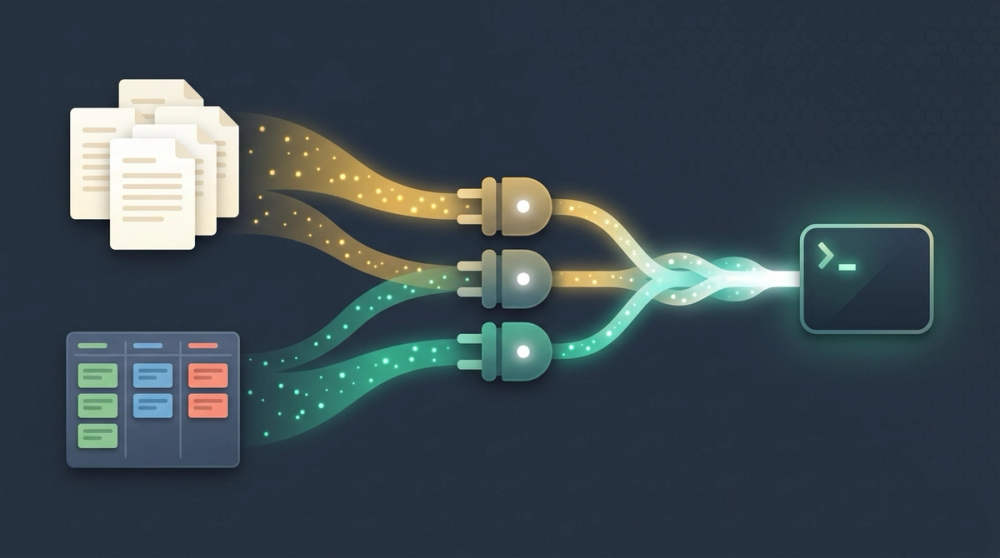
Bottom line: pick the official Atlassian server on Cloud, sooperset/mcp-atlassian on Server or Data Center, and Composio if your agents already live on its platform. All four grant document access, and none of them tells your agent which document to trust when a Jira ticket and a Confluence page disagree.
What's the best Jira MCP server for Claude Code in 2026? For teams on Atlassian Cloud, it's the official Atlassian Rovo MCP Server, which reached general availability on February 4, 2026 and connects Jira, Confluence, Jira Service Management, Bitbucket Cloud, and Compass through a single hosted endpoint (Atlassian, 2026). The best Confluence MCP server for coding agents is the same answer, because the two serious contenders each cover both products: Atlassian's hosted server for Cloud sites, and the community-maintained sooperset/mcp-atlassian for anything running on Server or Data Center.
And if your question is whether GitHub Copilot can read your Confluence ADRs: yes. VS Code loads remote MCP servers from a short mcp.json entry, so Copilot Chat can query Confluence pages and Jira issues through the same endpoints Claude Code and Cursor use (VS Code docs, 2026).
This roundup compares the four options worth evaluating this year, head to head, on setup, access scope, client compatibility, and one criterion the vendors never advertise: what happens when two of your documents disagree. Every raw connector fails that last test the same way, which is where a layer of institutional context for coding agents, the job Unblocked does, picks up. First, the servers.
Which Jira MCP Server Should Cloud Teams Pick?#
Atlassian Cloud teams should pick the official Rovo MCP Server, generally available since February 4, 2026 and hosted by Atlassian itself (Atlassian, 2026). Nothing to run, nothing to patch: you point your client at https://mcp.atlassian.com/v1/mcp/authv2 and sign in with your Atlassian account.
Scope is the widest of any option here. The server spans Jira, Confluence, Jira Service Management, Bitbucket Cloud, and Compass, with one wrinkle worth knowing before you standardize on it: Jira Service Management and Bitbucket tools require API token authentication, while Compass tools require OAuth 2.1, so a single auth mode won't expose everything at once (Atlassian on GitHub, 2026). Whatever the auth path, the agent inherits your personal Atlassian permissions rather than a service account's.
The hard boundary is deployment model. This server only talks to Atlassian Cloud. Our Jira MCP setup guide walks through client configuration in detail if you want the step-by-step.
What's the Best Option for Jira Server or Data Center?#
For on-prem Atlassian, the community sooperset/mcp-atlassian project is the practical default, and it has kept growing: the repo now sits at 5.6k GitHub stars and exposes 98 tools across Jira and Confluence (sooperset/mcp-atlassian, 2026).
Coverage is the selling point. It supports Jira Cloud and Jira Server/Data Center 8.14+, plus Confluence Cloud and Confluence Server/Data Center 6.0+, which makes it the one credible route for regulated teams whose issue and page data cannot leave the network. You run it yourself via uvx, Docker, or pip, and authenticate with an API token on Cloud or a personal access token on Server/Data Center.
The bill for that flexibility is operational. Upgrades, credential handling, and deciding which of those 98 tools your agents actually need all land on your team. Loading all of them is rarely wise; a wide toolset inflates every request, a failure mode we unpack in MCP tool overload.
Are Hosted Aggregators Like Composio and Zapier Worth It?#
Sometimes, and for a specific buyer. Composio runs hosted MCP servers with managed OAuth, including a Jira toolkit with 94 tools and a Confluence toolkit with 62 tools plus 23 triggers, both with a free tier (Composio, 2026; Composio Confluence, 2026). The pitch is credential management: Composio handles token refresh and per-user auth, and the same platform covers hundreds of other SaaS apps. If your agents already touch five non-Atlassian systems through Composio, adding Jira and Confluence there beats running another server.
Zapier also lists Confluence in its MCP catalog at mcp.zapier.com, but the integration is automation-shaped: a new-page trigger and a create-page action (Zapier, 2026). That suits workflow bots, not a coding agent that needs to search and read documentation mid-task.
The tradeoff for any aggregator is an extra intermediary between your agent and your data, one more vendor in the security review, and less control over which tools load into context.
Can GitHub Copilot Read Your Confluence ADRs?#
Yes, and so can Claude Code and Cursor, because all three speak the same protocol. For Copilot, add the official endpoint to .vscode/mcp.json as an HTTP server and VS Code handles the rest, including the sign-in flow (VS Code docs, 2026):
json{"servers":{"atlassian":{"type":"http","url":"https://mcp.atlassian.com/v1/mcp/authv2"}}}Claude Code registers remote HTTP servers with a single command, claude mcp add --transport http atlassian https://mcp.atlassian.com/v1/mcp/authv2, then authenticates via /mcp (Claude Code docs, 2026). Cursor reads the same URL from ~/.cursor/mcp.json and supports the OAuth handshake natively (Cursor docs, 2026).
One migration note if you set this up before mid-2026: Atlassian's legacy /v1/sse endpoint is unsupported after June 30, 2026, so older configs need the authv2 URL above (Atlassian support, 2026). Once connected, asking Copilot "what does our ADR say about retry policies" becomes a Confluence search call instead of a copy-paste job.
How Do the Four Server Options Stack Up?#
Here is the side-by-side, scored on the four criteria that decide the choice. Read the last column carefully. It is identical in every row, and it is the reason wiring up a Jira MCP server is the start of the work rather than the end of it.
| Server | Setup | Access scope | Tool compatibility | Conflict handling |
|---|---|---|---|---|
| Atlassian Rovo MCP Server (official) | Hosted; add URL, sign in with Atlassian account | Jira, Confluence, JSM, Bitbucket Cloud, Compass; Cloud only | Claude Code, Cursor, VS Code/Copilot, ChatGPT, Gemini CLI, others | None; returns documents as stored |
| sooperset/mcp-atlassian (community) | Self-hosted via uvx, Docker, or pip; API token or PAT | Jira and Confluence; Cloud plus Server/Data Center | Any MCP client pointed at your instance | None; returns documents as stored |
| Composio Atlassian toolkits | Hosted; managed OAuth with token rotation | Jira (94 tools) and Confluence (62 tools) among 500+ apps | Claude, Cursor, ChatGPT, 18+ agent frameworks | None; returns documents as stored |
| Zapier MCP | Hosted at mcp.zapier.com | Confluence trigger and page creation; automation-oriented | Zapier-supported AI clients | None |
What Happens When the Jira Ticket and the Confluence Page Disagree?#
The agent guesses. The MCP specification defines how servers expose tools, resources, and prompts to a client; it has no concept of recency, authority, or contradiction between sources (Model Context Protocol, 2026). A Confluence MCP server will return the superseded ADR and the current one with equal confidence. A Jira MCP server will return a ticket whose requirement quietly changed in Slack last sprint, exactly as written. Which one the agent believes depends on retrieval order and phrasing, not on which is true.
Picture the concrete case. An ADR in Confluence, approved in March, specifies exponential backoff with a hard retry cap. A Jira ticket from May says to remove the cap for one flaky upstream service. The pull request that closed the ticket implemented something narrower than either document describes. Ask an agent with raw access how retries work and it will quote whichever of the three its search returned first, with citations, sounding entirely sure of itself.
That is a different problem from choosing a connector, and it doesn't go away by adding more of them; our comparison of MCP servers for engineering teams shows how stacking single-source feeds shifts reconciliation work onto the agent. Unblocked works at that missing layer. Rather than returning matching documents, it weighs the Jira ticket against the Confluence page, the pull request that closed the work, and the Slack thread where the plan changed, then answers with the version that holds. Your agent gets decision-grade context: one resolved answer instead of a pile of search results to adjudicate.
Teams that run agents this way treat it as a precondition, not a nice-to-have:
The first instruction in every agent project file is: before making any changes, gather context. That pulls from Jira, Confluence, and Slack via Unblocked — because that's where most of our knowledge actually lives, in threaded discussions. I set it up the day it was announced and now I don't even think about it. I just get the relevant information.
Andrei Antanovich — Software Engineer, Waste Logics
Keep the raw connector for writes, like transitioning issues or posting comments. For the question of what is currently true across both sources, raw access was never designed to answer it.
FAQ: Choosing a Confluence or Jira MCP Server#
What's the best Confluence MCP server for Claude Code?#
The official Atlassian Rovo MCP Server, if your Confluence runs on Cloud. Register it with claude mcp add --transport http atlassian https://mcp.atlassian.com/v1/mcp/authv2 and authenticate through /mcp (Claude Code docs, 2026). On Server or Data Center 6.0+, self-host sooperset/mcp-atlassian instead. Our Confluence MCP guide covers both paths.
Do Jira and Confluence need separate MCP servers?#
No. Both leading options bundle the two products: Atlassian's official server covers Jira and Confluence alongside JSM, Bitbucket Cloud, and Compass, and the sooperset community project ships its 98 tools across Jira and Confluence together. Only aggregators like Composio treat them as separate toolkits you enable individually.
Does any Jira MCP server work with Data Center?#
Yes, one: sooperset/mcp-atlassian supports Jira Server and Data Center 8.14+ with personal access token authentication (sooperset/mcp-atlassian, 2026). Atlassian's official server is Cloud-only with no announced on-prem path, so Data Center teams should plan around the community project.
How does an MCP server decide which document is authoritative?#
It doesn't. MCP standardizes access: a client calls a tool, the server returns results. Nothing in the protocol ranks a current runbook above an abandoned draft or reconciles a ticket with the page that contradicts it (Model Context Protocol, 2026). Whether raw access is even the right interface for a task is its own decision; see when to use MCP vs CLI.
What should a team running both Cloud and Data Center choose?#
Run sooperset/mcp-atlassian as the single connector, since it is the only option that reaches Cloud and Server/Data Center from one self-managed deployment (sooperset/mcp-atlassian, 2026). The alternative is a split setup: Atlassian's official endpoint for Cloud sites plus the community project for on-prem, at the cost of two auth flows and two toolsets loaded into every agent session.
Is Unblocked a replacement for a Jira MCP server?#
For context questions, it replaces the guesswork; for write operations, it doesn't try to. Unblocked connects code, tickets, docs, and discussions in one query and returns an answer already reconciled across them. A direct connector still handles single-tool actions like creating an issue. Many teams run both, with Unblocked queried first.
Which Confluence or Jira MCP server should you pick?#
Three picks are stable enough to act on: Atlassian's official Rovo MCP Server for Cloud sites, generally available since February 4, 2026 (Atlassian, 2026); sooperset/mcp-atlassian, 98 tools across Jira and Confluence, for Server or Data Center (sooperset/mcp-atlassian, 2026); and Composio when your agents already live on its platform. None of the three decides which document is current.
- Atlassian Cloud, on Claude Code, Cursor, or Copilot: the official server. Add the URL, sign in, and one config serves all three clients.
- Server or Data Center, or data that cannot leave the network: sooperset/mcp-atlassian, self-hosted, with the toolset cut to what your agents call.
- Agents already on Composio: its Jira and Confluence toolkits, with managed OAuth and token rotation.
- Jira and Confluence context combined with Slack, pull requests, and code under one permission model: Unblocked, which weighs the ticket against the page, the closing PR, and the thread where the plan changed, then returns one resolved answer. Wire up a connector for access and writes, and add Unblocked when the agent must know which answer is current.