Is Glean Good Enough for Engineering Questions? An Honest Assessment
Glean is genuinely good enterprise search. But engineering questions about code, decisions, and the why behind both hit limits configuration can't fix.

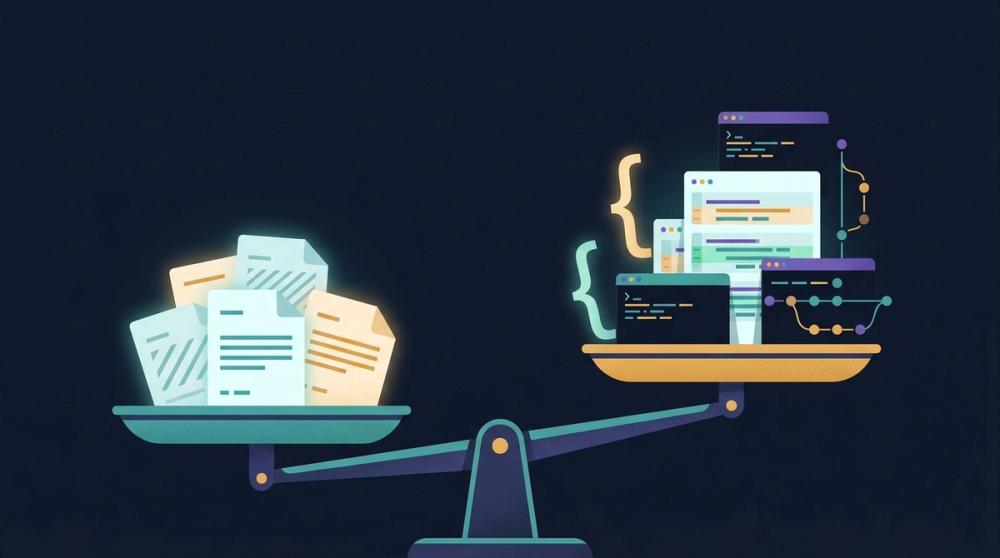
The short version: keep Glean for company-wide search, where it earns its seat. Treat engineering knowledge as a separate problem, because the properties that make a tool great at finding documents are not the properties that make it good at explaining a codebase.
Your company already pays for Glean, the rollout went fine, and now engineering is asking for budget for a separate knowledge tool. Someone on the eval committee asks the question this post exists to answer: is Glean good enough for engineering, or does the team actually need something built for it?
The verdict: for general enterprise search across a whole company, Glean is genuinely good and often enough. For engineering-specific questions, meaning codebase behavior, architecture decisions, and why the code is the way it is, Glean hits structural limits that no amount of configuration fixes. Those limits aren't bugs or missing connectors. They come from what enterprise search fundamentally is: a retrieval system over documents, applied to a domain where the answer is rarely inside any single document.
What is Glean actually good at?#
Quite a lot, and pretending otherwise would make the rest of this assessment worthless. Glean connects most of the enterprise stack through native connectors, push APIs for custom or self-hosted systems, and partner-built integrations (Glean docs). Its permission story is real engineering: connectors fetch each source's permission map so results only show a user what they can already see in the source application (Glean docs). That is harder than it sounds, and many homegrown search projects die on exactly that rock.
Its AI Answers feature returns permission-aware responses with citations, and Glean documents that identical queries produce deterministic results (Glean docs). For the HR policy lookup, the sales enablement doc, the security questionnaire answer buried in Drive, Glean is a legitimately strong product with a mature compliance posture. If your evaluation is about knowledge workers broadly, you can stop reading and keep it.
Where does it break for engineering teams?#
The problems start when the question is about a living system rather than a stored document. A sales deck from March is still true in August; the code from March is three refactors gone. That single difference in the underlying material drives four limits that show up repeatedly when teams try to use Glean for engineering knowledge, and none of them is fixable with more connectors or better prompt hygiene.
How code-aware is the index?#
Glean's GitHub connector indexes repositories, source files, commits, READMEs, issues with comments, and pull requests with reviews and diffs (Glean docs). That sounds comprehensive, but note what it is: code stored as text documents. Glean itself describes its assistant as retrieving indexed content and generating responses from it, drawing on company knowledge, web knowledge, and the LLM's training (Glean docs). Retrieval over text chunks is a reasonable model for prose. Code is not prose. Understanding it requires structure: what calls what, which service owns which behavior, how a function changed across releases. A keyword-relevant chunk of a 4,000-line file is not an answer to "how does billing retry work."
Can the index keep up with daily code change?#
Credit where due: Glean's GitHub freshness is decent, with incremental crawls every 10 minutes and webhook-based updates (Glean docs). But freshness varies by connector, with full crawls ranging from 6 hours to 28 days, and missed deletion events wait for the next full crawl (Glean docs). Initial deployment takes two to three days of crawling for a small org, 10 to 14 for a large one, plus another 2 to 14 days of ML training before Glean says you should let users in at all (Glean docs). And one operational gotcha: until each engineer individually completes a GitHub OAuth step, no GitHub content appears in their results at all (Glean docs). Teams discover that one ticket at a time.
Do you get an answer or a reading list?#
Enterprise search returns ranked documents; the synthesis burden stays with the engineer. Glean's AI Answers narrow this gap for questions whose answer lives inside one or two retrievable documents. Engineering questions rarely do. "Why do we run two payment providers?" is answered by a 2023 PR review thread, a Slack argument, an ADR that was half-updated, and a Jira ticket that contradicts the ADR. Ten relevant hits with citations is still homework. Worse, when sources conflict, ranking is not resolution; we wrote about why in how tools handle conflicting context and in context engine vs enterprise search.
Where did the "why" go?#
Glean's retrieval is also personalized: results are shaped by what each user has access to and interacts with, so answers can differ across users (Glean docs). For document search that is a feature. For engineering truth it is a liability, because "why is the auth service structured this way" has one correct answer regardless of who asks. The why lives in the connective tissue between artifacts, the thing search engines index as separate documents and never join. This is the same gap that hobbles coding agents, which we covered in what your coding agent can't see.
Is Glean's AI enough for codebase Q&A?#
For orientation questions, sometimes. "Where is the deployment runbook" or "who owns the notifications service" are retrieval problems, and Glean handles retrieval well. The harder class of question is the one that sends an engineer spelunking through git blame: what does this actually do in production, and is the doc describing it still true? The gap appears at the trust boundary. Stack Overflow's survey data shows 84% of developers using or planning to use AI tools while only 29% trust the output's accuracy, down 11 points from 2024, largely because verifying plausible-but-wrong answers costs as much as doing the work yourself (Stack Overflow, 2026). A RAG answer assembled from whichever chunks ranked highest, personalized per user, over sources that may disagree with each other, is exactly the kind of output senior engineers double-check. Once every answer needs verification against the codebase, the tool has become a suggestion box. Glean for engineering ends up trusted for finding things and distrusted for explaining them, which is a rational response to its architecture, not a rollout failure.
When is Glean genuinely the right choice?#
An honest evaluation names the cases where the answer is "keep Glean and stop there." There are several:
- Your pain is company-wide findability, not engineering comprehension. If engineers mostly ask "where is the doc," not "why is the code like this," Glean covers it.
- Engineering is a small share of the org. A 40-person engineering team inside a 3,000-person company may not justify a second platform until agent adoption forces the issue.
- Your codebase knowledge is unusually well-documented. Teams with disciplined, current ADRs feel this gap less, though in our experience they are rare, and homegrown context stacks built to compensate have their own carrying costs.
- You need one tool for legal, sales, support, and engineering. No engineering-native platform tries to be that, and Glean is one of the better answers to it.
- Procurement reality. If a second vendor review will take two quarters, deploying Glean's GitHub connector today beats a better tool you can't buy yet, and nothing about doing so forecloses adding an engineering platform later.
If two or more of those describe you, the honest read of "is Glean good enough" is yes, for now. Revisit when your engineers or their agents start asking questions the index can't answer.
What do engineering-first alternatives do differently?#
The alternative category isn't "better search." It's a context engine: a system that ingests code, PRs, Slack, tickets, and docs, then reasons across them to produce one synthesized, cited answer instead of a ranked list. Unblocked, the engineering-native context engine we build, connects GitHub, GitLab, Slack, Teams, Confluence, Jira, Linear, and more, and explicitly reconciles sources that contradict each other before answering (Unblocked docs). It serves that answer wherever the question happens: IDE and coding agents over MCP, pull requests, Slack, CLI, web. The same institutional-memory layer that answers engineers also feeds agents, which is why teams pair it with tools like Claude Code; see giving Claude Code institutional memory.
Here's how one customer describes the difference in practice: "Unblocked is game-changing for information availability. Most AI tools are siloed. This one connects all of our documentation across the disparate systems to give answers we trust." — James Ford, Principal Engineer for Developer Experience, Compare the Market
For head-to-head detail, see Unblocked vs Glean, the three-way Unblocked vs Glean vs Augment, and the broader field in Glean alternatives.
FAQ#
Can Glean search code?#
Yes. Its GitHub connector indexes source files, commits, issues, and PRs with reviews and diffs, across common code and text file types, though wikis and GitHub Pages content aren't indexed by default (Glean docs). Searching code as text is the easy half; the hard half is answering questions about behavior and history, which retrieval alone doesn't do.
Is Glean good enough for a small engineering team?#
Often, yes. If the team's questions are mostly findability and the org already runs Glean, the marginal pain may not justify a second tool yet. The tipping points are AI agent adoption and codebase archaeology becoming a daily activity.
Does replacing Glean make sense, or do teams run both?#
Most engineering teams we see run both: Glean as company-wide search, an engineering knowledge platform for codebase Q&A and agent context. They solve different problems, so this is complement, not rip-and-replace. Our engineering knowledge platform roundup covers how the categories split.
What should we test during a Glean-for-engineering trial?#
Ask questions whose answers span systems: "why did we pick this queue," "what broke last time we touched checkout," "which of these two docs is current." Score whether you got a defended answer or a list of links. Our AI tools for engineering teams guide includes more evaluation prompts.
How to decide in one afternoon#
Skip the six-week bake-off. Collect the last ten real questions engineers asked in Slack that took a senior person to answer. Run all ten through Glean and through an engineering-native platform. Grade each response on three axes: did it synthesize one answer or return links, did it cite sources you could check, and did it explain why the system is the way it is rather than just where something lives. Glean will win the pure findability questions, and that result is worth respecting. If the why-questions come back as reading lists, you have your answer on whether Glean for engineering is enough, and it took an afternoon instead of a quarter. Whichever way it lands, you'll have decided on evidence from your own codebase rather than anyone's pitch deck, ours included.