Tools That Resolve Conflicting Information Between Docs, Code, and Slack
Most tools aggregate sources. Few resolve conflicting information between docs, code, and Slack. Six approaches compared, from Glean to Unblocked.

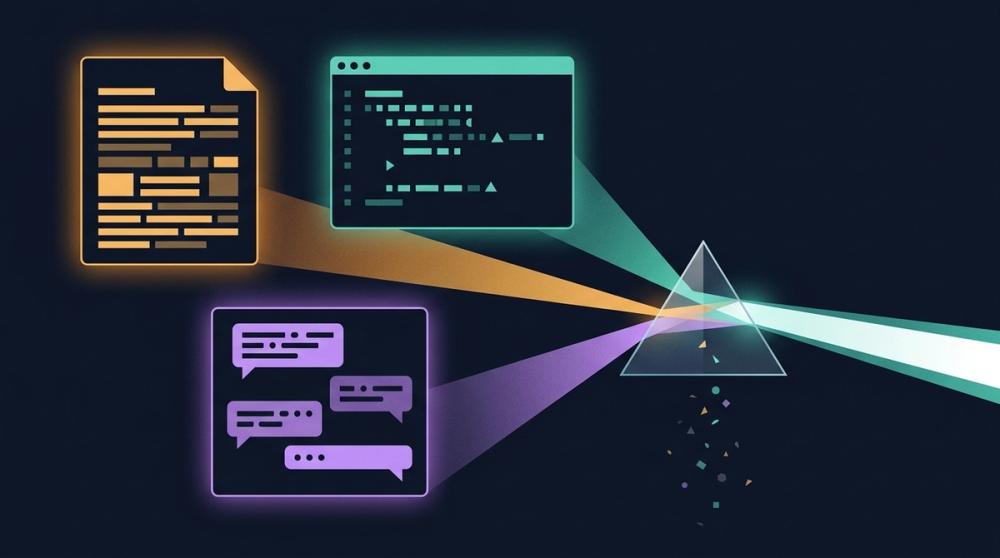
Bottom line: aggregation puts three contradictory sources in front of you or your agent and lets you guess. Resolution decides which source to believe, says why, and shows the losing source anyway. Only one tool in this roundup treats that second step as the product; the rest either rank results, stay inside one source of truth, or delegate the adjudication to humans.
If you need a tool that resolves conflicting information between your docs, your code, and your Slack history, Unblocked is the pick, because it is the only tool in this roundup whose core job is reconciling code, pull requests, Slack threads, and docs into a single conflict-resolved answer, weighted by recency and authority signals instead of similarity scores. That claim deserves immediate qualification, though: almost nothing in this category actually adjudicates between contradictory sources. Most tools retrieve. Some aggregate. A couple ask humans to settle disputes ahead of time. Genuine machine-side adjudication is rare, and pretending otherwise would make this a useless page. So here is the honest landscape, including where each tool's model of truth comes from and where it stops.
Why do docs, code, and Slack disagree in the first place?#
Because each one captures a different moment in a decision's life. A doc records intent at the time of writing. Code records what actually shipped, including the compromises nobody wrote down. Slack records the moment the plan changed, usually in a thread with eleven participants and no follow-up edit to the doc. Nothing back-propagates. The Confluence page that says "we retire the v1 endpoint in Q3" stays confident long after the thread that pushed it to Q1, which is how agents end up recommending deprecated APIs with complete conviction.
The problem is compounding. Writing a document now costs nothing, so document volume is climbing while average document authority falls. When three sources disagree, an engineer applies judgment: who wrote this, when, did it ship, did anyone senior push back? An agent treats every retrieved chunk as equally true unless something upstream decides otherwise.
Why does retrieval alone make conflicts worse?#
Similarity search has a structural bias toward the wrong answer. Call it the superseded-policy problem: the old policy doc is a polished, keyword-dense statement of exactly the thing you asked about, so it embeds beautifully and ranks first. The correction lives in a rambling Slack thread that mentions the policy once, obliquely, in a reply. Semantic similarity ranks the stale source above the current one almost by design, because clean prose about the topic beats messy prose about the change.
For a human skimming ten results, that is survivable. For an agent, it is fatal, because agents suffer from satisfaction of search: the first plausible hit becomes the truth they act on. A retrieval layer that returns contradictory chunks without adjudication launders stale information into confident output. This is the core reason enterprise search and a context engine are different products: one optimizes for finding, the other for deciding.
What are the tools?#
Unblocked: synthesis with conflict resolution built in#
Unblocked is a context engine that connects GitHub, GitLab, Slack, Microsoft Teams, Confluence, Jira, Linear, SharePoint, Sentry, Datadog, and more, and, per its documentation, "reconciles information across sources, including sources that contradict each other," answering with citations rather than a results list. Truth is decided by layered signals: code as ground truth for current behavior, recency with decay, and an expert graph built from PR and review activity that weights a statement by who made it. Agents reach the same engine through one MCP server, so the reconciliation happens before anything lands in a context window. It is the only entry here where adjudication is the headline feature, not a side effect.
Glean: broad aggregation, retrieval-ranked#
Glean is the heavyweight aggregator. Its workplace search product indexes 275+ app connectors, enforces source permissions in real time, and ranks results using a knowledge graph of people, projects, teams, and processes that personalizes relevance to the asker. That is a serious retrieval system. What its public documentation does not describe is adjudication: when Confluence and Slack disagree, Glean returns both, ranked by relevance, and the reader decides. For general enterprise search that is a defensible design. For engineering truth questions, it is the gap we've written about before: ranking is not deciding.
Atlassian Rovo: Atlassian sources first#
Rovo is Atlassian's play, built on its Teamwork Graph connecting teams, work, and goals. Its search combines results from Atlassian apps like Jira and Confluence with connected third-party apps such as Google Drive and Slack, and it respects source permissions. The product page emphasizes agents that automate workflows across that graph. Its docs do not describe how contradictions between sources get settled. If your engineering truth lives mostly in Jira and Confluence, Rovo's home-field coverage is real; if the correction usually lands in a PR review or a code discussion, you are outside its center of gravity.
Sourcegraph: code is the only witness#
Sourcegraph takes the cleanest position by refusing the question. Its platform covers code search across every repo, branch, and code host, plus Deep Search, an AI agent that answers natural-language questions about the codebase. Sources of truth never conflict because there is exactly one: the code. That makes it a sharp answer to "what does the system do right now" and structurally silent on "what did we decide" or "why." The code can faithfully implement a decision that was reversed in a design review last week. Code-truth is necessary; it just isn't sufficient.
Guru and Notion AI: humans resolve, the tool serves#
The curated-wiki model deserves fair treatment because it does resolve conflicts, just with people. Guru positions itself as a governed knowledge layer: content routes to designated experts for verification, the system flags duplicates and conflicting versions, and stale cards lose their verified status until a human re-blesses them. Notion AI runs enterprise search across Notion, Slack, Google Drive, and GitHub, with a "Verify any page" badge that surfaces in search results and AI citations. Both are honest architectures: adjudication happens at write time, by humans, on a schedule. The limit is throughput. Verification cadences work for policies and runbooks; they cannot keep pace with engineering reality that changes per merge, which is why team memory hubs drift unless curation is someone's actual job.
DIY: freshness heuristics over MCP#
The build-it path: wire MCP servers for each source, stamp retrieved chunks with metadata like last-modified dates and deprecation flags, and prompt the agent to prefer fresh sources. More on why this is half a solution below.
| Tool | What it aggregates | Resolves conflicts? | How truth is decided |
|---|---|---|---|
| Unblocked | Code, PRs, Slack, Teams, Confluence, Jira, Linear, docs, incidents | Yes, machine-side | Recency, expert-graph authority, review status, what shipped |
| Glean | 275+ enterprise app connectors | No, ranks results | Knowledge-graph relevance, personalized to the asker |
| Atlassian Rovo | Jira, Confluence, third-party apps like Google Drive and Slack | No, ranks results | Teamwork Graph relevance within permissions |
| Sourcegraph | Code repositories, branches, code hosts | Sidesteps it | Code is the only source consulted |
| Guru | Curated cards plus connected knowledge | Flags conflicts, humans resolve | Expert verification; system detects stale and conflicting content |
| Notion AI | Notion, Slack, Google Drive, GitHub | Yes, by humans | Page verification badges, manual curation |
| DIY (MCP + heuristics) | Whatever you wire up | Partially | Freshness metadata; authority is left to the agent |
How does conflict resolution actually work?#
Four signals, applied roughly the way a senior engineer applies them. Recency, with decay: a Slack message from last week outweighs one from last year, but time alone settles nothing. Authority: who said it, derived from who actually builds and reviews that area of the system, not from org charts. Review status: a merged PR carries more weight than a proposal; an approved design doc more than a draft. And what shipped: when a doc and the code disagree about current behavior, the code wins, while the doc gets reframed as intent. Unblocked applies these in combination and, when a conflict cannot be cleanly resolved, surfaces both sides with a weighting rather than silently discarding the loser. That is what makes the output decision-grade rather than merely relevant.
Here is how one customer describes it in practice: "Unblocked is the first MCP queried for everything we look up. It's not just checking the code — the code could be wrong. It pulls the Confluence docs, the feature planning documents, the Slack conversations. We can't use the Slack MCP for legal reasons, so Unblocked is the only way we can access that context. For an engineering manager trying to understand a platform fast, that's the difference." — Sam Younger, Engineering Manager, UserTesting
Note the first clause: the code could be wrong. That is the whole argument against single-source truth, stated by someone living with it.
Can you build this yourself?#
Partially, and the honest split matters. The freshness half is buildable. MCP gives you a standard way to connect agents to Slack, Confluence, and your repos, and nothing stops you from stamping every retrieved chunk with last-modified dates and deprecation flags so the agent can prefer newer sources. Teams do this, and it beats raw similarity search.
The authority half is the hard part, because recency is not authority. The newest message on a topic might be a wrong guess from someone who joined last month; the correction that matters might come from the engineer who has owned the service for two years. Deriving that weighting means building an expertise graph from commit and review history, with time decay and defenses against noisy contributors. Unblocked open-sourced a simplified version if you want to see the shape of the problem. Most teams instead pin truth manually in rules files, which rot on their own schedule and quietly degrade agent sessions as they drift from reality.
FAQ#
What's the difference between aggregation and conflict resolution?#
Aggregation collects sources into one search surface and ranks them; the reader reconciles contradictions. Conflict resolution compares the retrieved sources against each other and applies recency, authority, and shipped-state signals to decide which claim stands, before the answer is composed. Most "all your knowledge in one place" tools do the first and market adjacent to the second.
Can ChatGPT or Claude with connectors resolve conflicting sources?#
Not reliably. Connectors hand the model raw results from each source, and the model adjudicates with whatever is in its context window: no expert graph, no review-status signal, no decay model. It will often pick the most confidently worded chunk, which favors polished stale docs over messy current threads.
Do knowledge graphs resolve conflicts automatically?#
No. A knowledge graph relates entities, which improves retrieval and disambiguation, and both Glean and Atlassian build on one. Relating a doc to a thread is not the same as ruling on which is correct; that ruling requires an explicit adjudication layer on top of the graph.
How do agents know when a doc is stale?#
On their own, they don't; a five-year-old page and yesterday's page arrive as identical text. Staleness has to be computed upstream, from timestamps at minimum, and ideally from whether later PRs, decisions, or conversations superseded the content.
Which truth wins in your stack today?#
Run the test on your own system: pick a question your team has actually relitigated, something where the doc, the code, and the Slack thread genuinely diverge, and ask it through whatever your agents currently use. If you get three sources and a shrug, you have aggregation. If you get one answer with reasons and citations, including the source that lost, you have resolution. Unblocked is built for the second outcome; that is the difference this entire category turns on.