Decision-Grade Context: Why Retrieval Isn't Enough for AI Agents
Decision-grade context is context an AI agent can act on without re-verification: synthesized across sources, conflict-resolved, and permission-enforced. Here's why retrieval alone can't get there.


Key Takeaways
• Definition: Decision-grade context is context sufficient for an AI agent to act correctly on a specific task without human intervention: conflict-resolved, permission-enforced, and task-shaped
• Decision-grade context is a testable threshold, not a quality spectrum: the agent can act on it correctly without human intervention
• Retrieval returns similarity matches; decision-grade context returns resolved, authorized, task-shaped answers
• Three properties distinguish it: conflict resolution, permission enforcement, and task-shaping
• Stanford HAI's 2025 AI Index found that AI systems still struggle with complex, multi-step reasoning and factual grounding despite benchmark gains (Stanford HAI AI Index, 2025)
Decision-grade context is context an AI agent can act on without re-verification: synthesized across sources, conflict-resolved, and permission-enforced. Anthropic's context engineering guide frames the core problem clearly: agents need the right information, in the right shape, at the right time (Anthropic, 2025). Retrieval gets you information. It doesn't get you the right information in the right shape. That gap is where review cycles, hallucinations, and supervision taxes live.
Decision-grade context is context sufficient for an AI agent to act correctly on a specific task without human intervention: conflict-resolved across sources, permission-enforced per user, and shaped to the task at hand.
JetBrains' 2025 Developer Ecosystem Survey found that 76% of developers using AI assistants still manually verify AI-generated output before committing it (JetBrains, 2025). That verification tax is the symptom. This post defines the cure: not as marketing vocabulary, but as an operational threshold you can test against your own agent stack today. If your agent can act correctly on the context it receives, without asking follow-up questions and without a reviewer patching gaps after the fact, the context was decision-grade. If it can't, you have retrieval dressed as an answer.
Learn more in our context engineering guide.
---
What Is Decision-Grade Context?#
Decision-grade context is context sufficient for an AI agent to act correctly on a specific task without human clarification. Google DeepMind's 2025 research on retrieval-augmented generation found that naive RAG pipelines propagate source conflicts into model outputs, producing contradictory or fabricated answers (Google DeepMind, 2025). The term names the gap between what retrieval returns and what agents actually need.
Here's the difference in practice. Retrieval hands an agent seventeen Notion pages that mention authentication. The decision-grade alternative hands the agent the authoritative answer for how auth works in this codebase right now, with conflicts already resolved and stale docs already filtered out.
Three definitions capture the idea at different levels of zoom.
The one-sentence definition#
Decision-grade context is what an AI agent needs to act correctly on a specific task, with no clarification required and no fabricated assumptions filling gaps.
The technical definition#
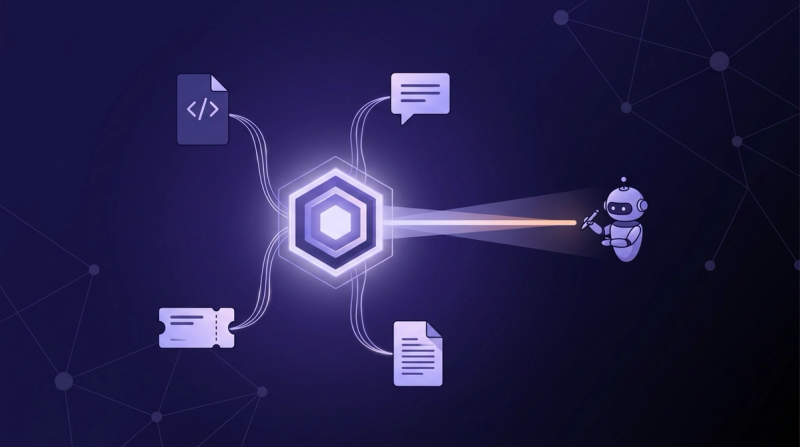
Decision-grade context is the output of a reasoning layer that sits above retrieval. That layer performs three operations on retrieved material: it resolves conflicts between sources, enforces source-level permissions against the requesting user, and shapes the final delivery to the specific task the agent is about to perform.
The operational definition#
Decision-grade context is the context state after which the agent does not need to ask. You measure it by three signals: the agent acts without clarifying questions, reviewers don't leave "the agent didn't know X" comments, and the output is mergeable on the first run.
Decision-grade context is context sufficient for an AI agent to act correctly on a specific task without human intervention. Google DeepMind's 2025 research found naive RAG pipelines propagate source conflicts into outputs, producing contradictory or fabricated answers (Google DeepMind, 2025). The term names the threshold between retrieval and reliable action.
For background, see what is a context engine.
---
Why Can't Retrieval Alone Produce Decision-Grade Context?#
Retrieval returns similarity matches, not authoritative answers. The 2025 NoLiMa benchmark tested thirteen models claiming 128K+ contexts and found accuracy degrades well before the stated window is full: at 32K tokens, eleven of the thirteen fell below half of their short-context baseline (NoLiMa, 2025). A separate study of eleven models across 150K+ controlled runs found that smaller relevant passages amid distractors compound the loss (Hidden in the Haystack, 2025). If frontier models degrade under controlled conditions, retrieval over messy enterprise codebases will fare worse.
The failure mode has a name: satisfaction of search. When three internal docs give three different answers about the same migration, retrieval surfaces all three. The agent reads the first plausible-looking result, acts on it, and moves on. You discover the mistake at review time.
We've watched this pattern repeat across dozens of engineering teams. The chunks the agent needed were almost always retrieved. They just weren't connected, prioritized, or reconciled. Retrieval without reasoning is a library without a librarian.
But doesn't a bigger context window fix this? It doesn't. NoLiMa showed that accuracy degrades sharply as input length grows, and neither reasoning models nor chain-of-thought prompting fixed it. OpenAI's own research on long-context retrieval acknowledged that models struggle with "lost in the middle" effects where relevant information buried in long inputs gets ignored (OpenAI, 2025). More tokens don't mean better decisions. They mean more noise for the model to navigate, and more surface area for satisfaction of search to take hold.
GitHub's 2025 Octoverse report found that AI-generated code now accounts for a significant and growing share of all code pushed to the platform (GitHub Octoverse, 2025). As more agent-generated code flows into production, the cost of each retrieval failure compounds. What was a minor annoyance at low volume becomes a review bottleneck at scale.
The 2025 NoLiMa benchmark stressed thirteen long-context models and found eleven fell below half of their short-context baseline by 32K tokens, well before the stated context window limit (NoLiMa, 2025). Bigger windows don't fix the quality problem.
For a detailed comparison, see context engine vs RAG.
---
What Are the Three Properties of Decision-Grade Context?#
Three operations separate decision-grade context from raw retrieval: conflict resolution, permission enforcement, and task-shaping. DORA's 2025 State of DevOps report found that teams adopting AI tooling without investing in supporting quality practices saw diminished delivery performance and stability (DORA, 2025). These three operations are the quality investment retrieval is missing.
How does conflict resolution work?#
Two internal documents describe the same architectural pattern differently. One is from 2023. One reflects last month's refactor. Retrieval returns both. A conflict resolution layer decides which is authoritative before the agent sees either, using evidence like recency, code-match verification, and source ownership. The agent receives one resolved answer with provenance. Without this step, the agent inherits the contradiction and picks at random.
What does permission enforcement prevent?#
The engine checks, at both ingestion and delivery, whether the user acting through the agent is authorized to see each source. A contractor's agent does not retrieve passages from repositories the contractor cannot access. This guardrail is architectural, not a post-hoc filter on output.
Skipping this step converts a productivity tool into a compliance incident. Gartner predicted that by 2026, over 30% of enterprises will abandon AI projects due to data governance and security failures (Gartner, 2025). Permission enforcement is what keeps your AI deployment off that list. And the failure happens silently, because retrieval asks "is this similar?" not "is the user allowed to see it?"
Why does task-shaping matter?#
The engine knows what the agent is about to do. Writing a test, refactoring a function, debugging an incident, reviewing a PR: these are different tasks that need different context shapes. Task-shaping delivers the specific subset that fits the work rather than returning the same generic bundle for every query.
Anthropic's context engineering guide calls this the parsimony principle: provide only what's needed (Anthropic, 2025). Task-shaping is what makes parsimony operational, not aspirational.
DORA's 2025 State of DevOps report found teams adopting AI tooling without quality investments saw diminished delivery performance (DORA, 2025). Three operations, conflict resolution, permission enforcement, and task-shaping, are the quality layer retrieval needs.
---
How Does Decision-Grade Context Change Agent Output?#
The difference shows up in review cycles. Stack Overflow's 2025 Developer Survey found that 82% of developers now use AI tools in their workflow, yet only 33% trust the accuracy of those tools' output (Stack Overflow, 2025). That trust gap is a context gap. When context is decision-grade, the trust gap narrows because the output is verifiably grounded.
In conversations with engineering teams running agents at scale, we've found three consistent signals that distinguish decision-grade from retrieval-grade context:
Signal 1: Clarification-free action. The agent doesn't pause mid-task to ask for more information. It acts on the first pass because the context was complete enough to act on.
Signal 2: No "didn't know" reviews. Review comments that say "the agent used the deprecated client because it didn't know about the migration" disappear. Those comments aren't code review. They're context review. When they vanish, the context is doing its job upstream.
Signal 3: First-run mergeability. Agent-generated PRs land on the first review round. No rework cycle, no re-prompting, no pasting Slack threads into the prompt to fill gaps.
McKinsey's 2025 State of AI report found that organizations scaling generative AI in software engineering report the biggest productivity gains only when they invest in data quality and context infrastructure, not model upgrades alone (McKinsey, 2025). That finding aligns with what we see in practice.
The test is binary. Either the agent can act on the context without supervision, or it can't. "High-quality context" is a spectrum with no floor. This threshold is something you can measure.
Stack Overflow's 2025 Developer Survey found 82% of developers use AI tools but only 33% trust the output accuracy (Stack Overflow, 2025). Decision-grade context closes that trust gap by ensuring agents act on resolved, authorized, task-shaped information.
Related: stop babysitting your AI coding agents.
---
What Does This Look Like in a Real Engineering Workflow?#
The New Stack reported that context, not model capability, is the real bottleneck for AI coding in 2026 (The New Stack, 2026). Here's what that bottleneck looks like when it's solved versus when it isn't.
Without decision-grade context#
An engineer asks an agent to implement a new API endpoint. The agent retrieves seven documents mentioning the service. Three describe the current architecture. Two describe a deprecated version. Two describe a planned migration that hasn't shipped yet. The agent picks the deprecated pattern because it appeared first in the retrieval results. The PR fails review. The engineer pastes the correct architecture doc, re-prompts, and waits again.
With decision-grade context#
The same engineer, same task. The context engine resolves the conflict between the three architecture versions before the agent sees any of them. It filters out the deprecated docs. It shapes the remaining context to the specific task: "implement an endpoint." The agent builds against the current pattern. The PR lands on the first review.
The difference isn't that the agent is smarter. The model is identical in both cases. The difference is upstream: what the agent was given to work with. This is why the term "decision-grade" matters. It shifts the conversation from model capability to context quality, which is where the actual failure surface lives.
Justin McCraw, Software Engineer at The Information, describes this shift in his own workflow: "My setup tells the agent: before you implement anything, go check Unblocked. It has everything, our repos, Notion, Slack, coding standards, and it surfaces things I wouldn't have thought to look for."
That's the pattern. The agent consults a source that tells it why a decision was made, not just what code exists. It resolves conflicts between sources rather than forwarding all of them. The engineer stops being the context middleware.
The New Stack identified context as AI coding's primary bottleneck in 2026 (The New Stack, 2026). Decision-grade context removes the bottleneck by delivering resolved, permission-enforced, task-shaped answers before the agent acts.
See also: how a context engine actually works.
---
FAQ#
What is decision-grade context?#
Decision-grade context is context sufficient for an AI agent to act correctly on a specific task without human intervention. It is the output of a reasoning layer above retrieval that performs three operations: conflict resolution between sources, permission enforcement per user, and task-shaping for the specific work the agent is about to do. The term names a testable threshold. If the agent can act without clarification and the output passes review on the first run, the context was decision-grade. If it can't, you have retrieval dressed as an answer.
Isn't decision-grade context just "good context"?#
"Good" is subjective and unmeasurable. Decision-grade names a specific operational bar: the agent can act correctly without human clarification. You can test whether context meets this threshold by checking three signals, clarification-free action, no "didn't know" reviews, and first-run mergeability. The Pragmatic Engineer has documented how top engineering teams increasingly evaluate AI tooling by output reliability, not feature lists (Pragmatic Engineer, 2025). Decision-grade context is the reliability test applied to context specifically.
Learn more in our context engineering guide.
How is decision-grade context different from Anthropic's "just enough context" principle?#
Compatible, not competing. Anthropic frames the parsimony principle: provide only what the agent needs (Anthropic, 2025). Decision-grade names the floor: what's provided must be enough for the agent to act. Parsimony is the ceiling. Decision-grade is the floor. You need both. Good context engineering hits both constraints simultaneously.
Does decision-grade context require a context engine?#
In practice, yes. The three operations, conflict resolution, permission enforcement, and task-shaping, require reasoning that retrieval systems don't perform. You can approximate decision-grade context manually by curating context by hand for each task, but that's exactly the babysitting pattern that breaks at scale. For a deeper look at what a context engine does and why it matters, see what is a context engine.
Can RAG ever deliver decision-grade context?#
RAG can be a component inside a system that clears this threshold. RAG alone cannot. Retrieval is one step among many. The remaining steps, resolving conflicts, enforcing permissions, and shaping delivery to the task, are what make the output actionable. For the full comparison, see context engine vs RAG.
---
From Retrieval to Reasoning#
Decision-grade context is the operational threshold that separates retrieval from reliable agent action. Stack Overflow found 82% of developers use AI tools but only 33% trust the output (Stack Overflow, 2025). That trust gap closes when agents receive context that is conflict-resolved, permission-enforced, and task-shaped.
The gap between retrieval and decision-grade context is where engineering teams lose the most time without realizing it. Every re-prompt, every "the agent didn't know X" review comment, every PR that needs a second round because the agent picked a deprecated pattern: that's the cost of context that looks sufficient but isn't.
The term isn't marketing. It's a test you can run against your last fifty agent PRs. Count how many the agent completed without clarification, without "didn't know" review comments, and without rework. That count is your decision-grade context score.
The question isn't whether your agents are smart enough. It's whether the context they're getting is good enough to act on. If it isn't, retrieval isn't the answer. Reasoning above retrieval is.
For background, see what is a context engine.
---
Brandon Waselnuk is the Head of Content at Unblocked, where the team builds context engines that deliver decision-grade context for enterprise engineering organizations.