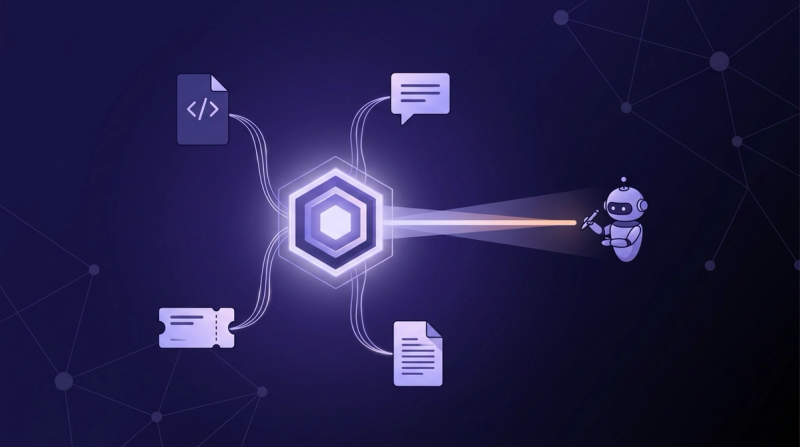
Context Engine vs RAG: Why Retrieval Alone Isn't Enough
RAG retrieves documents. A context engine resolves conflicts, enforces permissions, and reasons about what retrieval returned. Here is when each one fits.


TL;DR: RAG retrieves by similarity. A context engine retrieves, resolves conflicts, enforces permissions, and reasons about what retrieval returned. They are not rivals. Most production context engines use RAG as one internal step, then do the work RAG was never built to do.
RAG isn't broken. It's being asked to do a job it was never designed for. When engineering teams wire a vector store into an AI agent and watch it ship code that references a deprecated API or cites a Notion doc that contradicts the repo, the instinct is to blame the model. The real gap is architectural. Retrieval finds documents that look similar to a query. It does not decide which document is right, who is allowed to see it, or what the combination means for the task in front of the agent. That is the job of a context engine, and the context engine vs RAG distinction matters more every time an agent touches production code.
What's the difference between RAG and a context engine?#
The Vectara Hallucination Leaderboard 2026 tracks RAG-style summarization hallucination rates across frontier models, with leading systems still producing factual errors on a measurable share of outputs (Vectara, 2026). That is the ceiling retrieval alone can reach, and it is why reasoning on top of retrieval matters.
RAG (Retrieval-Augmented Generation) indexes documents as vector embeddings, finds similar ones at query time, and injects the top results into the prompt. It's a retrieval tactic. A context engine is a system. It retrieves, but then it resolves conflicts between sources, enforces permissions, and reasons about what the combination means for a specific task. RAG returns "plausibly relevant." A context engine returns decision-grade context, the kind an agent can safely act on.
The context engine vs RAG framing is less about picking one architecture and more about deciding where the work stops.
Learn more about what a context engine is and why it matters.
How does RAG actually work under the hood?#
Anthropic's engineering team describes effective context assembly as a layered problem where retrieval is the starting point, not the finish line, and where raw retrieved content must be curated before it reaches the model (Anthropic, 2025).
RAG has three steps. First, chunk and embed a corpus into a vector store. Second, at query time, embed the question and fetch the top N most similar chunks. Third, stuff those chunks into the prompt and let the LLM generate. The pattern is elegant for single-source Q&A, like a product manual or a support knowledge base. It breaks when you ask it to carry multi-source enterprise weight, because similarity is not correctness. Gartner estimates that by 2026, more than 80% of enterprises will have deployed generative AI APIs or models in production, up from fewer than 5% in early 2023 (Gartner, 2025), which means the ceiling of plain RAG is now an enterprise-scale problem. InfoWorld's 2025 analysis of RAG architectures in production confirmed that naive chunking and embedding strategies fail when documents conflict, noting that most enterprise RAG failures stem from context quality, not retrieval recall (InfoWorld, 2025). A stale doc can embed closer to a query than the current one. A private doc and a public doc can look identical in vector space. RAG has no opinion about either problem, which is where the context engine vs RAG split starts to bite.
Where does RAG break for AI coding agents?#
Stanford HAI's 2025 AI Index found that AI models still struggle with complex, multi-step reasoning and factual grounding, with benchmark accuracy dropping sharply as task complexity increases (Stanford HAI AI Index, 2025). Code and organizational context are messier than curated benchmarks. The failure surface is larger.
GitHub's Octoverse 2025 report found that AI-powered development continues to accelerate, with AI-generated code now comprising a growing share of all pull requests on the platform (GitHub Octoverse, 2025). As more agent-generated code flows into production, each RAG failure mode costs more. Four failure modes show up repeatedly when evaluating RAG limitations for code against the needs of a coding agent.
Stale vs current source confusion#
The Notion doc says one thing. The code does another. Similarity search returns both. RAG has no mechanism to say the code is the current truth and the doc is a 2023 draft. The agent picks whichever chunk ranked higher.
Permission leakage#
Retrieval asks "is this similar?" It does not ask "is the user allowed to see it?" A contractor agent can surface an exec-only strategy doc if the embedding matches. Stack Overflow's 2025 Developer Survey found that 76% of developers now use or plan to use AI tools in their workflow, yet fewer than half report that their organizations have established governance policies for AI-generated code (Stack Overflow Developer Survey, 2025). Enterprise deployments need the permission check to happen before context hits the prompt, not after.
Conflict blindness#
Three docs give three different answers about the same migration. RAG returns all three. The model averages them or picks one at random. No source is marked authoritative. No reconciliation happens. This is the "satisfaction of search" failure: the agent stops at the first plausible retrieved chunk.
Reasoning gaps#
RAG surfaces. It does not synthesize. When we watch agents fail on cross-repo tasks, the chunks they needed were almost always retrieved. They just were not connected. Retrieval without reasoning is a library without a librarian. That gap is the heart of the context engine vs RAG discussion.
How does a context engine solve what RAG can't?#
Anthropic frames effective context engineering as coordinated operations above retrieval: selection, compression, and reasoning over the selected material (Anthropic, 2025). Those are the same operations a context engine owns.
A context engine adds three layers on top of retrieval. Conflict resolution decides which source wins when two disagree, using freshness, authority, and cross-references. Permission enforcement filters retrieval output against the calling user's access, not after the fact. Reasoning synthesizes the surviving context into a task-shaped answer instead of a pile of chunks. DORA's 2025 State of DevOps report found that teams integrating AI into their workflows without investing in quality and review processes experienced declining delivery performance (DORA, 2025), which underscores why a reasoning layer above retrieval is not optional.
RAG can live inside an engine. Vector search, BM25, graph traversal: these are all valid ingestion tactics. The engine's contribution is what happens after the tactic returns results. An engine without conflict resolution, permission enforcement, and reasoning is just RAG with a nicer UI, and the context engine vs RAG difference collapses.
For a deeper look, read how a context engine actually works.
When to use RAG vs a context engine for AI agents?#
Vectara's 2026 leaderboard shows hallucination rates climbing noticeably on reasoning-heavy tasks compared to summarization, with reasoning-heavy tasks showing materially higher error rates than summarization even on grounded inputs (Vectara, 2026). The higher the reasoning load, the less retrieval alone can carry.
Use RAG when you have a single authoritative corpus, a question shaped like "find the relevant passage," and no permission complexity. Product docs, a contained knowledge base, a FAQ bot: RAG is excellent here, and the question of when to use RAG AI agents answer is straightforward in that setting.
Use a context engine when you have multiple conflicting sources, permission constraints, and an agent that has to act rather than just answer. Most enterprise engineering contexts sit firmly in this second bucket.
A quick decision table#
| If your use case has... | Reach for... |
|---|---|
| One clean corpus, read-only Q&A | RAG |
| Multiple sources that sometimes disagree | Context engine |
| Permission boundaries (contractors, teams, roles) | Context engine |
| An agent that writes code or takes action | Context engine |
| A simple chatbot over product documentation | RAG |
Every team we have worked with that started with pure RAG for coding agents eventually added a resolution layer. The question is whether you build it yourself or adopt one that already exists.
For a broader view, see the context engineering guide.
Can a context engine use RAG internally?#
Augment Code's comparison piece frames context engines and RAG as opposed architectures. We read it differently. Anthropic's guidance treats retrieval as one input channel among several that a broader system orchestrates (Anthropic, 2025).
Yes, and most do. RAG is a strong first-pass retrieval tactic. A context engine can use vector search, graph-based retrieval, structured queries, or hybrid approaches as ingestion steps, then run conflict resolution and reasoning on what came back. The RAG vs context engine debate frames the two as rivals. The production reality is that the engine wraps the retrieval, checks the permissions, resolves the conflicts, and hands the agent something it can trust.
Framing the debate as "RAG or not RAG" misses the real question. As The Pragmatic Engineer noted in 2025, the real bottleneck for AI coding tools is not generation quality but context quality, specifically whether the system can assemble the right context from scattered organizational sources (The Pragmatic Engineer, 2025). What matters is whether the system stops at retrieval or keeps going until the context is decision-grade.
Why does going beyond RAG matter more for code than for chat?#
Stanford HAI's 2025 AI Index reports that despite rapid progress, AI systems still fail on complex reasoning tasks at rates that would be unacceptable in production engineering workflows (Stanford HAI AI Index, 2025). Codebases are messier than benchmarks. Slack threads and Jira tickets are messier still.
Code has a particularly unforgiving failure mode. A chatbot that hallucinates gives a wrong answer and a user rolls their eyes. An agent that hallucinates ships a PR that references a function removed six months ago, or duplicates a pattern the team rejected in a prior RFC. McKinsey's 2025 report on generative AI in software development found that AI coding tools can boost developer productivity by 20% to 45% on well-defined tasks, but that gains drop sharply when agents lack sufficient project context (McKinsey, 2025). The cost of stopping at the first plausible retrieved chunk is much higher when the output is a diff.
Across the engineering teams we work with, the failure pattern is consistent. Retrieval finds the chunks, but the agent picks the wrong one because no layer told it which source was authoritative. That is the RAG ceiling.
Related: a context layer is not a context engine.
How does Unblocked approach context engine vs RAG in practice?#
Unblocked is the context engine for engineering. It synthesizes across Slack, Jira, Notion, Confluence, PRs, and code to produce reasoning-grade context before an agent acts. Retrieval is one step inside that pipeline, not the whole pipeline.
Raphael Bres, CTO at Tradeshift, put the problem plainly:
"You cannot make coding agents work without domain and functional context. We connected and trained Unblocked on our code repos, Atlassian tools, internal docs, product documentation, KB from Support, and Slack history. When an agent asks a question, it gets the full picture, not just the code analysis, but also why decisions were made and what the constraints are. Other tools like Copilot know only the code. That's limited value. Unblocked is a game changer for coding agents."
That's the architectural gap in one quote. Copilot-style tools read the code. Pure RAG reads the docs. An engineering context engine reads both, reconciles them against Slack threads and ticket history, enforces who can see what, and hands the agent something worth acting on.
Frequently asked questions#
Stanford HAI's 2025 AI Index confirms AI reasoning accuracy degrades on multi-step tasks, and Vectara's 2026 leaderboard confirms retrieval-only systems still produce factual errors at scale (Stanford HAI AI Index, 2025; Vectara, 2026). These FAQs address the most common follow-up questions.
Is "context engine" just rebranded RAG?#
No. RAG is retrieval by similarity. A context engine reasons about what was retrieved, resolves conflicts, enforces permissions, and synthesizes before delivering to the agent. Vectara's 2026 leaderboard shows retrieval alone still produces hallucinations on a meaningful share of queries (Vectara, 2026). Rebranded RAG keeps those failure modes.
Do I need vector databases for a context engine?#
You might use them as one component. You might also use graph-based stores, structured indices, or hybrid approaches. Anthropic's effective context engineering guidance treats retrieval as a pluggable input, not a fixed architecture (Anthropic, 2025). The engine is about what happens after retrieval, not which kind of retrieval. See also the difference between a context layer and a context engine.
My RAG pipeline works, do I need a context engine?#
It depends on the failure mode. If your agents consistently ship working code, your RAG is sufficient. If they ship code that compiles and fails review, or cites stale docs, retrieval is not the limiting factor. Reasoning is. Stanford HAI's 2025 AI Index shows AI accuracy still drops meaningfully on complex, multi-step reasoning, suggesting most teams hit this ceiling eventually (Stanford HAI AI Index, 2025).
What's "satisfaction of search" and why does it apply here?#
It's the bias where an agent stops at the first plausible retrieved answer. RAG surfaces plausible results. It does not verify them. Context engines counter this by continuing to reason after retrieval completes, checking for conflicts and authority before returning.
Choosing the Right Tool for Your Task#
DORA's 2025 State of DevOps report found that teams adopting AI tools without corresponding quality and review investments saw declining delivery performance, suggesting that the retrieval-to-reasoning gap is a measurable risk factor for engineering organizations (DORA, 2025).
RAG is a fine tool. Used for a single corpus with clean permissions and a well-shaped question, it will serve you well. It is not the right tool for multi-source enterprise code context, and pretending otherwise costs teams weeks of agent debugging every quarter.
The choice comes down to what your agent has to do. If it answers questions against one corpus, pick RAG. If it has to act across conflicting sources, respect permissions, and synthesize a picture no single document contains, pick the engine. Unblocked synthesizes across Slack, Jira, Notion, Confluence, PRs, and code so agents start with decision-grade context instead of plausibly relevant chunks. Stanford HAI's 2025 AI Index shows AI accuracy still falls short on the kind of multi-step reasoning production agents require (Stanford HAI AI Index, 2025). Pick the tool that matches the job.
Learn more about what a context engine is and why it matters.