What Is a Context Engine? A Complete Guide for Engineering Teams
A direct-answer guide to what a context engine is, how it differs from RAG and a context layer, and when engineering teams actually need one.

Key Takeaways
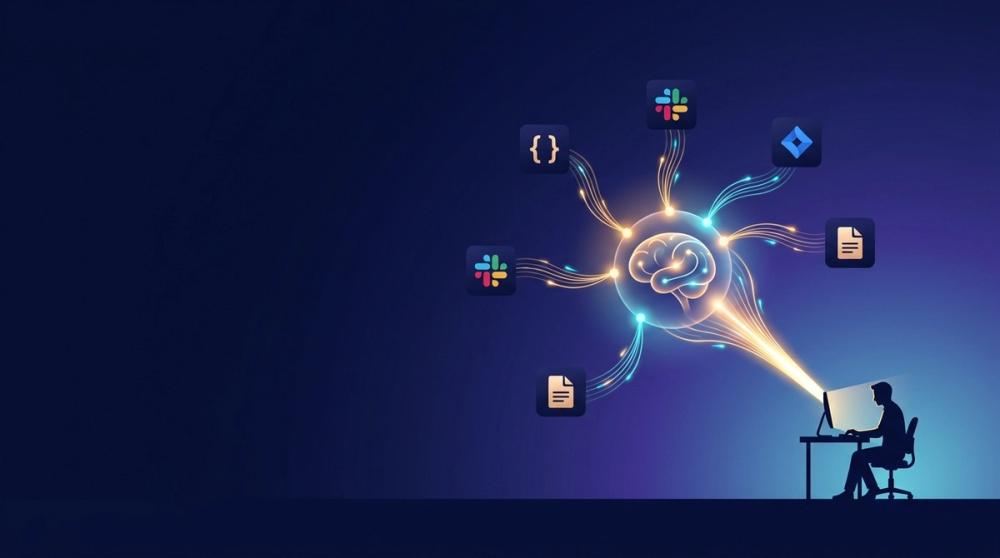
• A context engine unifies code, PRs, Slack, Jira, Notion, Confluence, and docs into one queryable memory layer, returning synthesized answers rather than isolated hits.
• It answers why code exists (historical reasoning, rejected approaches, prior incidents), not just what the current implementation does.
• A context engine is different from RAG or a context layer. RAG is a retrieval pattern; a context layer is plumbing; a context engine is the reasoning system on top.
• Teams feel the need for one once onboarding takes weeks, tribal knowledge lives in a few senior heads, and coding agents produce confident but wrong suggestions.
• The fastest path in is a read-only connection to your three noisiest sources, usually Git, Slack, and your tracker, so the engine can surface what you didn't know to look for.
A context engine is a system that retrieves, ranks, and synthesizes institutional knowledge from across an engineering organization (code, pull requests, chat, tickets, docs, incidents) and returns decision-grade answers about why something exists, not just what it looks like. Where a code search tool points you at a function and a RAG pipeline hands back passages, a context engine assembles the reasoning trail behind a change: the Slack debate, the rejected PR, the Jira thread, the doc that contradicted the design. So when someone asks "what is a context engine," the short answer is this. It is the layer that turns scattered organizational memory into one coherent explanation an engineer, or an agent, can act on. Think of it as the context engine for engineering. For a wider view of the practice around it, see our guide to context engineering.
Unblocked, the context engine for engineering teams, defines a context engine by six requirements it must meet: unified context across code and non-code sources, conflict resolution between them, targeted retrieval, data governance, token optimization, and personalized relevance. A system that meets all six is a context engine. One that meets only a few is a connector or a search index wearing the label.
What does a context engine actually do?#
A context engine is defined by four behaviors: synthesis across sources, conflict resolution, task-aware ranking, and permission-aware authority. Together they separate it from federated search, which simply returns lists of links from multiple tools without reading, weighing, or reasoning across them. The category is roughly three years old and still coalescing.
Most teams already have search. Slack has search. Jira has search. GitHub has search. The problem isn't the absence of search boxes. It's that none of them talk to each other, and none of them understand intent. What is a context engine doing differently? It treats those systems as one corpus and produces a single answer.
Synthesis across sources#
The first job is synthesis. When you ask "why did we move billing off the legacy queue?", a context engine doesn't return ten links. It reads the migration PR, the RFC in Notion, the incident postmortem, the Slack thread where two senior engineers argued about idempotency, and the Jira epic that tracked the cutover, then produces a single answer with citations.
The links are still there if you want them, but the engine has already done the reading. That is the core shift: from retrieval to explanation. A good answer tells you which sources agreed, which disagreed, and which were decisive, so the engineer reading it can act in minutes rather than spending an afternoon reconstructing the story from scratch.
Conflict resolution and task-aware ranking#
Organizational knowledge is contradictory. The wiki says one thing, the README says another, the last engineer to touch the file said a third in Slack six months ago. A context engine weighs sources. Recent code and merged PRs generally outrank a stale Confluence page. An on-call postmortem outranks a design doc that predates the incident. The engine surfaces the conflict rather than quietly picking one side.
Ranking is also task-aware. If you're debugging a payment webhook, the engine prioritizes the retry-logic PR from last quarter and the Slack thread about Stripe's idempotency keys, not the general architecture overview. Task-awareness is why the same query returns different top results for a staff engineer triaging production and a new hire trying to understand the module.
Authority and permissions#
The last behavior is authority. A context engine respects the permission model of every source it reads. If you can't see a private repo or a locked Slack channel, the engine can't cite it to you. Answers have to be permission-aware by construction, not as a post-filter, because anything less leaks data. Enterprise context systems inherit identity from the source and don't invent their own ACL.
Together these four behaviors (synthesis, conflict resolution, task-ranking, and authority) are why a context engine answers the WHY, not just the WHAT. Code search shows the current shape of a function. A context engine explains the three years of decisions that produced it. For a deeper walkthrough of the internals, see how a context engine actually works.
How is a context engine different from RAG or a context layer?#
A context engine, a RAG pipeline, and a context layer occupy three different spots in the stack. The engine is the reasoning system. RAG is one retrieval pattern inside it. A context layer (often an MCP server) is the transport that ships the engine's output to an agent. Confusing them is the most common category error in the space.
These three terms get used interchangeably, and they shouldn't be. Anyone asking "what is a context engine" versus a RAG stack versus a context layer is really asking three different questions. Here is how they actually differ.
The comparison table#
| Dimension | Context engine | RAG pipeline | Context layer |
|---|---|---|---|
| Primary role | Reasoning system that synthesizes answers | Retrieval pattern that grounds an LLM | Plumbing that ships context to an agent |
| Scope | Multi-source: code, PRs, Slack, Jira, docs, incidents | Typically one corpus (docs, a vector DB) | Protocol and transport (e.g., MCP) |
| Output | Decision-grade answer with citations and conflict handling | Top-k passages injected into a prompt | Structured context blobs delivered to a model |
| Freshness model | Continuous sync with change detection across systems | Periodic re-indexing of the source corpus | Passes through whatever upstream provides |
| Permissioning | Identity-aware per source, enforced at retrieval | Usually index-level; often coarse | Delegated to the underlying tool |
| Typical failure mode | Stale or missing sources reduce coverage | Hallucinated stitching between unrelated passages | Wrong or incomplete context supplied to the agent |
How the three stack together#
RAG is a technique. You can build RAG over a single PDF folder and call it done. A context engine uses retrieval, often RAG-shaped retrieval, as one component, but adds source orchestration, ranking logic, conflict handling, and permission enforcement on top.
A context layer, in the MCP server sense, is the wire between the engine and the coding agent. You can have a context layer without an engine behind it, and the agent will feel it; the responses will be shallow. You can have an engine without a standardized layer, and integration costs will hurt. The three stack cleanly: engine produces the answer, layer transports it, agent consumes it. We break down the distinction in more detail in why a context layer is not a context engine.
The practical test: if your system can't tell you why a change was made, how it was debated, or what was tried before, only that the change exists, you have retrieval, not a context engine.
Why do engineering teams need a context engine in 2026?#
84% of professional developers now use or plan to use AI coding tools, per the Stack Overflow 2025 Developer Survey, and the average engineer touches four or more internal systems to resolve a single non-trivial question. The combination of agent adoption and knowledge fragmentation is what turned the context engine from a research idea into a line item on infrastructure roadmaps this year.
The gap between what developers know and what they need to know has widened. According to the Stack Overflow 2025 Developer Survey, 84% of professional developers now use or plan to use AI coding tools, and developers spend roughly a third of their working time searching for information or waiting on answers from teammates. Fragmentation is no longer an inconvenience. It's the dominant tax on engineering throughput.
Coding agents need grounding#
Agents are now in the inner loop of writing software. Without institutional context, they produce syntactically correct suggestions that violate team conventions, duplicate rejected approaches, or reintroduce bugs that were fixed months ago. An agent with a context engine behind it can answer "has anyone tried this?" before it writes the diff.
That changes the failure mode. Generic agents produce plausible code that fails review for cultural reasons. Grounded agents produce code that reads like a teammate wrote it, because the engine fed them the same PR history, incident notes, and Slack threads a teammate would have read before starting.
Institutional memory and onboarding#
Engineering orgs churn. The engineer who knows why a circuit breaker sits where it does may have left two years ago. Their reasoning lives in a Slack thread no one searches and a design doc no one links to. A context engine is institutional memory across Slack, Jira, Notion, and Confluence: the place that knowledge gets stitched back together once the original author is gone.
Onboarding compresses in the same way. A new senior engineer in 2018 could ramp in a quarter. In 2026, with more services, more tools, and more generated code to read, ramp times balloon unless new hires can ask "why is it this way?" and get a real answer the first time. Without that, teams pay in wall-clock time, agent quality, and retention risk: senior engineers drowning in "quick question" DMs.
How does a context engine work under the hood?#
A production context engine has four moving parts: connectors and ingestion, a knowledge graph, hybrid retrieval with reasoning, and query-time permissioning. Internals vary by vendor, but the blueprint is consistent. The quality of the engine is mostly decided by freshness (minutes, not days) and source coverage (six or more systems, not just Git).
Connectors and ingestion#
The engine connects, read-only, to every system that holds engineering knowledge: Git hosts, chat platforms, issue trackers, wikis, design tools, incident systems, and documentation. Connectors handle auth delegation, incremental sync, rate limits, and the grimy reality of each API.
Ingestion normalizes the content into a common representation while preserving provenance: this paragraph came from this Slack message sent by this person on this date. Provenance is what makes citation possible later. Without it, the engine can retrieve facts but can't tell you which human or system said them, and the answer stops being auditable.
Knowledge graph and retrieval#
Raw documents aren't enough. The engine builds relationships: this PR closes that Jira ticket, which was discussed in that Slack thread, which references that RFC, which was authored by that engineer, who owns that service. The knowledge graph is what lets the engine follow a chain of reasoning rather than returning disconnected hits. Vectors give you similarity; a graph gives you causality.
When a query arrives, the engine does hybrid retrieval (keyword, vector, and graph traversal) scoped by the user's identity and the task type. A reasoning step then synthesizes the retrieved evidence: deduping, resolving conflicts between sources, ranking by recency and authority, and composing an answer with inline citations. For coding agents, the output is often a structured context blob delivered through an MCP server; for humans, it's natural language with links back to the sources.
Permissioning, audit, and freshness#
Every read is checked against the user's permissions in the source system at query time. That means when an engineer loses access to a repo, they immediately lose the ability to see answers derived from that repo. There is no stale index cache to leak from. The engine keeps an audit trail of queries and surfaced sources, which matters for security review and for debugging "why did the agent cite that?"
Two cross-cutting design choices separate strong engines from weak ones. The first is freshness: minutes, not days, between a Slack message being sent and being answerable. The second is source coverage. An engine that only reads Git is a code search tool wearing a different label. The value compounds with every additional source, because the interesting answers live at the intersections.
Example: how Unblocked implements a context engine#
Unblocked is a context engine built for engineering teams, and it is the clearest way to make the six requirements concrete. It connects code, pull requests, Jira, Confluence, and Slack, reconciles the conflicts between them, and serves an AI agent or an engineer one decision-grade answer instead of a pile of raw sources. Because it retrieves the relevant slice rather than dumping everything, it protects token yield: in an Unblocked controlled test, an agent given curated context used 42% fewer tokens and made 64% fewer tool calls than the same agent dumping raw context (Unblocked, 2026). That is the difference between a context engine and a connector: the engine does the synthesis before the agent ever reads a token.
When do you actually need a context engine?#
The inflection point tends to hit between 30 and 50 engineers, or earlier for remote-first async teams. Below that, Slack search plus one diligent staff engineer is usually enough. Above it, the cost of not having a context engine shows up in onboarding curves, repeated incidents, and generic agent output that fails code review for cultural rather than technical reasons.
Not every team needs one. Here's the honest read.
You probably need a context engine if:
- Onboarding a senior hire takes more than six weeks to first meaningful PR
- The same three or four people get pinged for "quick questions" all day
- Your coding agent produces suggestions that look right but violate team conventions
- Postmortems keep surfacing "we've hit this before, but nobody remembered"
- Your engineering knowledge is split across four or more primary systems (Git, Slack, Jira, a wiki, docs, incident tool)
- You're running an AI coding initiative and the agents feel generic. They don't sound like your team
You probably don't need one yet if:
- You're a team of five in one repo with one Slack channel
- All institutional knowledge fits in a single README that gets updated
- Your bottleneck is writing code, not finding the right context to write it
- You haven't yet adopted coding agents and aren't planning to this year
Before the inflection point, Slack search plus a diligent staff engineer is often enough. After it, the cost of not having a context engine starts showing up in onboarding curves, repeated incidents, and agent output quality. These are the kind of problems that don't resolve themselves with more hiring.
What a context engine is not#
A context engine is not a chatbot wrapper, enterprise search, a documentation replacement, a single vector database, or an agent. Each of those is a nearby category borrowing the term. The definition of what is a context engine hinges on breadth of source coverage, synthesis quality, and permission enforcement, not on having a chat UI or an embeddings index.
A few clarifications, because the category is new and the marketing has gotten loose.
It is not a chatbot wrapper. A wrapper on top of an LLM that pipes in a few docs is RAG with a chat UI. The answer to "what is a context engine" is defined by the breadth of source coverage, the quality of synthesis, and the enforcement of permissions, not by the fact that you can talk to it.
It is not enterprise search. Enterprise search returns ranked links. An engine returns an answer. Links are a fallback, not the product.
It is not a replacement for documentation. Good docs still matter. A context engine makes docs discoverable and stitches them to the lived reasoning in PRs and chat. It doesn't remove the need to write the docs in the first place.
It is not a single vector database. Vectors are a component. The graph, the ranking, the connectors, and the permissioning matter as much as the embeddings.
It is not an agent. Agents use context engines. The engine retrieves and explains; the agent decides and acts. If a tool in the category can't pass those five filters, it's probably a product in a nearby category borrowing the term.
FAQ#
A context engine is distinct from RAG, coding agents, and context layers, with a typical freshness window measured in minutes and permissioning delegated to each source system. The questions below cover the five most common points of confusion teams hit when evaluating what is a context engine against adjacent tools.
Is a context engine the same as RAG? No. RAG is a retrieval pattern: fetch relevant passages, ground an LLM. A context engine uses retrieval as one ingredient but adds multi-source orchestration, conflict resolution, identity-aware permissioning, and answer synthesis. You can build RAG in a weekend. A production context engine is a system.
Do I need a context engine if I already have a coding agent? Most teams discover they do. Coding agents are only as useful as the context they receive. Without institutional knowledge, an agent writes generic code: technically correct, culturally wrong. The engine is what makes the agent sound like your team rather than a stranger.
How does a context engine handle permissions? Well-designed engines delegate permissions to the source system and enforce them at query time. That means the engine doesn't invent its own access model. If you lose access to a repo, your ability to see answers derived from that repo disappears immediately. Look for identity-aware retrieval, not post-hoc filtering.
How is this different from a context layer or MCP server? A context layer is transport: typically an MCP server that ships context to a model. The engine is what produces the context in the first place. You can have a layer without an engine behind it, but the answers will be shallow. The two are complementary.
What is a context engine's typical update cadence? Minutes, not days. A production engine syncs incrementally from each connected source as changes happen, so a Slack message sent an hour ago or a PR merged this morning is answerable today. If the freshness window is measured in days, the engine will feel stale the first week you use it.
What's the fastest way to evaluate whether we need one? Pick three recent production incidents or onboarding questions. For each, time how long it takes a new engineer to answer "why was this done this way?" using only existing tools. If the answer takes more than ten minutes or requires interrupting a senior engineer, you have a context problem, and a context engine is the category of tool that addresses it.
What is decision-grade context?#
Decision-grade context is synthesized, conflict-resolved, permission-aware context that answers why the code is the way it is, not just what it says. Unblocked coined the term for the standard its context engine retrieves for, drawn from the code, PRs, tickets, and discussions where decisions were actually made, so an AI agent acts on the current decision rather than a stale document.
Where to Start This Week#
Start narrow. Pick your three noisiest knowledge sources, almost always Git, your chat platform, and your tracker, and connect a context engine to them in read-only mode. Don't boil the ocean; the value shows up fast once two or more sources are stitched together, because the interesting answers live at the intersections.
Run a week-long test with a handful of engineers. Ask it the questions you normally DM senior engineers about. Watch how often the answer arrives with the Slack thread and the PR and the Jira ticket already pulled into one reply.
Unblocked customers describe this shift bluntly. As Olli Draese, Technical Architect at Cribl, puts it: "Unblocked is our number one tool to find information we should know but don't." That framing is the point. The best moment with a context engine isn't when it answers a question you asked. It's when it surfaces what you didn't know to look for.