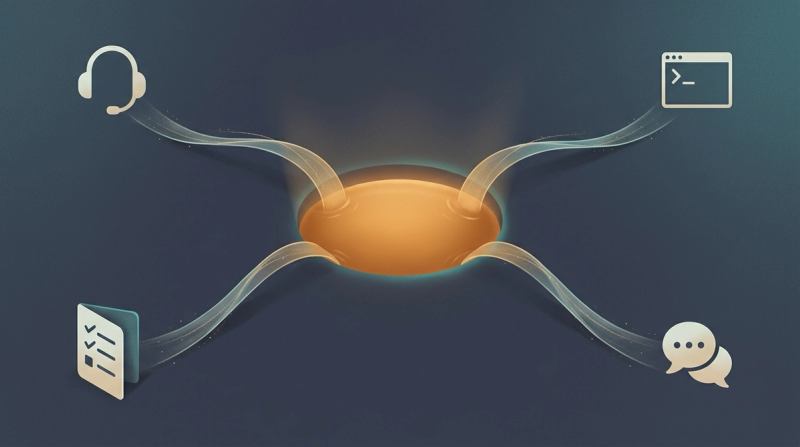
Code Plus MCP Isn't a Context Engine: What a Real Reasoning Layer Actually Ingests
An AI coding agent wired to your repo and a few MCPs is still missing most of the context it needs. The decisions, conventions, and history that explain why the code is the way it is don't live in the code. Here's what a real context engine ingests, and why.


Bottom line: A context engine isn't a code-search index with a few MCPs bolted on. The code tells you what exists; the decisions, conventions, and incident history that explain why it exists live in PRs, Slack, Jira, Notion, Confluence, postmortems, and ADRs. A reasoning layer that ingests only the code, even via well-wired MCPs, will keep producing confident-but-wrong output, because the answer to most engineering questions isn't in the code in front of you.
An engineering team wires Claude Code into their main repo, pipes in a Slack MCP and a Jira MCP, and turns the agent loose on a backlog ticket. Three days later, the agent ships a pull request that violates a convention the team retired six months ago in an incident postmortem. The postmortem lives in Notion. Nobody indexed it. The agent never saw it. The PR compiles, the tests pass, and the senior engineer reviewing it has to explain to the agent (in a comment thread that costs everyone an hour) why the code is wrong.
This is the gap that "context engine source code" alone cannot close. The code is one signal among many. Plugging in MCPs to a few sources doesn't make a context engine, it makes a tool list. This piece is about the surface area a real reasoning layer ingests, why MCP plumbing alone doesn't deliver it, and what changes when it does.
Why does code alone fail as context for an AI agent?#
Code answers "what" but not "why." When an AI coding agent has access to the repo and nothing else, it's reading the result of dozens of decisions without any of the reasoning that produced them. Treating context engine source code as the whole input is the error: code is the artifact, not the rationale. The NoLiMa benchmark found that performance degrades significantly across 13 leading models, including GPT-4o, as input length grows, with 11 of the 13 falling below half of their short-context baseline by 32K tokens (NoLiMa, 2025).
The implication is sharper than it looks. Stuffing more code into the window doesn't help if the relevant signal isn't code at all. It's a Slack thread from last quarter, a PR comment from a senior engineer, an incident review that retired the very pattern the agent is about to reuse.
That mismatch shows up in trust numbers. The Stack Overflow Developer Survey 2025 reported that 46% of professional developers actively distrust AI tool accuracy, while only about 33% trust it (Stack Overflow, 2025). Distrust isn't a vibe. It's the rational response to an agent that has confidently produced output without seeing the discussion that would have changed the answer. The rest of this piece walks the surface area code alone cannot cover.
What does an agent actually need to know that the code doesn't say?#
The answer to "why is this code shaped this way?" almost never lives in the code. It lives in five categories of artifacts that most coding agents never touch. Anthropic's guidance on effective context engineering for AI agents makes the principle explicit: the right tokens beat more tokens, and curating the smallest set of high-signal context outperforms flooding the window (Anthropic, 2025).
The five categories an agent needs to reason well:
- Decisions. PR review threads where a senior engineer pushed back on the original design. Slack debates that converged on a pattern. Internal RFCs that compared three options and picked one.
- Conventions. Architecture decision records, retired patterns, and incident-driven rules. The convention isn't in the linter. It's in the postmortem that explains why the linter rule exists.
- Ticket rationale. The Jira or Linear ticket that explains what the feature is supposed to do, who asked for it, and which constraints the original spec already negotiated away.
- Constraints. Compliance requirements, customer-specific contracts, security review notes. None of these live in the source tree.
- History. Postmortems and runbooks that explain why the code is shaped a certain way after a real incident bent it into its current form.
An agent that can't see these is reasoning with one eye closed. It will keep proposing approaches the team has already considered and rejected, because decision-grade context is exactly what it doesn't have.
Why doesn't MCP solve this on its own?#
MCP is transport, not reasoning. Connecting twelve MCPs to your agent is plumbing, not ingestion. The agent still has to figure out which MCP to call when, what to do when two sources contradict each other, and how to weigh authority across them. The Pragmatic Engineer's analysis described MCP as "the USB-C of AI applications," a standardized port for tools to plug into (Pragmatic Engineer, 2025). USB-C is a connector. It is not a database, a ranker, or a synthesis engine.
The protocol's own roadmap confirms the boundary. The MCP 2026 roadmap names governance, gateway patterns, and audit trails as concerns the protocol layer does not own (MCP, 2026). Those are exactly the responsibilities a reasoning layer has to absorb: who owns the source, when was it last updated, does the user asking the question have permission to see it, and which of two conflicting answers wins.
So you can plug in a code MCP, a Slack MCP, a Jira MCP, a Notion MCP, and a Confluence MCP, and you will still not have a context engine. The MCP context engine framing is mostly marketing collapse: protocol plus connectors does not equal reasoning. You'll have an agent that has to make five separate calls, hold five fragmented results in its window, and guess at synthesis. We've covered this gap in detail in why MCP servers aren't enough and in the three-layer split between context engine, search, and orchestration. The short version: connectors don't reason.
What does the context surface area actually look like?#
The full ingestion surface is broader than most teams realize, and it grows as the team's agentic engineering maturity climbs. GitHub's Octoverse 2025 reported that 1.1 million public repositories now use an LLM SDK, with a new developer joining GitHub every second (GitHub, 2025). The work that produces those repos lives across far more surfaces than the repos themselves.
Here is the realistic ingestion list for a 2026 engineering org:
- Code repos. GitHub, GitLab, Bitbucket. The "what" layer.
- PR diffs and comments. Where decisions are negotiated and conventions get enforced in line.
- Commit messages and git blame. The narrow trail of why a line changed.
- Slack and Microsoft Teams. Channels and DMs where access permits, the live decision substrate.
- Tickets. Jira, Linear, Asana. The rationale and acceptance criteria most agents never see.
- Design docs. Notion, Confluence, Google Drive. RFCs, specs, sequence diagrams.
- Postmortems and runbooks. Why the code is the shape it is, and what to do when it breaks.
- ADRs. Architecture decision records that capture why a pattern won.
- API specs. OpenAPI schemas, internal API catalogs, contract docs.
- Customer-driven artifacts. Sales engineering notes, customer success threads, support escalations that explain feature shapes.
This is what we mean by the context engine that pulls institutional context across PRs, Slack, Jira, Notion, Confluence, and code, not just the repo in front of your agent. Strip any one of these out and you'll see specific failure modes. Strip several out, as most "code-search plus a few MCPs" stacks do, and you get the failure pattern in this article's opening: a clean PR that violates a retired convention. For a wider tour of the blind spots a code-only agent inherits, see what your coding agent can't see.
What changes when context covers all of that?#
Behavior shifts measurably. In a controlled internal benchmark, the same coding agent on the same codebase used roughly 42% fewer tokens, completed work about 27% faster, and made about 64% fewer tool calls when it was reasoning over the full surface area instead of grep-walking the repo. The agent stopped re-deriving facts that already lived in a Slack thread or an ADR. It cited the prior decision instead of guessing. We unpacked the test design and the deltas in same prompt, same model, different context.
The shift isn't only about speed. It's about being right. The Stanford RAG Hallucinations study found that retrieval-grounded systems still hallucinate on 17% to 34% of queries depending on the task (Stanford HAI/RegLab, 2025). The difference between hallucinating and answering correctly often turns on whether the right non-code source was in scope. When the postmortem is reachable, the agent doesn't reinvent the rejected pattern. When the PR thread is reachable, the agent doesn't repeat an argument the team already had.
That's the practical meaning of decision-grade context for coding agents. The agent stops behaving like a confident new hire on day one and starts behaving like a tenured engineer who actually read the room. Operationally, the three hard lessons we learned scaling context cover what changes in the failure modes once you cross this threshold.
What's the difference between connecting MCPs and ingesting context?#
Connection is one-shot transport. Ingestion is continuous synthesis. A connector hands the agent a raw tool result and walks away. An ingestion layer ranks the result by source authority and freshness, resolves conflicts when two sources disagree, inherits the user's permissions, and returns a single synthesized answer rather than five fragments. Anthropic's work on code execution with MCP described the just-in-time computation pattern that ingestion layers use to compose tool results into something usable, rather than dumping every tool's raw output into the model's window (Anthropic, 2025).
The cost of skipping that synthesis shows up in developer trust. JetBrains' State of Developer Ecosystem 2025 reported that 99% of developers express some level of concern about AI in coding (JetBrains, 2025). Unsynthesized tool output is exactly what fuels that concern. A wall of fragments isn't context. It's noise the developer now has to reconcile by hand, which defeats the point of bringing the agent in at all.
So how do you actually build the synthesis layer above the connectors? We covered the architecture in building a context engine on MCP. The short framing: MCP gets you the pipes. The reasoning layer above the pipes is what ranks, resolves, and synthesizes. Without it, more connectors makes the problem worse, not better, because the agent now has more conflicting fragments to reconcile and no authority model to do it with.
How do you know if your stack is missing the rest of the context?#
There are three diagnostic questions you can run on your existing stack today. DORA's 2025 State of AI-Assisted Software Development report found that only about a quarter of developers report deep trust in AI outputs (DORA, 2025). That gap is largely about the unsynthesized context behind those outputs, and these three tests will tell you which side of the gap your stack is on.
Test 1: "Why is this code written this way?" Ask the agent. If it answers by reading more of the code, the rest of the context isn't reachable. The "why" almost always lives in a PR thread, a postmortem, or a Slack decision. If your agent can't reach those, it can't answer the question, and any answer it gives is reconstruction, not retrieval.
Test 2: "What conventions apply to this change?" If the agent cites only the file in front of it (or a generic linter rule), the team's conventions aren't being ingested. Real conventions live in ADRs, retired patterns, and incident rules, not in the file currently open.
Test 3: "Trace a known prior decision." Pick a real change the team made, say, a migration from pattern X to pattern Y in 2024. Ask the agent to explain why. If it can't trace the decision back to the PR review or the postmortem where it was made, you have a connector, not an ingestion layer. The plumbing works. The reasoning doesn't.
If two of three tests fail, the gap isn't your model and isn't your MCP wiring. It's the surface area you're ingesting. Code alone isn't context, and treating context engine source code as the whole picture is what produced the gap in the first place.
The real ingredient list#
Context engine source code coverage is the floor, not the ceiling. Code is one input among many. The decisions live in PR threads. The conventions live in ADRs and postmortems. The rationale lives in tickets. The constraints live in compliance docs and customer artifacts. The history lives in incident reviews and runbooks. An agent that can only see the repo will keep producing confident-but-wrong output, because the answer to most engineering questions isn't in the code in front of you.
Knowing what your context engine ingests is the diagnostic that separates real reasoning from MCP plumbing in disguise. Where you sit on the eight levels of agentic engineering determines how badly this gap hurts: at lower levels you can paper over it with senior review, at higher levels the agent's autonomy makes the missing context catastrophic. Unblocked is the context engine engineering teams reach for when MCP isn't enough, the reasoning layer above retrieval that synthesizes across PRs, Slack, Jira, Notion, Confluence, and code rather than handing the agent five disconnected tool results and hoping it figures the rest out.