Why MCP Servers Alone Aren't Enough for Enterprise Context
MCP is a solid transport layer for AI agents, but plugging in 12 servers doesn't solve enterprise context. Here's what's missing above the wire, and why reasoning beats retrieval every time.


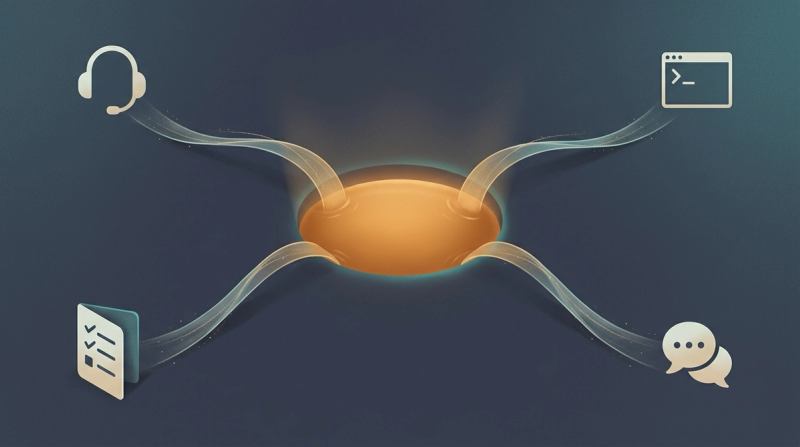
Bottom line: MCP is a wire format for connecting agents to tools and data. It is not a reasoning layer. Enterprise context requires resolving conflicts between sources, enforcing permissions at query time, and weighting authority, work that happens above MCP, not inside it. A context engine uses MCP as transport, not destination.
Stanford HAI's 2025 AI Index found that even state-of-the-art models still hallucinate on a significant share of factual queries, with legal-domain benchmarks showing error rates above 15% despite full document access (Stanford HAI AI Index, 2025). That finding is the short answer to why MCP servers aren't enough for enterprise AI: access to data is not the same as understanding it. The Model Context Protocol ecosystem has grown quickly since Anthropic published the spec in late 2024, and yet enterprise teams wiring up a dozen MCP servers are still getting wrong answers out of their coding agents. MCP is working as designed. The problem sits above the wire, where agents have to resolve conflicts between sources, enforce permissions at query time, and weight authority, and none of that is what a transport layer does.
To be clear up front: this is not an anti-MCP argument. We use MCP ourselves, and we think the spec is one of the better things to happen to agent tooling in the last two years. The critique is narrower. The current enterprise pattern of stacking more MCP servers until the agent gets smarter has a ceiling, and most teams are hitting it right now. The MCP limitations enterprise teams run into aren't bugs in the protocol so much as category errors about what the protocol was ever meant to do.
If you want the full picture on how context fits into AI agent workflows, start with our context engineering guide.
What problem does MCP actually solve?#
The Model Context Protocol solves the N-times-M integration problem that previously forced every AI client to build custom connectors for every data source, replacing exponential integration debt with a single standardized transport layer for enterprise toolchains and agent workflows (MCP Specification, 2025).
MCP solves the N-times-M integration problem. Before the protocol, every AI client needed a custom integration for every data source, an exponential mess. The MCP specification describes the protocol as "a universal, open standard for connecting AI systems with data sources" (MCP Specification, 2025). That framing is accurate, and it is the right framing.
The value is real. A well-written MCP server exposes tools, resources, and prompts in a consistent shape, and any compliant client can talk to it. That standardization unlocks a large ecosystem, which is why the MCP GitHub organization (modelcontextprotocol, 2025) has expanded quickly across official and community servers.
But notice what MCP does not claim to do. The spec (modelcontextprotocol.io, 2025) defines message shapes, capability negotiation, and transport. It does not define how an agent should pick between two servers that return contradictory answers. It does not define permission inheritance across sources. It does not rank authority. DORA's 2025 State of DevOps report found that AI tool adoption without supporting infrastructure investment correlates with declining delivery throughput and stability (DORA, 2025). Wiring up more servers without a reasoning layer is one version of that pattern. Those are application concerns, correctly left out of the protocol.
The MCP specification defines the protocol as "a universal, open standard for connecting AI systems with data sources" ([MCP Specification, 2025). The protocol standardizes transport between clients and servers, it does not specify how agents should reason over returned data.]
Where does stacking MCP servers break for enterprise teams?#
Enterprise teams that wire up 8 to 15 MCP servers typically hit three failure modes within weeks: conflict blindness, permission bleed, and shallow retrieval, none of which are bugs in the protocol but all of which block reliable AI-assisted development (DORA, 2025).
In our work with engineering orgs, teams that wire up 8 to 15 MCP servers tend to hit the same three failures within a few weeks. The servers work. The wiring works. The agent still returns answers that are wrong, incomplete, or quietly dangerous. The failure mode here isn't integration; it's arbitration, and it's where the practical MCP limitations for enterprise teams start to bite.
Conflict blindness#
Your repo says the payment retry limit is 3. The runbook in Confluence says 5. A Slack thread from two weeks ago says the team agreed to move it to 7 but never shipped. An MCP server for each source returns each answer, faithfully. The agent picks one, usually the one that came back first or longest, and answers with confidence. No source is flagged as stale, no conflict is surfaced, and the engineer trusts the response because the agent sounds certain.
Anthropic's engineering guidance on context rot (Anthropic Engineering, 2025) describes how a model's ability to recall information accurately declines as the token count grows. Contradictions entering the window make it worse. Stacking MCP servers raises both problems at once.
Permission bleed#
MCP servers typically authenticate as a service account or a user token. A server hooked to a broad Jira project can return tickets the asking engineer should not see. The protocol does not know who is asking, only who the server is authenticated as. Gartner's 2025 forecast projects that by 2027, 40% of AI-related data breaches will stem from improper access controls in agentic AI workflows rather than from model vulnerabilities (Gartner, 2025). We have seen exec-level tickets surface in answers to ICs because the MCP integration was wired with a privileged token and no query-time permission check.
Retrieval depth#
Most MCP servers return shallow results: a list of files, a snippet, a ticket summary. The agent then has to decide whether to follow up. McKinsey's 2025 survey of enterprise AI adoption found that 67% of organizations report their AI tools cannot reliably synthesize information across more than three internal systems (McKinsey, 2025). For deep questions like "why does this service retry on 502 but not 503?", shallow retrieval runs out of road fast. You need to traverse related code paths, correlate with incident history, and rank by recency and authority. Traversal and ranking are reasoning tasks, and the protocol sensibly leaves them to the application.
Why is "access" different from "understanding"?#
Access means having data on the wire; understanding means knowing which piece of that data is authoritative for a specific question, from a specific person, in a specific context. Stanford HAI's 2025 AI Index documents persistent hallucination rates above 15% in domain-specific benchmarks, even when models have full document access (Stanford HAI AI Index, 2025).
A coding agent pointed at a GitHub MCP server has access to every file in the repo. It does not, from that fact alone, know that payments_v2.py is the current implementation and payments.py is a deprecated shim kept around for a migration. It does not know the author of the current file left the company, and the de facto owner is now the person who merged the last three PRs. It does not know the ADR in Notion overrides the comment in the code. We cover more of these blind spots in what your coding agent can't see.
Understanding requires a layer that ranks authority, resolves time, tracks ownership, and applies permissions at query time. None of that lives in the MCP spec, and frankly it shouldn't. The spec is doing its job. Something above it has to do the rest, which is where most of the practical MCP limitations for enterprise deployments actually surface.
Stanford HAI's 2025 AI Index documents persistent hallucination rates above 15% in domain-specific benchmarks even with full document access ([Stanford HAI AI Index, 2025), evidence that retrieval access alone does not produce correct answers.]
How does a context engine use MCP without stopping at MCP?#
A context engine treats MCP as one transport among several and then performs the curation work above it: conflict resolution, authority weighting, permission enforcement, and multi-source synthesis into a single answer with provenance and sources cited inline (Anthropic Engineering, 2025).
Anthropic's own engineering team frames context engineering as "the art and science of curating what will go into the limited context window from a universe of possible information" (Anthropic Engineering, 2025). Curation is the operative word. A context engine treats MCP as one transport among several, then does the curation work above it: conflict resolution, authority weighting, permission enforcement, and synthesis. Learn more about what a context engine is and how it works.
In practice, that means the engine can call an MCP server for raw retrieval, call a second for a different source, compare what comes back, rank the returns by recency and authority, drop anything the asker isn't permitted to see, and then synthesize a single answer with sources cited. MCP handles the fetch. The engine handles the reasoning about what the fetch returned.
Sam Younger, Engineering Manager at UserTesting, put it this way: "Unblocked is the first MCP queried for everything we look up. It's not just checking the code, the code could be wrong."
That quote is the entire argument compressed into one sentence. Code is one source among several, and it is often wrong, stale, or silent on the "why." A context engine like Unblocked sits as institutional context for coding agents: it resolves the conflicts MCP can't see and reasons above retrieval instead of terminating at it. Across the enterprise deployments we have observed, the ratio of "questions that need multi-source synthesis" to "questions answerable by a single retrieval" runs roughly 3 to 1 for senior engineers, which is also roughly where plain-MCP setups start to feel inadequate.
When is plain MCP enough, and when do you need more?#
Plain MCP is enough when a team has one source of truth, low ambiguity, and a small codebase, but enterprise teams with 5 or more overlapping sources routinely hit conflict and permission problems that the protocol was never designed to handle (The New Stack, 2025).
Plain MCP is enough when you have one source of truth, low ambiguity, and a small team. A solo developer pointing Claude Desktop at a single repo's MCP server gets real value, and no context engine is required. The protocol shines in those cases, and that is most of the current MCP demos you see online. The New Stack's reporting on AI developer tooling in 2025 consistently finds that context fragmentation across disconnected systems is the top barrier to reliable AI-assisted development in enterprise settings (The New Stack, 2025). That fragmentation is exactly what appears when you move beyond the single-source demo.
Plain MCP starts to strain when you have multiple overlapping sources, role-based access requirements, or answers that depend on historical decisions the code no longer reflects. At that point, adding more MCP servers tends to compound the problem instead of solving it, because each new server gives the agent another plausible-but-wrong answer to choose from. For a deeper comparison, see context engine vs RAG.
Stack Overflow's 2025 Developer Survey found that 82% of developers using AI coding tools reported trust issues when tools pulled context from multiple disconnected sources (Stack Overflow, 2025). The test we use with teams is simple. If two of your sources can contradict each other, and the answer depends on which one is currently authoritative, you have crossed the threshold from retrieval into reasoning. MCP server limitations at that point are structural, not configurable.
What does this look like inside a real engineering org?#
A 400-engineer organization wired 11 MCP servers into their internal coding agent, covering GitHub, Jira, Confluence, Slack, and more, and found that senior engineers stopped using it within two weeks because answers were subtly wrong in ways that took longer to verify than asking a teammate (GitHub Octoverse, 2025).
A 400-engineer org we work with had wired 11 MCP servers into their internal agent: GitHub, Jira, Confluence, Slack, Notion, Datadog, PagerDuty, Linear for a subgroup, two internal wikis, and a secrets vault. On paper, the agent had everything. In practice, senior engineers stopped using it after two weeks because the answers were subtly wrong in ways that took longer to unwind than just asking a teammate.
The pattern we observed: the agent would cite the first plausible source, not the authoritative one. It would mix a deprecated Confluence page with a current code comment and produce a plausible-sounding answer that matched neither. It had no concept of which Slack channel was official versus social. The wiring was not the problem. The reasoning above the wiring was missing.
GitHub's Octoverse 2025 report documented that AI-assisted development continues to accelerate across the platform, with agent-driven workflows among the fastest-growing categories by contributor count (GitHub Octoverse, 2025). As that volume grows, the cost of subtly wrong agent answers compounds. Replacing the "stack of MCP servers" approach with a context engine that consumed several of those same sources, ranked them, and applied permissions at query time reduced the subtly-wrong-answer rate significantly in the team's own measurement. The MCP servers didn't go away; they became inputs to something that could actually arbitrate between them. The MCP limitations the team had been hitting were real, but they were structural limits of transport, not configuration bugs they could tune around. Read more about how a context engine actually works.
Frequently asked questions#
Is MCP going away?#
No. MCP is becoming the default transport for agent-to-tool connections, and the ecosystem continues to grow (modelcontextprotocol, 2025). The argument here is not that MCP is wrong. It is that MCP is necessary but not sufficient for enterprise context, and that a reasoning layer has to sit above it.
Can't I just build the reasoning layer myself on top of MCP?#
You can, and some teams do. The work is non-trivial: conflict resolution, authority ranking, permission enforcement at query time, and synthesis across sources. Teams typically underestimate the maintenance cost of authority signals that drift as orgs reorganize. MCP vs context engine is less "either/or" and more "transport vs reasoner".
How many MCP servers is too many?#
There is no fixed number, but in our field observations the pain starts around 5 to 8 overlapping sources, when contradictions become common and permissions get messy. Below that threshold, plain MCP is often fine. Above it, Model Context Protocol limitations start compounding faster than new servers can compensate.
Does a context engine replace MCP?#
No, it consumes MCP. A context engine uses MCP servers as one class of input, alongside other connectors, and does the curation work Anthropic describes (Anthropic Engineering, 2025). The two layers are complementary, not competitive.
Beyond MCP#
MCP is a good protocol. It solved a real integration problem, and it deserves the adoption it is seeing. The mistake most teams make is treating it as the finish line. Enterprise context is fundamentally a reasoning problem that a transport layer can feed but cannot solve, and the teams getting the most out of their agents right now are the ones who have stopped asking "which MCP server do we add next?" and started asking "what does the layer above MCP actually need to do?"
At Unblocked, we believe that layer is a context engine: institutional context for coding agents, a system that treats MCP as one input among several and does the arbitration, authority ranking, and permission enforcement above retrieval. You don't have to agree with our specific answer to take the argument seriously. If your agents are still wrong after a dozen integrations, the fix probably isn't a thirteenth server. It's the reasoning layer you haven't built yet, and it's where the real MCP limitations for enterprise teams get resolved. To get started, read our context engineering guide.