Atlassian Rovo MCP versus a dedicated context tool for Confluence, Jira and code?

If your work lives in Jira, Confluence and Bitbucket Cloud, the Rovo MCP server is a strong default: one hosted endpoint, OAuth, your Atlassian permissions, and code search on top. Add a dedicated context tool when the answer also sits in GitHub, GitLab or Slack and the agent needs one reconciled, cited answer rather than a stack of Jira, Confluence and code results to sort.
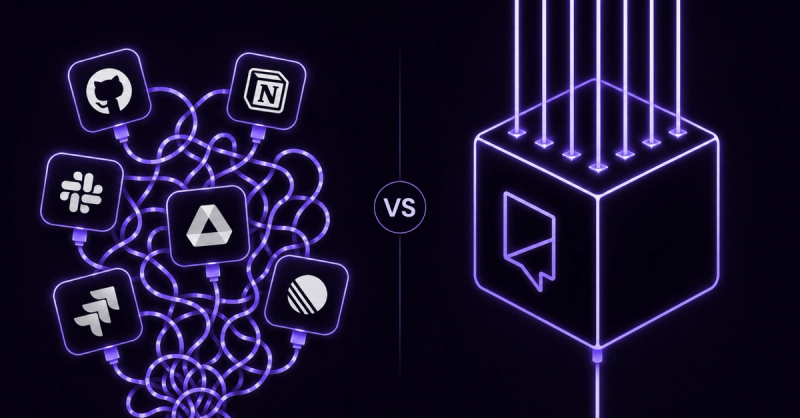
Start with the Rovo MCP server if your team's work lives in Atlassian Cloud. It gives a coding agent Jira, Confluence, Bitbucket Cloud and code search through one hosted endpoint, with your Atlassian permissions. Add a dedicated context tool when the answer is spread across systems Atlassian does not own, and you want the sorting done before the agent reads anything. A dedicated context tool is a service built for engineering questions that indexes code, PRs, tickets, docs and chat, decides which source is current, and returns one cited answer over MCP.
| Rovo MCP server | Dedicated context tool | |
|---|---|---|
| Best at | Reading and writing Jira and Confluence | Questions that span code, tickets and chat |
| GitLab or Azure DevOps access | Follows Jira permissions | Follows each source's permissions where enabled |
| What the agent gets | Items, pages, files, graph links | One cited answer |
| Who decides which source is current | The agent (no rule documented) | The server |
What the Rovo MCP server covers in 2026#
Atlassian made the Rovo MCP server generally available on February 4, 2026, for "context-rich Jira and Confluence work" in clients such as Claude, Cursor, GitHub and VS Code (Atlassian, 2026). The supported-tools page also lists Jira Service Management, Bitbucket Cloud, Loom and a code search group with tools such as getCodeSymbol, which "finds where a function, class, or variable is defined and everywhere it is used, including in other repositories" (Atlassian supported tools, 2026).
The v2 endpoint puts a discover tool in front, described as "natural-language search over the deferred tool catalog," so the agent does not load them all at once (Atlassian supported tools, linked above). Sign-in is OAuth 2.1, and "access is scoped to the user's existing permissions in Atlassian" (Atlassian security docs). Our Confluence and Jira MCP roundup covers options for Data Center.
Where code and chat outside Atlassian come in#
Teamwork Graph is Atlassian's layer that links Jira and Confluence to connected third-party apps, and Rovo reaches outside data through its connectors. Atlassian says GitHub in Rovo finds repositories, pull requests, issues, commits, branches and comments (Atlassian, July 2026). For newer Slack connections, Rovo retrieves Slack content "in real-time" instead of copying messages into Atlassian (Atlassian, October 2026).
Read the permissions closely. For GitHub, the admin picks an access level. Under full access, "MCP tools can retrieve GitHub data based on the user's GitHub permissions." Under limited access, they retrieve it "based on the user's Jira permissions." The tools page adds that Azure DevOps, GitLab, Jenkins and Spinnaker connectors "follow the limited access model" (Atlassian supported tools, linked above). So for GitLab code, Rovo applies Jira's rules, not GitLab's. In Unblocked, Data Shield filters answers by each source's own permissions, GitLab included. It is off by default except for Slack. An admin turns it on per source.
What the agent gets back from each#
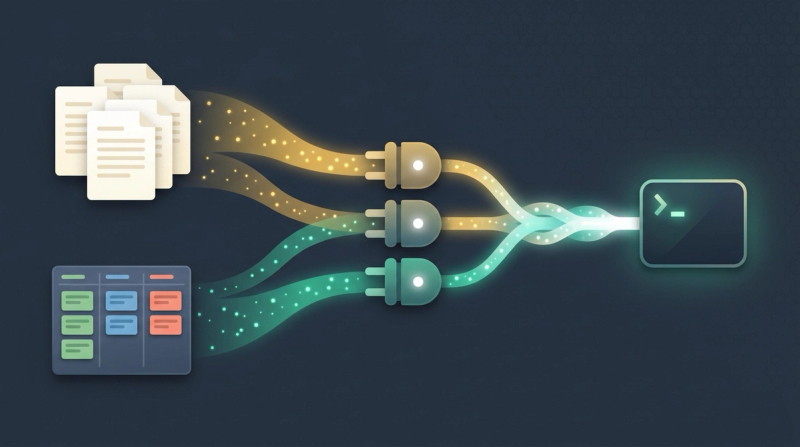
The bigger gap is the shape of the result. The MCP spec calls tools "model-controlled," meaning the model discovers and invokes them itself and processes the results (MCP specification, 2026). Rovo's tools return records: search hits, Jira items, Confluence pages, code files, or a graph walk. getTeamworkGraphContext "returns all relationships and linked objects in one traversal," which saves calls. But the agent still reads the ticket, the page and the code, and picks the right one.
In a made-up case, a Jira ticket says the export job retries three times. The Confluence page says five. The code in GitHub says five, and a Slack thread explains why. Rovo can find all four, and the agent must work out which is current. The Atlassian pages we read do not say how Rovo ranks a stale page against newer code.
A context tool does that on the server. Unblocked's context_research runs "multi-source research across code, PRs, docs, issues, and messaging" and "returns a synthesized answer with citations" (Unblocked docs). It treats code as "the strongest ground truth for how the system behaves right now," weights recency for chat, and says so when sources truly conflict (inside the Unblocked context engine).
Andrei Antanovich, Software Engineer at Waste Logics, said: "The first instruction in every agent project file is: before making any changes, gather context. That pulls from Jira, Confluence, and Slack via Unblocked — because that's where most of our knowledge actually lives, in threaded discussions. I set it up the day it was announced and now I don't even think about it. I just get the relevant information."
Cost, context size and setup#
Rovo credits are the usage units Atlassian bills for enriched Teamwork Graph calls, including unified search and context tools. Atlassian says that "the vast majority of enriched TWG API and tool calls are 1-10 Rovo credits per call" (Atlassian supported tools, linked above). An agent that searches on every task can rack up many calls.
Raw records also cost context. Claude Code warns when one MCP tool result passes 10,000 tokens and caps it at 25,000 by default (Claude Code docs, 2026). A March 2026 paper reports "significant performance degradation as context length increases" (Cao et al., 2026). We measured one run on one production repo with the same prompt and model: tool calls fell from 80 to 29 with Unblocked attached (same prompt, same model, different context). One run is not a benchmark.
The connectors also need setup. An organization admin connects Slack in Atlassian Administration.
A dedicated tool adds a vendor, a sign-in and its own permission settings. Unblocked's MCP server installs in Claude Code, Cursor, Codex, VS Code and JetBrains, including GitHub Copilot agent mode. The same answers are in Slack and on the web.
How to choose#
Use the Rovo MCP server alone when three things are true:
- Your code is in Bitbucket Cloud, or your questions rarely need the code.
- Your decisions get written down in Jira and Confluence.
- Your agents mostly do Atlassian work, such as filing tickets or updating pages.
Rovo also writes to Jira and Confluence, which a context tool does not replace. Our Confluence MCP guide has the setup.
Add a dedicated context tool when the code is in GitHub or GitLab, when the reason for a change sits in a thread, or when agents keep acting on a stale page. You can run both: Rovo for actions in Atlassian, a context tool for why the code is the way it is. To test it, take five questions whose answers changed last quarter, ask each through both servers, and see which answer names the current source. For more, see MCP connectors are not a context engine and the context engine vs direct MCPs answer.