A Pile of MCP Connectors Is Not a Context Engine
MCP connectors give an agent access to your sources, one system at a time. Cross-source assembly, contradiction resolution, and unwritten conventions still need a context engine.

TL;DR:
- MCP connectors give agents access to Slack, Jira, GitHub, and other sources. They still leave the agent to search across silos, reconcile contradictions, and figure out what matters at inference time.
- A context engine does that work before the agent asks. In our benchmarks, that meant up to 83% faster task completion with roughly 40% of the tokens.
Today, wiring an agent into your tools takes about ten minutes. Claude ships a connector catalog, there are MCP servers for GitHub, Slack, Jira, Notion, Google Drive and whatever else your team is paying for.
We frequently get the question: if Claude can already reach every source directly, what is Unblocked for?
The premise is true: Claude can reach every source. But connecting an agent to your sources gives it access. It does not give it understanding. The distance between those two is where most of the value lives, and where most of the cost hides.
What a connector actually gives you#
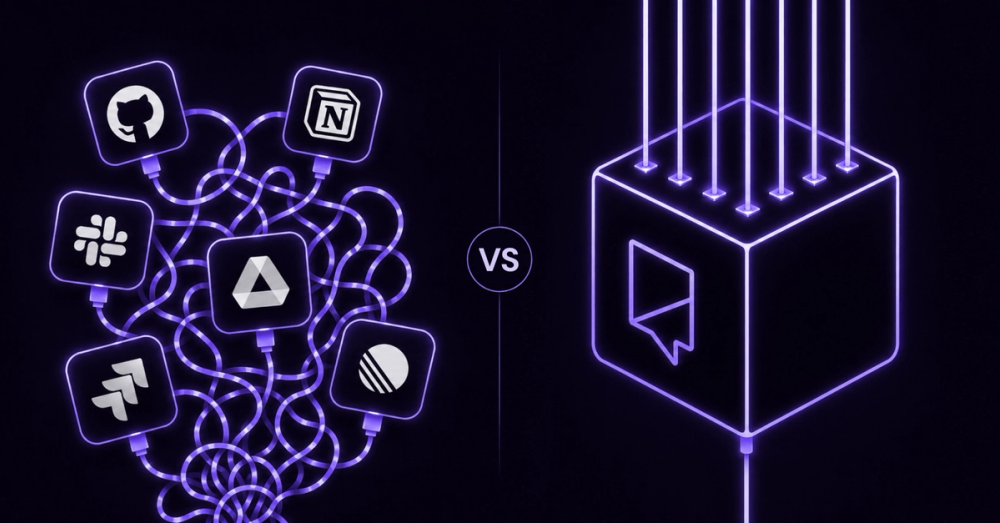
Give an agent a Slack MCP, a Jira MCP, and a GitHub MCP, and each one behaves the way its authors built it, often mapped 1:1 to the underlying API: you send a query, you get back a list of matching documents from that one system. Search Slack, get Slack messages. Search Jira, get Jira tickets.
That's genuinely useful for known-item lookups. "Fetch PR #4821." "Create a ticket in PROJ." If that's the whole job, connectors do it fine.
But the questions that actually slow engineers down don't sit inside one system. Take something like "why does the payment service retry like this?" The answer is spread across a PR review thread from last year, a Slack argument that never made it into any doc, a Jira ticket that got closed as won't-fix, and the code itself. No single connector holds more than a fragment of it. Which means someone (or something) has to assemble it.
With raw connectors, that somebody is your agent, and the assembly happens at inference time on your token bill.
Your agent becomes the integration layer#
When the agent does the stitching itself, cross-source research goes like this: query Slack with three or four keyword guesses derived from the quality of your prompt, query Jira, query GitHub, read a dozen results per source, notice a link, fetch it, guess again, repeat. Every intermediate result lands in the context window, relevant or not, and each hop costs another turn and the tokens that come with it.
All of it is slow, expensive and easy to get wrong, which is the same thing we said about humans doing it manually back when humans were the ones doing it.
We benchmark this constantly. We run the same task, same model, same codebase with a blind (LLM) judge:
- On a Kotlin SDK task, the agent with Unblocked context finished 83% faster, used 48% fewer tokens and cost 60% less. It scored 9.5/10 on following the team's conventions, where the agent without context scored 2/10.
- On a frontend feature-toggle task, 26.6% faster with 41.6% fewer tokens. The agent without context ran out of turns and never produced working code at all.
We also ran the same question through Claude Code internally, once with Unblocked and once without. The session without it spent 81 turns of subagent exploration crawling the codebase, roughly 84% of a session that cost about 10x more, and still came back with the wrong answer.
The session with Unblocked answered correctly in 40 seconds.
You shouldn't take our word for any of that, which is why we open sourced context-engine-simulator. Point it at your own repo, use your own tooling and your own model key, and see what the delta looks like on your codebase instead of ours.
"Search each silo and reconcile the results" is a hard, expensive job, and per-source connectors assign it to the most expensive worker in the building: your frontier-model inference loop. Frontier labs have even written explicitly about separating the thinking model from the working model.
The agent doesn't know what it doesn't know#
There's an assumption buried in that retrieval loop: that the agent knows what to search for in the first place. Mostly it doesn't. It doesn't know your team calls the checkout rewrite "phoenix" in Slack and "checkout-v2" in Jira. It doesn't know the retry behavior was settled in a PR comment rather than a doc. It doesn't know the argument that settled it ever happened. You can't write a query for a conversation you don't know exists, in vocabulary you've never seen, against a system you didn't think to check.
Anthropic's Thariq Shihipar has a good framing of this: the map is not the territory. The map is the prompts, skills, and context you hand the model. The territory is where the work actually happens. The gap between them is your unknowns, the points where the agent hits something it wasn't told and has to guess at what you wanted. With frontier models, his argument goes, the quality of the work is no longer limited by the model. It's "bottlenecked by my ability to clarify its unknowns."
His prescriptions are worth reading in full: blind spot passes, brainstorms, structured interviews, reference walkthroughs, implementation logs. They work, and each one is a human-in-the-loop ritual, re-run for every task, that spends your time and your tokens rediscovering context that already exists somewhere in your org. Each is also bounded on both ends: an interview only surfaces what you already know how to answer, and a blind spot pass only scans what the agent can reach, so a convention buried in three years of PR history gets past both.
Unblocked attacks unknowns from the other end and shrinks them before the session starts, at ingestion time instead of inference time. By then the engine has mapped which system holds what, learned that phoenix and checkout-v2 are the same project, and linked that PR to the Slack thread that reversed it, so the agent doesn't have to know where to look.
Connectors can't tell you which source is right#
Say the agent clears that hurdle and finds the information. A second problem is waiting: knowing which version of it is still true.
Almost every engineering org I've worked in looks like this: a Confluence page says one thing, a Slack thread three weeks later reversed it and nobody went back to update the page. The README documents the old auth flow, and the reasoning behind the new one lives in a review comment on the PR that replaced it.
An agent querying sources one at a time has no way to know which answer wins. It stops at the first plausible result, and "plausible" is exactly how you end up shipping code against a decision your team reversed months ago.
Unblocked's context engine does this reconciliation server-side, before anything reaches the agent: recency and authority signals resolve contradictions, and every answer carries citations so you can check where it came from. That's a different contract than search. Search tells you where information lives, and you still have to work out which of it is true. The context engine does that part before it answers.
Some knowledge doesn't live in any source#
The last gap is one no amount of connector-chaining can close. Some organizational knowledge cannot be constructed from queries to individual systems, no matter how many you run, because it only exists in the patterns across systems, observed over time.
- Unwritten conventions. No document says "PRs touching the auth module always get a security review" or "changes near the order flow always run the payment integration tests first." Those rules exist only as patterns in years of PR history, so there is nothing to query for.
- Expertise topology. Who actually knows the payment service, not who the org chart says owns it? The answer is derived from who reviews those PRs on GitHub, who answers those questions in Slack, and who closes those bugs in Jira, weighted by recency. That answer only shows up when you watch all three over time.
Unblocked builds this continuously as part of ingestion: an institutional map of people, projects, conventions, and workflows that gets applied to every query. An agent with ten MCP connectors and an empty context window reconstructs none of it and it starts from zero on every session. That's a high price to pay in search tokens and wasted time.
Ten connectors is ten security surfaces#
There's an operational cost to the connector-mesh approach that security teams have started noticing. Every direct source connector you hand an agent comes with its own credential and its own permission model, and each one adds to the "lethal trifecta": an agent with access to sensitive data, exposure to untrusted content, and the ability to act. We hear this from platform and security teams weekly: they don't want an agent holding raw keys to Google Drive and Slack and Jira, each governed differently, each auditable separately.
Unblocked collapses that to one connection with server-side enforcement: permissions from every underlying source are propagated at ingestion and enforced before results leave the server, so an agent can only ever surface what the requesting user is authorized to see. That leaves a single integration to govern and audit, and no source credentials living in an agent's configuration.
When a connector is the right call#
If the job is transactional, use a connector. Create the ticket, post the message, fetch the one file you already know you need. Unblocked is not trying to replace any of that, and plenty of our customers run both, with connectors handling the writes and Unblocked as the research layer their agents call when the question is why something was built that way or what the team already decided.
| Per-source MCP connectors | Unblocked | |
|---|---|---|
| Returns | Documents from one system | A synthesized, cited answer across all systems |
| Cross-source assembly | Your agent, at inference time | Server-side, before the agent sees anything |
| Unknowns | The agent guesses at names, systems, and whether a discussion exists | Aliases and cross-system links resolved at ingestion |
| Contradictions | First plausible result wins | Reconciled by recency and authority, with citations |
| Unwritten conventions and expertise | Invisible | Mined continuously from cross-source history |
| Permissions | Per-connector, agent-held credentials | One connection, enforced server-side |
| Token cost | You pay for every init and dead-end search | Ranked and resolved before it hits your context window |
From access to an answer an agent can act on#
MCP made it easy to give agents access, and that's genuinely good. It's the reason Unblocked can deliver its context through a single MCP server into Claude Code, Cursor, Windsurf, Copilot, or anything else that speaks the protocol. The work that remains is turning ten systems' worth of partial, contradictory, decade-deep history into one decision-grade answer an agent can act on, quickly enough to matter and cheaply enough to run on every task.
A connector catalog doesn't get there by adding connectors, because the work happens at ingestion, before any query is asked.
Run context-engine-simulator against your own repo. If the numbers come out differently than ours did, I'd like to hear about it.