ServiceNow vs Tabnine vs Unblocked: Context Engine Guide
 Dennis Pilarinos·May 11, 2026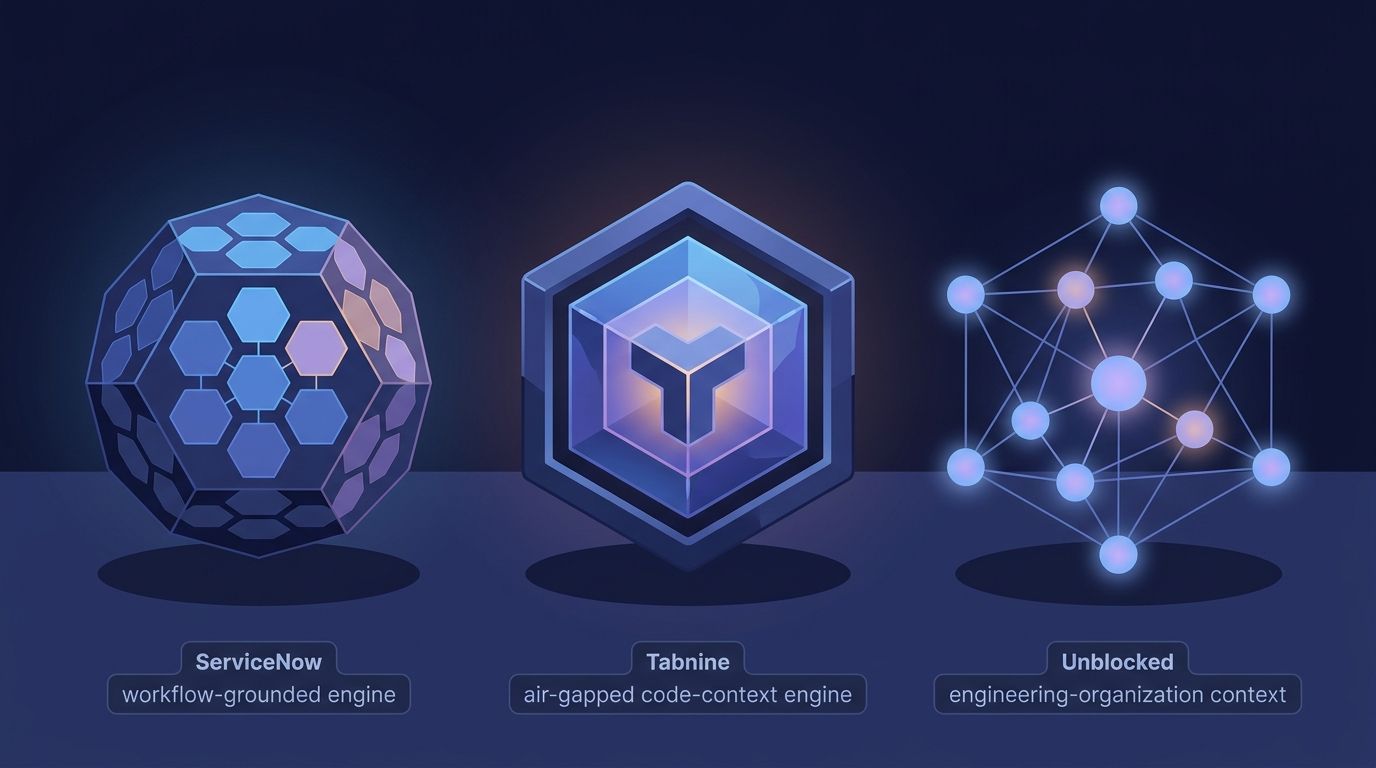
Bottom line:
- The label "context engine" now sits on three very different products.
- ServiceNow reasons over enterprise workflow and policy for AI governance.
- Tabnine reasons over code architecture for regulated engineering.
- Unblocked reasons over the full engineering surface — code plus the conversations that explain it.
- Pick the engine that matches where your institutional knowledge actually sits, not whichever vendor claimed the phrase first.
Disclosure: The author's company (Unblocked) is one of the three vendors compared here. The analysis represents competitors fairly using their own published materials; the differentiation emerges from what each product actually does, not from marketing adjectives.
Bottom line:
The label "context engine" now sits on three very different products. ServiceNow's version entered preview April 9, 2026, anchored in 85 billion Now Platform workflows and 7 trillion transactions (The Letter Two, 2026). Tabnine hit GA February 26, 2026 with an air-gapped engine aimed at regulated coding teams (Tabnine, 2026). Unblocked is scoped to engineering-organization context.
Same term, three scopes. ServiceNow reasons over enterprise workflow and policy for AI governance. Tabnine reasons over code architecture for regulated engineering. Unblocked reasons over the full engineering surface — code plus the conversations that explain it.
Gartner projects 40% of enterprise applications will ship task-specific AI agents by end of 2026, up from under 5% in 2025 (Gartner, 2025). Buyer demand is outrunning the category's definitional work.
Pick the engine that matches where your institutional knowledge actually sits, not whichever vendor claimed the phrase first.
Table of Contents
- Why Do Three Vendors Use the Same Term?
- What Does Each Vendor Actually Mean?
- Side-by-Side Comparison Matrix
- Which Should You Pick?
- Where Do They Overlap, and Where Don't They?
- How Do the Three Compare on Pricing and Deployment?
- What to Ask Each Vendor in a Demo
- FAQ
Why Do Three Vendors Use the Same Term?#
Picture a VP of Engineering walking out of three vendor pitches in the same week. Monday: a ServiceNow account team demos an engine that reasons over approvals, identity, and ITSM workflows. Wednesday: Tabnine walks through an air-gapped system that grounds coding agents in repo architecture and dependency graphs. Friday: Unblocked shows an engine that stitches code together with the Slack threads, Jira tickets, and design docs that explain it. Every deck uses the phrase "context engine." None of the three products overlap on more than a quarter of what the others do. The three vendors are ServiceNow, Tabnine, and Unblocked — and the evaluation only gets tractable once you accept that the shared term hides three different scopes.
This post compares the three on their own published materials. Vendor claims are attributed to vendors. Overlap is flagged. The goal is a decision framework that survives a buying cycle, not a winner.
What Does Each Vendor Actually Mean?#
The three vendors use the same term for systems that solve different problems. Understanding what each one means by "context engine" is the first step of any serious evaluation.
ServiceNow Context Engine#
ServiceNow launched its Context Engine on April 9, 2026 in limited preview with select customers. The framing from the announcement: "the why behind decisions, not just the what" (CIO.com, 2026). The engine grounds AI agent decisions in the Now Platform's Service Graph and Knowledge Graph, which ServiceNow reports span 85 billion workflows and 7 trillion transactions (The Letter Two, 2026).
The target is enterprise IT and business-operations AI. Identity relationships, asset dependencies, approval chains, cost thresholds, vendor history, policy enforcement. External coding agents like Claude Code and Cursor can deploy into ServiceNow while governance and execution stay inside the platform. ServiceNow also integrates recent acquisitions: Traceloop for AI decision tracing, Veza for identity/security, and Armis for cyber exposure.
Amit Zavery, ServiceNow's President and CPO, framed the positioning: "ServiceNow brings it all together, so every customer starts with a complete AI-first experience, not a procurement project." John Aisien, SVP of Product for Security and Risk, added that the engine "captures the why behind decisions, not just the what."
Tabnine Enterprise Context Engine#
Tabnine reached general availability with its Enterprise Context Engine on February 26, 2026. The framing: "a new infrastructure layer" that gives AI "a structured understanding of the environments in which they operate" (Tabnine, 2026). The engine ingests remote repositories, services, APIs, and dependency systems, extracting entities, relationships, and patterns into a knowledge graph.
Named capabilities include Blast Radius Analysis, Temporal Understanding, Cross-Repository Synthesis, Zero-Config Discovery, Code Review Intelligence, Organizational Memory, and Architectural Compliance. Integration via Model Context Protocol (MCP) means the engine can feed Cursor, GitHub Copilot, Claude Code, Augment, Cline, and Windsurf. Deployment options span SaaS, VPC, on-premises, and fully air-gapped, which is the differentiator for regulated industries.
Co-CEOs Dror Weiss and Eran Yahav frame the positioning directly. Weiss: "Enterprises don't have an AI capability problem. They have an understanding problem." Yahav: "Every major shift in computing introduced a new foundational layer... organizational context will become a standard layer for enterprise AI."
Unblocked#
Unblocked is built for engineering organizations specifically and is agent-agnostic by design. The reasoning target is the combined surface of code and the conversations around it: GitHub and GitHub Enterprise, GitLab, Bitbucket, Azure DevOps, Jira and Jira Data Center, Linear, Asana, Slack, Microsoft Teams, Confluence and Confluence Data Center, Notion, Google Drive, Coda, and CI systems (GitHub Actions, GitLab Pipelines, Buildkite, CircleCI, Jenkins). Interfaces include MCP server, REST API, web app, Mac desktop app, Slack and Teams apps, CLI, and an AI Code Review bot that posts PR comments (docs.getunblocked.com).
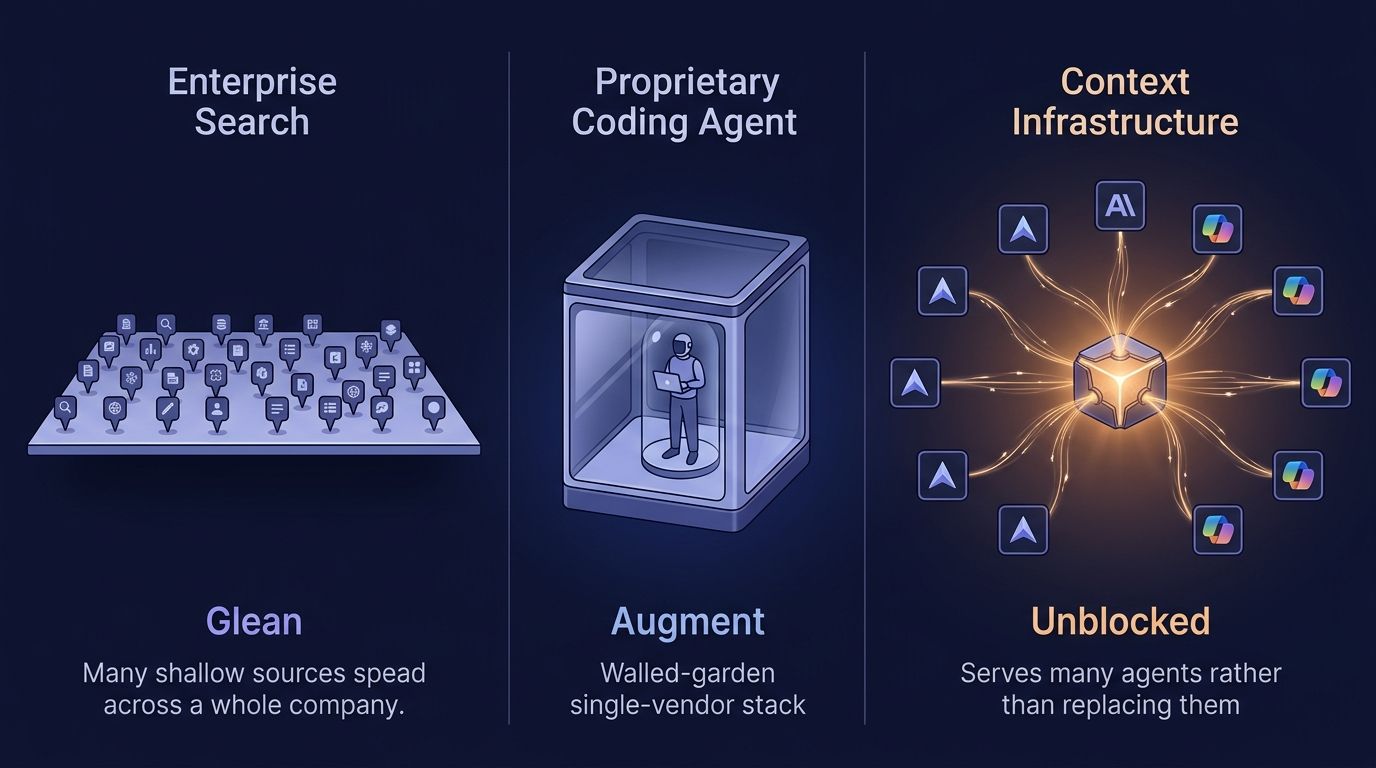
The architecture is deliberate: Unblocked does not replace coding agents, it feeds the ones already in use. Through MCP, it delivers decision-grade context to Cursor, Claude Code, GitHub Copilot, Codex, and Windsurf. Through REST API, it feeds anything that can make an HTTP call. Through Slack and Teams apps, it answers in the channels engineers already use. This is the key difference from proprietary coding-agent products: Unblocked compounds across whatever agent stack the organization runs, now and in the future.
Enterprise posture: SOC 2 Type II, CASA Tier II, SAML SSO with SCIM provisioning, RBAC, audit logs, Data Shield permission enforcement at both ingestion and delivery, and on-premises deployment at the Enterprise tier (getunblocked.com/security). Permissions are inherited from each source system, so an agent acting on behalf of a specific user sees only what that user is authorized to see.
Published benchmark: on a controlled test on the same codebase with the same agent, Unblocked reported 48% fewer tokens (20.9M vs 10.8M) and 83% faster completion when feeding decision-grade context upstream (getunblocked.com). A single-task self-reported data point, but directionally the kind of delta that shows up when context quality moves out of the supervision loop.
Side-by-Side Comparison Matrix#
Nine dimensions that separate the three products on substance rather than marketing. Cells are drawn from published vendor materials.
Enterprise context engine comparison matrix:
| Dimension | ServiceNow | Tabnine | Unblocked |
|---|---|---|---|
| Primary domain | Enterprise workflow / ITSM | Regulated-industry coding | Engineering organization |
| Reasoning focus | Policy, approvals, workflows | Code architecture + deps | Code + conversations |
| Core sources | Now Platform CMDB | Repos + services + APIs | Git + Slack + Jira + docs + PRs |
| Agent integration | External agents into Now | MCP, 7+ coding agents | MCP + IDE + APIs |
| Deployment | SaaS (preview) | SaaS / VPC / on-prem / air-gap | SaaS + on-prem (Enterprise) |
| Ideal customer | ServiceNow-centric enterprise | Regulated industries | Engineering-first orgs |
| Public benchmarks | None cited | None cited | 48% fewer tokens, 83% faster |
| Pricing transparency | Not disclosed | Not disclosed | Published tiers |
| Launch status | Preview, Apr 9 2026 | GA, Feb 26 2026 | GA |
Each product solves a genuinely different problem. Buy based on fit, not shared vocabulary. Source: Vendor announcements + Unblocked analysis.
The same comparison in table form for screen readers and AI crawlers:
| Capability | ServiceNow Context Engine | Tabnine Enterprise Context Engine | Unblocked |
|---|---|---|---|
| Primary domain | Enterprise workflow / ITSM | Regulated-industry coding | Engineering organization |
| Reasoning focus | Policy, approvals, workflows | Code architecture + dependencies | Code + conversations around it |
| Core sources | Now Platform CMDB, Service Graph, Knowledge Graph | Repositories, services, APIs, dependency systems | Git, Slack, Jira, Confluence, docs, PRs |
| Agent integration | External coding agents deploy into Now Platform | MCP; 7+ coding agents (Cursor, Copilot, Claude Code, Augment, Cline, Windsurf, Codex) | MCP, IDE integrations, REST API, Slack/Teams apps |
| Deployment | SaaS (limited preview) | SaaS / VPC / on-premises / air-gapped | SaaS / VPC; on-premises at Enterprise tier |
| Ideal customer | ServiceNow-centric enterprise | Regulated industries (finance, defense, healthcare) | Engineering-first organizations |
| Public benchmarks | None cited | None cited | 48% fewer tokens, 83% faster (self-reported, single task) |
| Pricing transparency | Not disclosed; part of Now Platform licensing | Per-seat tiers public; enterprise contact-sales | Per-engineer; enterprise agreements |
| Launch status | Preview, April 9, 2026 | GA, February 26, 2026 | GA |
In buyer conversations we've sat in on, the confusion usually surfaces in the first ten minutes — a ServiceNow-oriented buyer expects an ITSM reasoning layer, a platform engineering lead hears the same phrase and pictures code-graph analysis, and both sides spend the rest of the call talking past each other.
Which Should You Pick?#
Three decision criteria, in order. First and most determinative: where does your team's tribal knowledge currently live? Second: what are your deployment and compliance constraints? Third: what existing vendor relationships reduce integration friction?
First criterion: where does the knowledge live?#
If your engineering decisions, approval chains, and operational context live inside ServiceNow-adjacent systems (ITSM, HR platforms, cost governance), ServiceNow's Context Engine is built for that world. The scale anchor (85 billion workflows, 7 trillion transactions) is the relevant number because those workflows are where the context already is.
If your knowledge is primarily code and code-adjacent artifacts (repositories, services, APIs, architectural decisions), Tabnine's ECE is designed for that reasoning target. The air-gapped deployment option is the differentiator for regulated industries that cannot send code outside the perimeter.
If your knowledge is scattered across engineering tools (code in Git, decisions in Jira, conversations in Slack, specs in Confluence, incidents in PagerDuty) and the gap between "agent has access" and "agent has understanding" is the problem, Unblocked is built for that surface.
Second criterion: deployment and compliance#
ServiceNow is SaaS, currently in preview. Tabnine offers SaaS, VPC, on-premises, and fully air-gapped. Unblocked offers SaaS by default with on-premises deployment available at the Enterprise tier (getunblocked.com/pricing). If your compliance framework forbids any code leaving the perimeter, the choice narrows to Tabnine or the Unblocked on-prem Enterprise option.
Third criterion: existing relationships#
A company already standardized on ServiceNow will get faster time-to-value from its Context Engine because the ingestion work is already done. A company whose engineering runs outside ServiceNow will spend more time integrating than running. Apply the same logic to Tabnine (coding-assistant incumbent) and Unblocked (engineering-context native).
Where Do They Overlap, and Where Don't They?#
All three ingest some form of organizational data. None of them replace each other cleanly. ServiceNow does not index your Slack engineering discussions. Tabnine is not built for HR workflows. Unblocked is not built for ITSM. A mature enterprise may end up using two in different domains.
The overlap is narrower than it looks#
The word "context engine" implies interchangeability. The substance does not. ServiceNow reasons about enterprise policy; Tabnine reasons about code architecture; Unblocked reasons about engineering organization. You could run all three and have minimal feature overlap because each one's reasoning target is distinct.
When to combine#
Many enterprises will. ServiceNow for the workflow governance layer, Unblocked for the engineering context layer, and Tabnine as the air-gapped coding interface. The combinations are additive, not substitutive. Buyers should price the complete stack rather than assume one engine covers the others.
"Unblocked is game-changing for information availability. Most AI tools are siloed. This one connects all of our documentation across the disparate systems to give answers we trust."
— James Ford, Principal Engineer for Developer Experience, Compare the Market
How Do the Three Compare on Pricing and Deployment?#
All three sell enterprise with limited public pricing. ServiceNow's Context Engine ships as part of broader Now Platform licensing; analyst coverage has flagged concerns about cost predictability inside consumption-based tiers. Tabnine publishes per-seat tiers but contact-sales for enterprise. Unblocked sells per-engineer with enterprise agreements.
Deployment time varies. Tabnine can deploy into an air-gapped environment in weeks once networking is agreed. ServiceNow's deployment depends on existing Now Platform footprint; green-field deployments can take months. Unblocked's time-to-value depends on source-connection scope, typically days to weeks.
What to Ask Each Vendor in a Demo#
Five questions that cut through marketing and reveal whether a vendor's "context engine" is doing the work of an engine or the work of a well-polished retrieval layer.
- Show the same task with and without the product. Force an apples-to-apples before/after. If the demo only shows the "after" state, you are looking at a staged result.
- What sources does the engine actually reason across, specifically? Listen for specifics: "code repositories, issue tracker decision trails, chat threads, design docs," not "your enterprise data." Specificity is how you separate real ingestion from marketing copy.
- How does the engine resolve conflicts between sources? Two internal docs disagree. What does the system do? An acceptable answer names a resolution rule. An unacceptable answer describes top-k retrieval.
- How does permission enforcement work end-to-end? Verify ingestion-time filtering and delivery-time filtering. A system that filters only on output is less safe than it looks.
- What is the time-to-value, in hours or days? A vendor that cannot give a concrete answer is not ready for your scale.
FAQ#
Is ServiceNow's Context Engine for engineering teams?#
Its primary audience is enterprise workflow users (ITSM, HR, IT service). Engineering fits when the team is already embedded in ServiceNow-centric processes. For engineering-specific context, it is typically a poor fit unless ServiceNow is the organization's standard operating system.
Is Tabnine a context engine or a coding assistant?#
Tabnine expanded from coding assistant into context-aware AI coding infrastructure, branded as a context engine. The reasoning target is code and IDE-anchored workflows. It is not built for reasoning across non-code sources like Slack or Jira, though MCP integration gives it some reach through other tools.
Can I use Unblocked alongside ServiceNow or Tabnine?#
Yes. The reasoning targets are different, so the products coexist in most enterprise stacks. The common pattern is Unblocked for engineering context, ServiceNow for workflow governance, and Tabnine when an air-gapped code-assistance layer is required.
Which is cheapest?#
Per-seat pricing is similar across the three at list. Total cost depends on integration scope, existing vendor relationships, and deployment model. Analyst coverage has flagged ServiceNow's consumption pricing as a cost-predictability concern.
How long does each take to deploy?#
Ranges: ServiceNow weeks to months depending on existing footprint. Tabnine days to weeks (IDE-centric, air-gap option). Unblocked days to weeks depending on source-connection scope.
What public benchmarks exist?#
Unblocked publishes a self-reported controlled benchmark: on the same codebase with the same agent, decision-grade context upstream produced 48% fewer tokens and 83% faster completion (getunblocked.com). ServiceNow and Tabnine have not published comparable numbers for their context engines as of this writing. None of the three has an independent, audited benchmark specifically for context-engine output; adjacent coding-tool benchmarks (like SWE-bench scores from proprietary coding agents) measure a different job and should not be treated as equivalents.
The Right Call Depends on Where Knowledge Lives#
Run the decision backwards from the knowledge, not forward from the vendor. If the authoritative record of how your company operates lives in ServiceNow — approvals, assets, identity, cost thresholds, policy — the ServiceNow Context Engine is the only one of the three that reasons over that graph natively, and the preview-stage risk is worth absorbing for teams already standardized on the Now Platform. If the authoritative record lives in your repositories and cannot leave the perimeter, Tabnine's air-gapped deployment is the decisive capability; pair it with a coding agent and accept that non-code context stays out of scope. If the authoritative record is scattered across Git, Slack, Jira, Confluence, and the memory of senior engineers, Unblocked is built for that surface and compounds across whichever coding agents the org adopts next.
Two practical moves before signing anything. First, run the five demo questions against every shortlist vendor; the answers separate an engine from a retrieval skin. Second, price the full stack you are likely to end up with — many enterprises will run two of the three, so single-line-item comparisons understate real cost. The category will consolidate eventually. Until then, pick by fit, not by the phrase on the slide.
Continue reading:
- What is a context engine? — the definitional framework.
- Context engineering — the practice above the tools.
- Context engine vs RAG — why all three sit above retrieval.
- A context layer is not a context engine — the distinction that vendors blur.
Dennis Pilarinos is the founder and CEO of Unblocked, where his team builds context engines for enterprise engineering organizations. Previously, he led engineering teams at Microsoft and AWS.