Products
MCPAI Code ReviewDeveloper Q&A
Outcomes
Improve QualitySave tokensReduce rework
SecurityBlogDocsPricing
Book a DemoGet Started



Products

MCP
Improve AI coding agent output by connecting knowledge from your codebase, docs, and messaging platforms.
AI Code Review
High-signal PR feedback informed by how your system actually works. No noise or nits.
Developer Q&A
Fast, high quality answers without digging or disrupting coworkers.
Outcomes

Improve Quality
With plans and code that reflect how the system actually works you're one step closer to production.
Save tokens
Give agents the right context up front to reduce costly retrieval loops and tool calls.
Reduce rework
Get more accurate output on the first pass and spend less time reprompting and reviewing.
SecurityBlogDocsPricing
Log InBook a DemoGet Started

<
All posts
Perspectives
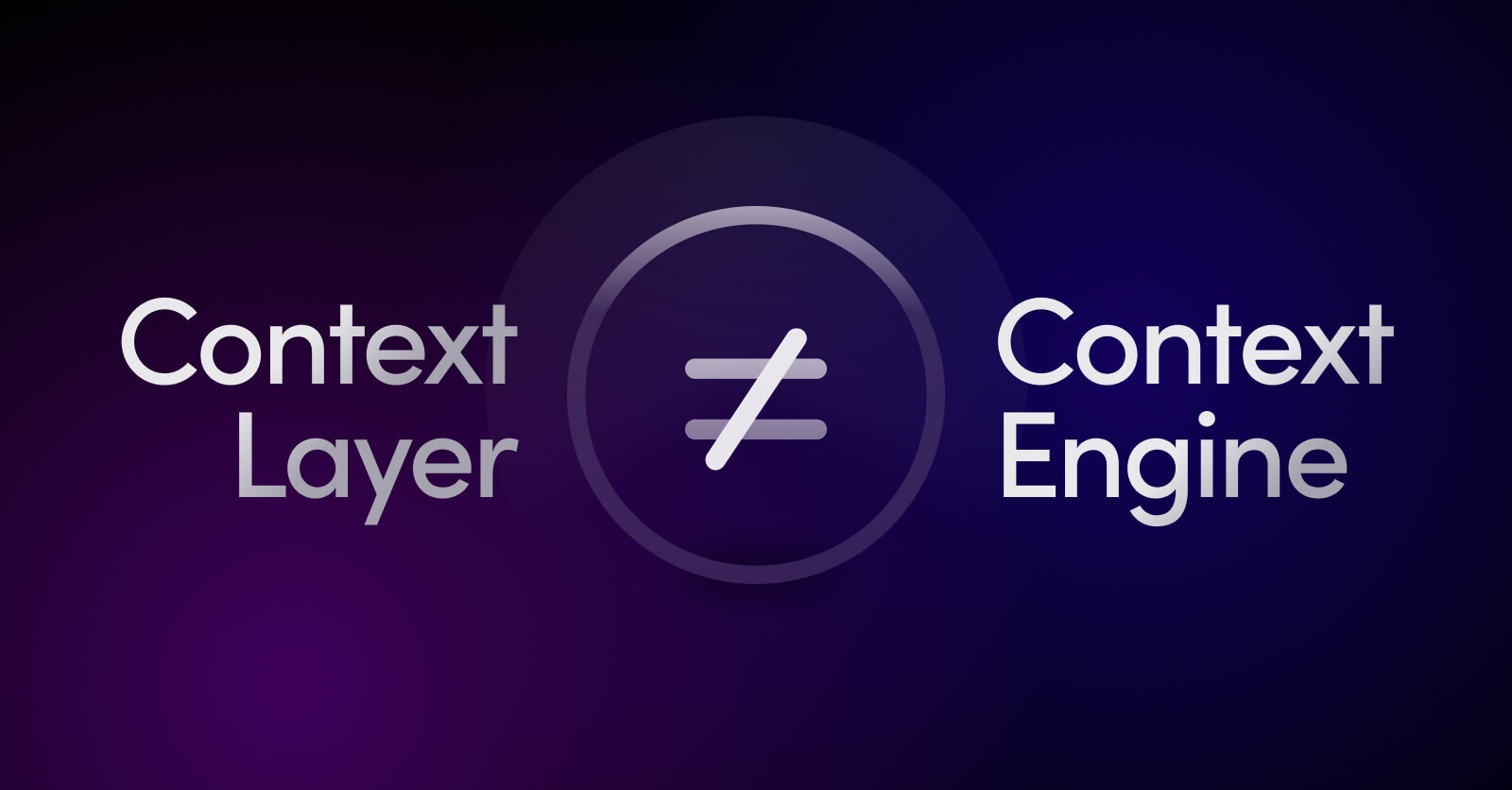
A context layer is not a context engine
Brandon Waselnuk
·
April 6, 2026

Welcome to the context arena, we’re so glad you’re here!

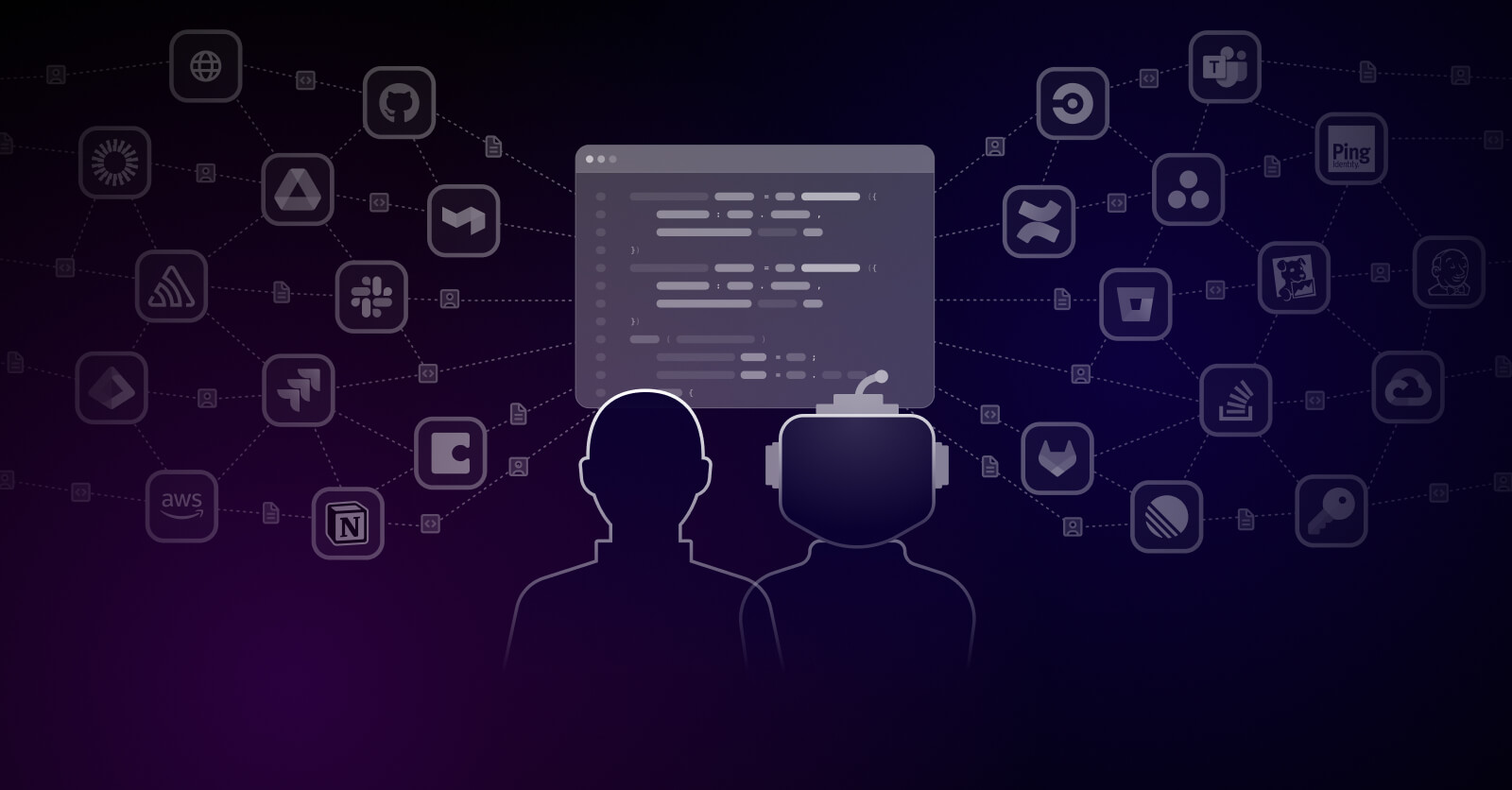
Every platform team building around AI agents crashes into the same wall: the agent is completely blind to how the system actually works. The obvious fix: give it more context.

So teams build context layers. They connect knowledge sources, curate rules files, pipe in documentation, and manage the context window. It helps. The agent stops hallucinating the basics. It follows some conventions. It generates code that looks closer to correct.

But the code still gets sent back in human review. The agent still misses the migration pattern that was decided in a Slack thread. It still ignores the PR that changed the convention last sprint. The context layer gave the agent more information. It did not give the agent understanding or any idea what to do with it.

What is a context layer?

A context layer, also called a knowledge layer, is a static delivery mechanism. It sits between your information sources and your agent, serving up content that someone on the platform team has curated, formatted, and committed to maintaining.

Rules files. Skills. MCP server connections. Documentation indexes. Retrieval pipelines that pull chunks from a vector store. These are all context layer or knowledge layer components. They answer one question: what information should the agent have access to?

That's real work, and it pays off. But it's harness engineering — the practice of shaping an agent's behavior by manually encoding what matters, updating it when the system changes, and hoping the agent finds the right piece at the right moment.

The ceiling is lower than most teams expect. Someone has to decide what goes into the layer and keep it current. When the convention changes, someone updates the rules file. The layer is only as good as the last time a human touched it.

Static content can't resolve conflicts either. Your documentation says one thing. The code does another. A Slack thread from last week explains why they diverge. A context layer or knowledge layer serves all three without telling the agent which one is authoritative right now, for this specific task.

And retrieval isn't reasoning. A context layer finds content that matches a query. It doesn't evaluate whether that content is complete, whether something contradicts it, or whether the agent should keep looking. The agent gets a plausible answer and stops.

This behaviour has a name: satisfaction of search. In radiology, it's the cognitive bias where a technician stops looking after finding the first abnormality. In retrieval systems, it's structural — agents are optimized to produce an answer, not to verify they've found the right one. The agent found the API spec and stopped. It never reached the Slack thread from last week explaining why that spec is no longer accurate.

What is a context engine?

A context engine is a system that continuously synthesizes organizational knowledge across sources, resolves contradictions, and delivers understanding — not just information — to an agent at the moment of decision.

Where a context layer retrieves content, a context engine reasons about that content before delivering it. The difference is concrete and, often, drastic.

When an agent asks about a service's retry behaviour, a context layer returns the API spec. A context engine returns the API spec, the PR that changed the default timeout last quarter, the Slack discussion about why, and the incident that prompted the change. It connects these into a coherent picture rather than dumping four disconnected documents into the window.

Sources disagree. That's normal in any organization with more than a handful of engineers. A knowledge layer serves the conflict and lets the agent pick whichever result it hits first. A context engine identifies the disagreement, evaluates recency and authority signals, and surfaces it with provenance— so the agent (or the developer reviewing its output) knows where the tension is and which source is more likely to be current.

This isn't a solved problem. Determining which source is authoritative is genuinely hard, and no system gets it right every time. But there's a difference between a system that attempts to evaluate authority and surface disagreements versus one that serves raw results and hopes for the best.

A context engine also ranks what it delivers based on what the agent is actually doing, not just what's semantically similar to the query. When the task is implementing a new endpoint, the team's API conventions and related service patterns matter more than tangentially related documentation from a different part of the system.

A context layer is a pipe. A context engine reasons about what should flow through that pipe, in what order, with what caveats.

"Can't I just build a smarter context layer?"

This is the right question. You can add re-ranking to your retrieval pipeline. You can add LLM-based post-processing. You can build agentic RAG loops. At some point, what you've built isn't a layer anymore — it's an engine! The distinction isn't about feature checklists. It's about whether the system has reasoning in its loop: continuously synthesizing across sources, resolving conflicts, and evaluating relevance against the task at hand. If you're building that, you're building a context engine whether you call it one or not yet. The question is whether you want to build and maintain that infrastructure yourself, or use one that already exists.

Context layer vs context engine

Question Context layer Context engine
What it delivers Documents matching a query Synthesized understanding with provenance
How it handles conflicts Serves all sources, agent picks first hit Identifies disagreements, surfaces provenance
How it ranks Semantic similarity to query Task-relevance, recency, authority signals
How it stays current Manual curation by a human Continuous synthesis from live sources
How it scales More sources = more curation work More sources = richer understanding

Why context layers plateau

Teams that have built context layers have already seen real improvement in agent output. That improvement is worth preserving, not replacing.

But it plateaus. The agent with a context layer generates better first drafts than a bare agent. It does not generate code that reflects the full picture: how the system works, why it works that way, and what changed last week that the documentation hasn't caught up to yet.

That gap between information access and actual understanding is where correction cycles live. Every re-prompt, every PR comment that says "actually, we stopped doing this after the incident in January" is a symptom of an agent that had access to information but lacked the understanding to apply it correctly. You've seen these comments in your own reviews. Count them next sprint.

The economics follow from the structure. When an agent starts with reconciled, ranked context, it makes fewer tool calls, generates fewer wrong assumptions, and spends less time in search-and-retry loops. In one controlled test — same agent, same codebase, same prompt — the agent without a context engine burned roughly double the tokens and needed four correction cycles over two and a half hours. With a context engine, it produced production-ready code in 25 minutes with no human correction (it got 1 nit pick). That's one test on one task; your mileage will depend on codebase complexity and task type. But the structural argument holds: fewer wrong assumptions means fewer wasted cycles.

This is also where context engineering as a discipline increases in relevance. The practice of structuring what agents see is important. The infrastructure underneath it — whether that's a context layer or a context engine — determines the ceiling.

This problem compounds at scale. A team with three services and six engineers might manage fine with curated rules files and a knowledge layer. A team with fifty engineers, multiple services, and years of accumulated decisions in Slack threads, PR discussions, and design docs will feel the ceiling sooner. The context layer doesn't break. It just stops improving without constant human intervention.

From context layer to context engine

Context layers are a useful step toward AI adoption. They prove the value of giving coding agents more than just code access. But they're a stepping stone, not the thing you're building toward.

The thing you're building toward is a context engine — a system that continuously builds organizational understanding, resolves the contradictions that static curation can't keep up with, and delivers decision-grade context at the moment an agent needs to make a choice.

A context layer is a pipe. A context engine reasons about what flows through it. If your agents are still producing code that gets sent back, the pipe isn't the problem. What's missing is the reasoning.

Read More

March 19, 2025

•

Perspectives

Developers Don’t Need More Docs
When developers start a new project or get stuck on a task, they don’t just need pages of structured documentation; they need answers.

March 24, 2026

•

Perspectives

The context problem moved from people to agents
Developers ship faster when they understand how their system actually works, not just how to write code. That context is nearly impossible for agents to reconstruct, so AI-native software teams end up wasting time and tokens fixing their code.
Get answers wherever you work
Book a Demo
vscode logo
VS Code
IntelliJ logo
JetBrains IDEs
Unblocked logo icon
macOS App
Slack logo
Slack
web icon
Web
Product
Get StartedBook a DemoDownload UnblockedPricingSecurity
Outcomes
Improve QualitySave TokensReduce Rework
Resources
BlogDocumentationPrivacy policyTerms of service
Company
About usCareersContact us