The MCP Plateau: Why Connecting More MCP Servers Stops Improving Your Agents
The MCP plateau is the point where adding more MCP servers stops improving agent output. Anthropic measured one workflow burning 150,000 tokens on tool definitions before any real work began. Here's why, and what sits above the protocol.

Key Takeaways
• The MCP plateau is the point where adding MCP servers stops improving agent output quality and starts adding cost and context bloat.
• MCP is a transport layer. It standardizes how agents reach tools and data; it does not resolve conflicts, rank authority, or enforce permissions.
• Anthropic measured 150,000 tokens spent on tool definitions before real work, cut to 2,000 by changing architecture, not adding servers.
• More context is not better context: the 2025 NoLiMa benchmark shows model performance degrades significantly as input length grows.
• A context engine sits above MCP and does the six things a transport layer cannot: unify, resolve conflicts, retrieve precisely, govern access, optimize tokens, and personalize relevance.
The Model Context Protocol solved a real problem, and then teams ran straight into a wall it was never meant to knock down. Anthropic's own engineers measured a single agent workflow consuming 150,000 tokens on tool definitions and intermediate results before the agent did any useful work, a load they later cut to 2,000 tokens, a 98.7% reduction, by changing the architecture around MCP rather than adding more of it (Anthropic Engineering, 2025). That gap is the MCP plateau in one number: past a certain point, connecting more servers stops making your coding agent better and starts making it slower, more expensive, and no more correct.
What is the MCP plateau?#
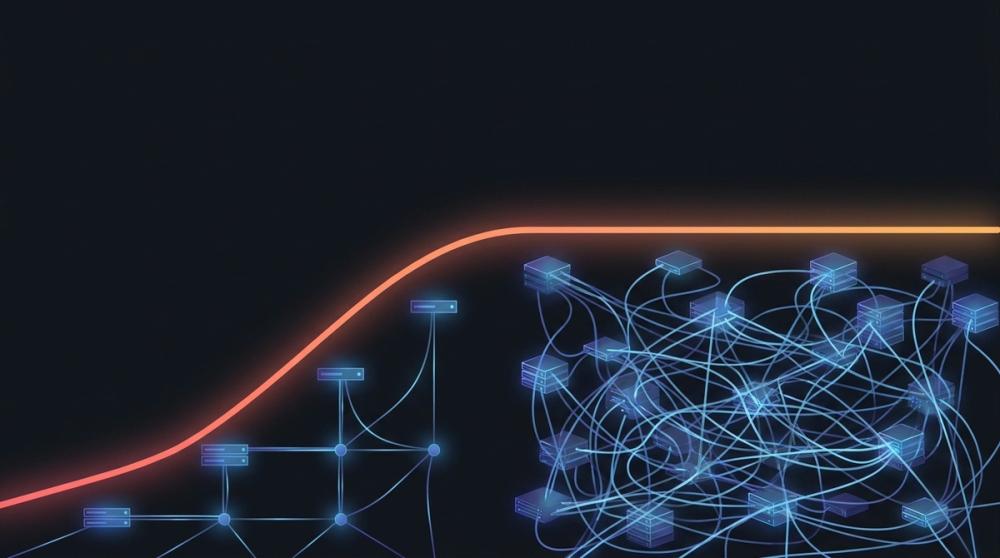
The MCP plateau is the point where adding more MCP servers to a coding agent stops improving output quality. Teams connect GitHub, Jira, Slack, and Confluence, see an early jump, then watch the curve flatten while token costs keep climbing. Developers feel the plateau as output that is almost right but not quite, which Stack Overflow's 2025 survey found is the single biggest frustration with AI tools, cited by 66% of developers (Stack Overflow, 2025). The protocol is doing its job; the plateau is a ceiling on what a transport layer can deliver on its own.
MCP itself is straightforward. The official documentation describes it as "a USB-C port for AI applications," a standardized way to connect AI systems to external tools and data (Model Context Protocol, 2025). Anthropic introduced it in late 2024 to replace the N-times-M mess of custom integrations with one protocol. That standardization is genuinely valuable, and adoption reflects it: GitHub's Octoverse 2025 counted more than 4.3 million AI-related repositories and a 178% year-over-year jump in projects using an LLM SDK (GitHub Octoverse, 2025). The plateau is not a failure of MCP. It is a category error about what MCP was designed to do.
Why does adding more MCP servers stop helping?#
More servers help until the agent has to reason across them, and then they stop, because each new server hands the agent another plausible answer with no way to arbitrate. The 2025 NoLiMa benchmark tested 13 models that claim 128K+ contexts and found performance degrades well before the window is full: at 32K tokens, 11 of the 13 fell below half of their short-context baseline (NoLiMa, 2025).
Picture the failure. Your repo says the retry limit is 3. A Confluence runbook says 5. A Slack thread says the team agreed on 7 but never shipped it. Three MCP servers each return their answer, faithfully. The agent picks one, usually whichever came back first, and answers with confidence. Nothing flags the conflict, nothing marks the stale source, and the engineer trusts a wrong answer because the agent sounds certain. Adding a fourth server does not fix this. It adds a fourth voice to an argument no one is refereeing.
Is MCP a context engine? No, and here's the difference.#
MCP is a transport layer, not a context engine. It defines how an agent connects to a tool and moves data across the wire. A context engine defines what happens above the wire: which source is authoritative, how conflicts resolve, who is allowed to see what. Confusing the two is why so many teams hit the plateau expecting a thirteenth server to do a reasoning layer's job.
The distinction matters because the work that produces a correct answer is reasoning work, not fetching work. Anthropic frames context engineering as "curating what will go into the limited context window from a universe of possible information," and curation is the operative word (Anthropic Engineering, 2025). MCP fetches. Something above it has to rank, resolve, and synthesize. That something is a context engine, and it consumes MCP rather than replacing it.
What can't MCP do on its own?#
MCP cannot rank authority, resolve conflicts, enforce query-time permissions, or synthesize across sources, because none of that is transport. The result is that access does not equal understanding: Stanford researchers found leading AI legal tools still hallucinated more than 17% of the time even with retrieval over trusted databases (Stanford Law, 2025).
Three gaps show up fastest. First, tool-description quality: an agent wired to dozens of servers spends tokens loading definitions before it reads your request, which is exactly the 150,000-token overhead Anthropic measured. Second, context-window bloat: more connected tools mean more tokens spent on retrieval, which the context-rot research shows actively degrades reasoning. Third, permission bleed: a server authenticated as a service account returns whatever that account can see, not what the asker is allowed to see. Gartner predicts more than 40% of AI-related data breaches will stem from improper cross-border use of generative AI by 2027 (Gartner, 2025). A transport layer cannot enforce a permission it never sees.
MCP server vs context engine: how do they compare?#
The clearest way past the plateau is to separate what a transport does from what a reasoning layer does. An MCP server gives an agent raw access. A context engine gives it decision-grade context: synthesized, conflict-resolved, permission-aware understanding it can act on directly. The six requirements below are where the two diverge.
| Requirement | MCP server (transport) | Context engine (reasoning) |
|---|---|---|
| Unified context | One source per server, unmerged | Single query across all sources |
| Conflict resolution | Returns every answer, picks none | Ranks authority, flags stale sources |
| Targeted retrieval | Shallow list or snippet | Traverses related paths, ranks by relevance |
| Data governance | Server-account permissions | Query-time, per-user permission checks |
| Token optimization | Loads all tool definitions upfront | Retrieves only what the task needs |
| Personalized relevance | Same result for everyone | Weighted to the asker's role and history |
Read across any row and the plateau explains itself. A team stacking servers is buying more of column two when the wrong answers are coming from the absence of column three.
When do you need both MCP and a context engine?#
You need MCP whenever an agent talks to a tool, and you need a context engine the moment two of your sources can disagree. For a solo developer pointing an agent at one repo, plain MCP is enough and no reasoning layer is required. The threshold is contradiction, not company size.
Most engineering orgs cross that threshold fast. DORA's 2025 report found 90% of respondents now use AI at work, yet AI adoption correlated with a negative effect on delivery stability, because AI amplifies whatever a team already has (DORA, 2025). Adoption is not the hard part: McKinsey's 2025 State of AI found 88% of organizations use AI, but only about 6% qualify as high performers capturing real value (McKinsey, 2025). The differentiator is what the agents can actually see. If your context is fragmented and contradictory, more agents reach more wrong conclusions, faster. This is where a context engine earns its place. Unblocked sits above MCP as the first MCP your agents query, unifying PRs, Slack, Jira, Notion, and Confluence into one conflict-resolved answer with permissions enforced at query time. Sam Younger, Engineering Manager at UserTesting, described it this way: "Unblocked is the first MCP queried for everything we look up. It's not just checking the code, the code could be wrong. It pulls the Confluence docs, the feature planning documents, the Slack conversations."
Frequently asked questions about the MCP plateau#
Is the MCP plateau a flaw in the protocol?#
No. MCP does exactly what it was designed to do: standardize the connection between agents and tools. The plateau appears when teams expect that transport layer to also do reasoning, ranking, and permission enforcement. Those are application concerns the spec deliberately leaves out. Hitting the plateau means you have outgrown transport, not that transport is broken.
MCP vs RAG: are they the same problem?#
No. RAG retrieves relevant text and stuffs it into the prompt. MCP standardizes how an agent calls tools and data sources, which may include a RAG system. Both stop at retrieval. Neither resolves conflicts between what they retrieve, which is why both can hit a quality ceiling once sources disagree. A context engine adds the arbitration layer on top of either one.
How many MCP servers is too many?#
There is no fixed number, but the pain usually starts around five to eight overlapping sources, when contradictions become common and permission scopes get messy. Below that, plain MCP is often fine. Above it, each new server tends to add another wrong-but-plausible answer faster than it adds value. The signal to watch is token cost rising while answer quality stalls.
Does a context engine replace my MCP servers?#
No, it consumes them. A context engine treats MCP servers as one class of input, then ranks authority, resolves conflicts, applies permissions, and synthesizes across them. The two layers are complementary: MCP handles the fetch, the context engine handles the reasoning about what the fetch returned.
Getting past the plateau#
The teams still adding servers are asking the wrong question. "Which MCP server do we connect next?" has a ceiling, and most orgs running ten or more integrations have already found it. The better question is what the layer above MCP needs to do, because that is where correct answers actually come from: authority ranking, conflict resolution, query-time permissions, and synthesis across every source at once.
MCP is good infrastructure, and it is not going away. Treat it as the transport it is, then put a reasoning layer on top that turns raw access into decision-grade context. If your agents are still wrong after a dozen integrations, the fix is not a thirteenth server. To go deeper, read why MCP servers aren't enough, MCP tool overload, and our context engineering guide.