Context7 for Internal Docs: Can It Cover Your Own Code, PRs and Slack?
Engineers who like Context7 ask for the same thing over their own code and docs. Context7 now indexes private repos and Confluence on paid plans. Here is what that covers, what it leaves out, and how to pick by situation.


Key Takeaways
• Context7 now supports private sources: Pro and Enterprise teamspaces can index private Git repos, Confluence and OpenAPI specs, starting at $10 per seat a month.
• That covers reference docs well: SDK usage, README setup steps, API specs, versioned examples.
• It does not index Slack, Jira, Linear or PR review threads, and in the cloud product access is set by teamspace role.
• Internal knowledge is a conflict and permissions problem. Library docs are a lookup problem. Different problems want different tools.
• The two can run side by side: Context7 for library and SDK reference, a context engine for the why behind the code.
"Can we get Context7 for our internal code and docs?" Yes, partly, and the part it covers is the easy part. Context7 for internal docs exists today. On its Pro plan ($10 per seat a month, per Context7's plans page) and Enterprise plan, it indexes private Git repos, Confluence spaces and OpenAPI specs. Your agent reaches them through the same MCP server it uses for public libraries. That handles reference lookup over your SDKs and READMEs. It does not reach pull request threads, Slack, tickets or the wiki nobody has touched since the last re-org, and that is where many of the hard questions live.
What is Context7 and how does it work?#
Context7 is an MCP server and CLI from Upstash that gives coding agents current, version-specific documentation and code examples for libraries, so the agent stops guessing at APIs from its training data. The Context7 GitHub repository describes two tools: resolve-library-id, which maps a name like "next.js" to a Context7 library ID, and query-docs, which returns the matching docs and snippets for a question. Both work over MCP or through the ctx7 CLI.
The problem it solves is real. An April 2026 benchmark tested 270 real API updates across eight Python libraries. Without full documentation, models wrote executable code only 42.55% of the time (Ashik et al., arXiv 2604.09515).
The repository holds only the MCP client code, under an MIT license. The README says the backend, parsing engine and crawling engine "are private and not part of this repository." Context7 is a hosted lookup service over documents someone has already written.
Can you use Context7 for our internal code and docs instead of public library docs?#
Yes, on a paid plan. Context7's private sources guide lists six source types: GitHub, GitLab, Bitbucket, any other Git URL, Confluence and OpenAPI. You add them from a teamspace's Sources tab. A "Generate docs" option writes documentation from source code for repos that have little of it, and the guide notes that each refresh with new commits runs that generation again and is billed again. Parsing private sources costs $5 per million parsed tokens on top of the seat price, per the plans and pricing docs.
The limits are worth reading before you buy:
- Refresh is manual in the cloud product. Owners and admins click a source's refresh icon, and Context7 re-parses it, charging only for changed content. Its internal docs guide (updated 2026-10-23) describes automatic updates that check each repo's branch on a schedule as part of the on-prem install. Those updates cover Git repos only; Confluence spaces and OpenAPI specs update on demand.
- Access is by teamspace role. The teamspace docs define Owner, Admin and Developer roles. Pro caps a teamspace at 10 members. Per-user restrictions by SSO group are described for on-prem deployments.
- The source list stops at docs and code. Slack, Teams, Jira, Linear and PR review discussions are not on it.
If your internal SDK has a README and an OpenAPI spec and agents keep inventing method names, Context7 is a fair answer.
Why is internal knowledge a different problem from library docs?#
Library docs are a lookup problem. For a given version of React or Stripe's SDK there is one published answer, and the job is to fetch the right page for the right version. Context7 is built for exactly that.
Internal knowledge is the record of how your company's software works and why: decisions made in PR reviews, trade-offs argued in Slack, constraints logged in tickets, runbooks, and design docs of varying age. It rarely has one published answer. The 2026 Stack Overflow Developer Survey asked what stops developers finding context. Outdated information came in at 56.5%, scattered tools at 53.4%, conflicting versions of the truth at 25.4% and blocked permissions at 15.8% (survey data). Prior decisions were the third most-needed kind of context.
That makes internal knowledge a conflict problem and a permissions problem. A design doc from 2024 says the payments service retries three times. A Slack thread from last month says the team cut it to one after an incident. The README was never updated. An index that returns all three hands the agent a contradiction to settle with no signal for which one is current. And the Slack thread may sit in a channel half the team cannot see, so the answer has to respect that too.
Stale context also does active harm. In a May 2026 study, stale-only retrieval pushed one model to reference outdated helper signatures in 15 of 17 samples (Weng et al., arXiv 2605.14478). More on that in how to stop agents using stale documentation.
What are the options for giving coding agents internal docs?#
The table below compares the common routes. Each one indexes something different. Methodology: every price and limit below comes from the vendor's own pricing or docs page, checked on November 2, 2026.
| Tool | What it indexes | Private/internal support | Starting price | Free tier |
|---|---|---|---|---|
| Context7 | Public library docs; on paid plans, private Git repos, Confluence, OpenAPI specs | Pro and Enterprise teamspaces; on-prem on Enterprise | $10 per seat/month plus $5 per 1M parsed tokens | 1,000 API calls/month, public libraries only |
| Grounded Docs (self-hosted docs MCP) | Websites, GitHub repos, npm and PyPI packages, local folders and archives | Runs on your machine with a local index | Free (MIT); you pay your embedding provider | Yes, open source |
| Atlassian Rovo MCP Server | Jira, Jira Service Management, Confluence, Bitbucket, Loom | OAuth 2.1; respects each user's existing permissions | MCP calls consume Rovo credits | No separate free tier listed |
| Notion MCP | Pages in your Notion workspace | OAuth; works on content the user can access | No separate MCP price listed | Not stated on the MCP docs |
| CLAUDE.md, AGENTS.md, rules files | Whatever your team writes into the repo | Lives in the repo | Free | Yes |
| Mem0 | Memories an agent saves across sessions | Open source self-host; on-prem on Custom plan | Custom plan by quote | Free plan with monthly add and retrieval limits |
| Unblocked | Code, PRs, issues, docs, Slack or Teams, incidents | Permissions mirror the source systems | $29 per user/month (annual) | 21-day free trial |
Sources: each vendor's docs linked in this post, plus Mem0 pricing and Unblocked pricing.
Where do self-hosted doc servers, Confluence and Notion MCPs, and rules files fit?#
Each one solves a slice of the internal docs problem.
A self-hosted doc server such as Grounded Docs is Context7's shape run on your own hardware. Its README says it keeps its index in a local SQLite database and sends document text only to the embedding provider you configure. It is a good fit when docs cannot leave your network and you have someone to run it.
Confluence and Notion MCPs search the live system, so there is no index to keep fresh. The Atlassian Rovo MCP Server says all actions "respect users' existing access controls and permissions," which solves permissions for that one system. Notion MCP likewise reads and updates only content the signed-in user can access. The agent still has to reconcile what comes back with Slack and the code. Our Confluence MCP guide covers setup.
Rules files carry the conventions you already know. Claude Code's memory docs suggest keeping each CLAUDE.md under 200 lines, because longer files use more context and reduce adherence. That fits coding standards and a few key facts, and little else. If the agent skips them, see why agents ignore CLAUDE.md rules.
Frequently asked questions about Context7 for internal docs#
Context7 vs Mem0 vs a company context engine for coding agents: what's the difference?#
They answer three different questions. Context7 answers "how does this library or SDK work at this version?" from written docs. Mem0 answers "what did this agent or user learn before?" from memories saved across sessions; its docs describe it as long-term memory that persists across sessions, tools and runs. A company context engine answers "how does our system work, and why is it this way?" by reading code, PRs, tickets, docs and chat, then settling conflicts between them. Our memory MCP servers comparison goes deeper on the memory side.
Does Context7 respect our GitHub or Confluence permissions?#
In the cloud product, access is set at the teamspace level by role, and private libraries belong to the teamspace that added them. A member who signs in under their personal teamspace sees none of them. The on-prem install adds library restrictions by SSO group or user. Neither is described as mirroring each person's permissions in the source system.
Can I self-host Context7?#
Yes, on Enterprise. Context7's pricing docs say to contact context7@upstash.com for self-hosting or teamspaces over 50 members. The open source repo alone does not include the backend.
Does Context7 index Slack, Jira or pull request discussions?#
No. Its private source types are Git repos, Confluence and OpenAPI specs, and its internal docs guide adds PDF and Word uploads through the API.
Where does a context engine fit next to Context7?#
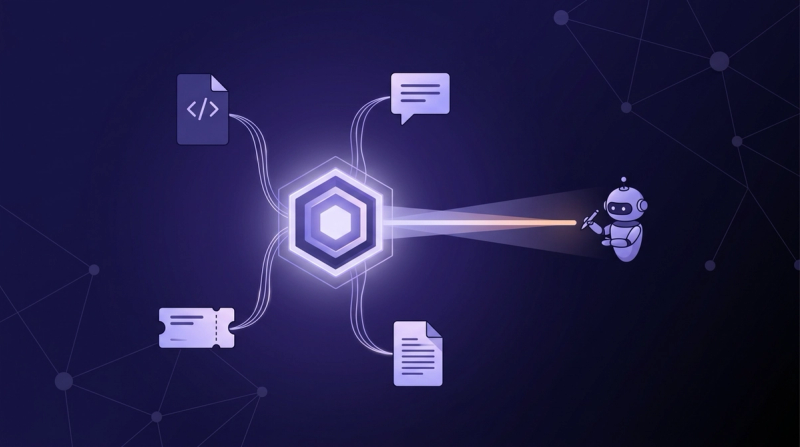
A context engine is a service that reads across code, pull requests, tickets, docs and chat and works out which source is current when they disagree. It returns one cited answer, filtered by what the asking user is allowed to see. It is built for the conflict and permissions problem described above.
Unblocked is a context engine built for engineering teams. It connects to GitHub, GitLab, Jira, Linear, Confluence, Slack, Microsoft Teams, Sentry and other sources, and its documentation states that access controls mirror the source systems. Agents reach it through one MCP server in Claude Code, Cursor, VS Code, JetBrains, Codex and Windsurf, and people use it from Slack and the web. Asked why the payments service retries once, it can point to the incident thread and the PR that made the change.
Tushar Kawsar at UserTesting describes the workflow this enables:
My workflow is: here's the Jira ticket, here's the Confluence doc, here are the Slack threads — now build me a plan. Unblocked pulls all of that together so the agent starts with the full picture. Without it, I'd estimate I'm 20 to 30 percent less productive.
Tushar Kawsar — Software Engineer, UserTesting
That figure is his own estimate, shared with Unblocked in March 2026, and was not measured in a controlled test. For a wider look at the category, see our roundup of context retrieval tools for AI coding agents and how a context engine compares with direct GitHub, Confluence and Slack MCPs.
Which option should you pick for your situation?#
Match the tool to the question your agent keeps getting wrong.
- It invents methods in a public library. Context7 Free. That is the job it was built for.
- It invents methods in your internal SDK, and the SDK has decent docs. Context7 Pro, with the repo and its OpenAPI spec added to a teamspace. Budget for the parsing cost and a manual refresh habit.
- Docs cannot leave your network and you have platform engineers. A self-hosted doc server like Grounded Docs, or Context7 Enterprise on-prem if you want vendor support.
- Most answers live in Confluence or Notion and nowhere else. The vendor's own MCP server, which keeps that system's permissions.
- It breaks team conventions. Write them into CLAUDE.md or AGENTS.md and keep the file short.
- It repeats mistakes from earlier sessions. A memory layer such as Mem0.
- It gets the "why" wrong: reverts a decision, ignores an incident, misses a constraint from a ticket. A context engine. No document index fixes this, because the answer is spread across sources that disagree.
You may end up running two or three of these. Our list of MCP servers for engineering teams shows how they combine.
Start with the question your agent got wrong last week#
Pull up the last three times a coding agent gave a confidently wrong answer about your own system. If the miss was a method signature or a config flag in a documented SDK, Context7 for internal docs will likely fix it for $10 a seat plus parsing. If the miss was a decision, an incident, or a constraint someone mentioned in a ticket, an index of docs will hand the agent the same stale page again. That second kind of miss is where a context engine earns its place, by connecting code, discussions, tickets and docs in one query so the agent starts from what your team actually decided.