Context for Support and Ops Agents: One Source for Every Agent You Run
How to give support bots, ops runbook agents, and internal Q&A the same organizational context your coding agents use: four approaches compared, and the Slack deflection case to start with.

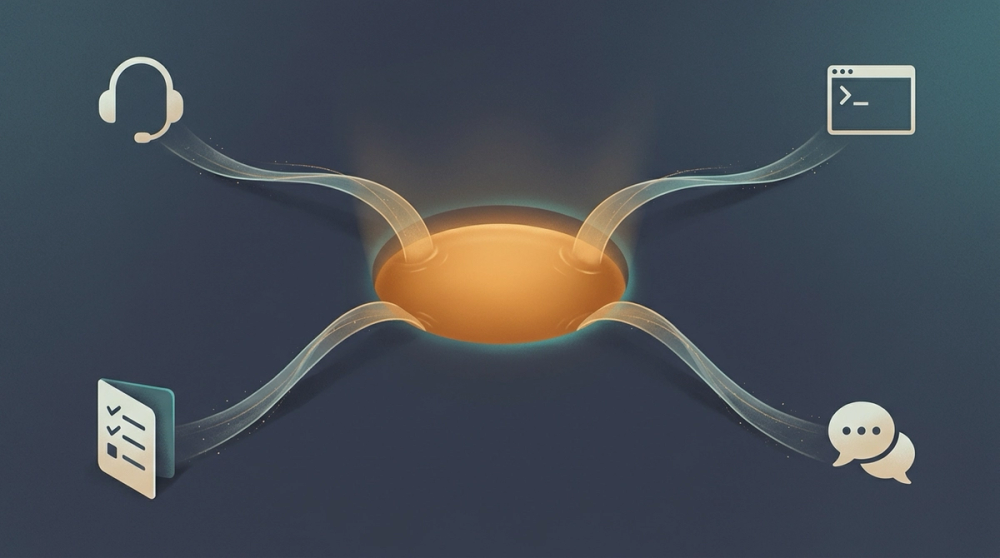
The short version: support, ops, and internal Q&A questions nearly all resolve to engineering systems, so build one context layer and let every agent query it with the asker's permissions enforced. Support-platform AI and help-center RAG only see the documents someone remembered to write. Start with the Slack channel where support and sales ask engineering the same questions every week.
Context for support agents is the same thing it is for coding agents: a governed, permission-scoped answer assembled from your code, pull requests, tickets, and Slack history, delivered to whichever agent is asking. The asker might be a support bot, an on-call runbook agent, or an internal Q&A assistant in Slack. The phrasing differs; the sources that answer are the same. This guide covers how to give non-coding agents that context, the four honest ways to do it, and which case to start with. Our guide to centralizing context for coding agents handles the developer side; this one extends the idea to everyone else.
How do we give non-coding AI agents (support, ops) access to organizational context?#
Give them a query endpoint rather than a document pile. AI spending by customer service leaders rose 38% while overall service budgets rose 2%, according to Gartner's August 2026 survey (Gartner). Most of that spend buys an agent that reads a help center. The gap is everything the help center doesn't say.
Three questions show the pattern. "Why does this customer's export fail?" resolves to the PR that changed the CSV encoder and the ticket that explains the limit. "Who owns this service?" resolves to a CODEOWNERS file and the Slack thread where ownership moved last quarter. "What changed before the incident?" resolves to a deploy log and three merged pull requests. None of those live in a knowledge base article. A bot that only reads articles answers "I'm not sure" or, worse, answers from a page that was true in March. The practical move is to give non-coding agents the same context endpoint your coding agents already query, scoped to what the asking person may see.
Why do support and ops questions resolve to engineering systems?#
Because the knowledge was produced there. The 2026 Stack Overflow Developer Survey lists "answering straightforward technical questions" as a top-five AI task at 59% of respondents (Stack Overflow). Those questions come from support, sales, and ops as often as from other engineers, and they arrive in Slack.
Plain's January 2026 guide to scaling support in Slack names the breaking point: "Engineers get pulled in constantly," with no escalation structure as the root cause and development velocity as the cost (Plain). Ops has the same shape. incident.io's 2026 guide describes the incident lifecycle running inside Slack and recommends surfacing runbooks in-channel so responders don't leave the room (incident.io). The runbook, the ownership answer, and the "what changed" answer all sit in git, the tracker, and chat. Context for support agents has to come from those primary sources, or it comes from a summary that aged the day it was published.
Context tools for AI support agents answering from company knowledge#
The support platforms themselves are the first option, and they are better than their reputation. Intercom's Fin draws on public and internal articles, snippets, PDFs, website crawls, and internal articles synced from Confluence, Guru, and Notion (Intercom docs). Zendesk's advanced AI agents connect a help center plus external sources brought in through a crawler or connector (Zendesk docs).
Read the sync cadence closely, because it sets the ceiling. Intercom's docs say natively created articles are ingested almost instantly while website sources are "only updated weekly." Zendesk's docs say a connected help center is searched live, but an external source is searched "as of the last sync, which usually happens every 24 hours," and too many sources can reduce accuracy. Both platforms are specialists in your published documentation: the right design for "how do I reset my password," the wrong one for "why did this account's export fail last night," because that answer isn't in a document yet. Neither reads pull requests, deploy logs, or engineering Slack, and neither claims to.
What does RAG over a help center miss?#
A homegrown retrieval pipeline over your help center removes the vendor ceiling and keeps the document ceiling. Anthropic's March 2026 context-engineering cookbook frames context as "finite with diminishing marginal returns," where the discipline is "finding the smallest set of high-signal tokens" (Anthropic). Retrieval over articles optimizes the wrong corpus.
Three things go missing. Recency: a help center is a copy of what engineering knew when someone last wrote it down, and the thread that overrode it lives in Slack. Conflict: when the article says one thing and last week's PR says another, plain retrieval returns both and lets the model guess. Permissions: a customer-facing bot and an internal ops agent should not retrieve the same passages, and a flat vector index has no idea who is asking. Teams usually discover all three the week the bot cites a deprecated page. The longer comparison is in context engine vs RAG. Retrieval is a component; context for AI support agents is the synthesized, permission-checked answer that comes out the other end.
How do the four approaches compare?#
The table compares the four honest routes on the axes that decide the choice. Enterprise search tools (Glean and its peers) index everything a user can see and return ranked results, which is useful for people and thin for agents; the full argument is in context engine vs enterprise search.
| Axis | Support-platform AI (Fin, Zendesk) | RAG over a help center | Enterprise search (Glean-style) | Context engine |
|---|---|---|---|---|
| Sources | Help center, synced docs, PDFs | Whatever you index, usually docs | Most SaaS apps, ranked results | Code, PRs, tickets, Slack, docs, incidents |
| Freshness | Live for native content; daily or weekly for synced | Your re-index schedule | Connector crawl cadence | Continuous, recent weighted higher |
| Conflict handling | None; answers from the article | None; returns passages | None; returns ranked hits | Reconciles sources into one cited answer |
| Permissions | Platform roles | You build it | Per-user search ACLs | Per consumer, inherited from each source |
| Serves coding agents too | No | Not without rework | Weakly | Yes, same endpoint over MCP |
| Best for | Customer-facing FAQ deflection | Teams with one clean corpus | Human search across apps | Support, ops, Q&A, and coding agents on one source |
Pick the top row if your questions are answerable from published docs. Pick the bottom row if your questions are "why" and "what changed."
One context source serving coding agents, support bots, and internal Q&A: does this exist?#
Yes, and Anthropic made the architecture argument for it in April 2026. Their Managed Agents post describes decoupling the "brain" (the model and its harness) from the "hands" (sandboxes and tools) so that "brains can pass hands to one another" and many agents share infrastructure (Anthropic). Context is the hand every brain needs.
Drata is a working example on the knowledge side. Their engineering knowledge was spread from source-code docs to Slack channels across a distributed team; with Unblocked the team saves one to two hours per engineer each day and onboards 30% faster (Drata customer story). The same connected sources answer support and ops questions, because an ops agent asking "what changed before the incident" runs the query an engineer would have run by hand. Unblocked exposes that as one endpoint: institutional memory across Slack, Jira, Notion, Confluence, GitHub, and S3, queried over MCP by Claude Code, in Slack by a support lead, and by whatever runbook agent you point at it. One connection per source, answers reconciled, permissions inherited per consumer.
Best context platforms for agentic applications beyond coding#
Judge platforms by four requirements rather than connector count. Forrester's Q1 2026 Wave on customer service solutions describes the flipped model where "AI addresses the majority of the work, while CSRs assist AI" (CX Today). An AI doing most of the work needs most of the context.
- Permission enforcement per consumer. A customer-facing bot, an internal support agent, and an on-call engineer each get a different slice of the same source, inherited from that source.
- Synthesis with citations. When the article and the PR disagree, the platform returns one answer and shows which source won.
- Freshness without re-index projects. This morning's Slack thread should outrank last year's wiki page.
- One endpoint for every agent type. Two systems means two sources of truth reconciled by hand.
Support-platform AI meets the first and fourth inside its own walls. Enterprise search meets the first and third, for humans. A context engine is built to meet all four, which is why the context for support agents should be the system your coding agents already use.
Support and sales keep asking engineering the same questions in Slack. What deflects this with real answers?#
An agent in that channel that reads what the engineers would have read. Slack's own MCP server exposes message and channel search under user-level OAuth with scopes such as search:read.private (Slack docs). That gives an agent the thread history. It doesn't give it the PR the thread is about, and many teams can't hand a bot a private-channel search scope anyway.
Rally's CTO ran this experiment for his go-to-market team, with Slack, GitHub, Linear, and the help center connected:
Unblocked has saved me at least five to ten hours a week in the worst weeks. I used to be the equivalent of Unblocked in our product-questions channel. I've reduced the time I spend in there by about 90%. I'm only in there to confirm responses now. As I've gained trust, I know the answers are going to be directionally correct, answered in a really similar way to how I would.
Alec Robins — CTO & Co-founder, Rally
At one 420-engineer fintech evaluating the same pattern, engineers described a 60 to 80% answer-completion rate on internal support channels. The mechanics are simple. Install the agent where support and sales already ask. Let it answer with citations. Have one engineer confirm for two weeks. What remains is the real escalation volume. Our Slack MCP guide covers the connector route if you want to start smaller.
How do you enforce permissions when one source feeds many agents?#
Inherit them from the source, per request. Gartner's January 2026 outlook predicts GenAI cost per resolution will exceed $3 by 2030, above many offshore human agents (Gartner). A resolution that leaks a private channel costs far more than $3.
The failure mode is a single service account. Teams connect GitHub, Jira, and Slack once with an admin token, point every agent at it, and discover the customer-facing bot can read the incidents channel. The fix is a context layer that resolves each query as the asking identity: the support agent sees what the support team sees, the ops agent sees what on-call sees, the coding agent sees what its developer sees. Rally's CTO has said that safe codebase access for non-engineers, without GitHub Enterprise seats, was the capability no other tool supported. Audit logs then record who asked what, which matters once a customer-facing answer is traced to its source. The deeper treatment is in our permission-aware context retrieval comparison.
FAQ#
Can Intercom Fin or Zendesk AI agents read our codebase or pull requests?#
No. Both answer from published and synced documentation: Intercom lists articles, snippets, PDFs, websites, and internal articles from Confluence, Guru, and Notion; Zendesk lists help centers plus crawled or connected sources. Neither reads git, PRs, deploy logs, or engineering Slack. Pair them with a context layer for those questions.
Is a context engine a replacement for our support platform?#
No. The support platform owns the customer conversation, routing, and the public knowledge base. The context layer supplies context for support agents on the questions the knowledge base can't answer, inside the platform and in the support channel. Most teams keep both.
How is this different from giving every agent its own MCP servers?#
Per-agent MCP servers give access, not answers. Each agent still reconciles conflicting results alone, holds its own credentials, and nothing checks permissions per consumer. Our Slack, Jira, and Confluence guide compares the per-tool route with a unified one.
What should an ops runbook agent be able to ask?#
Who owns this service, what changed in the last 24 hours, has this error been seen before and what fixed it, and which runbook applies. All four resolve to code history, PRs, tickets, and chat, which is why the ops agent belongs on the same endpoint as everyone else.
What to try this week#
Pick the one Slack channel where support or sales ask engineering the most questions, count a week of them, and sort each into "answerable from the help center" and "answerable only from code, PRs, tickets, or threads." The second pile is the case for shared context for support and ops agents, and it's usually the bigger one. Connect that channel's sources to one endpoint, let an agent answer with citations under the asker's permissions, and have one engineer confirm for two weeks. It surfaces what the team didn't know to look for, and the questions that remain are the ones that genuinely need an engineer.