How to Evaluate a Context Engine: The Buyer's Checklist
 Brandon Waselnuk·April 23, 2026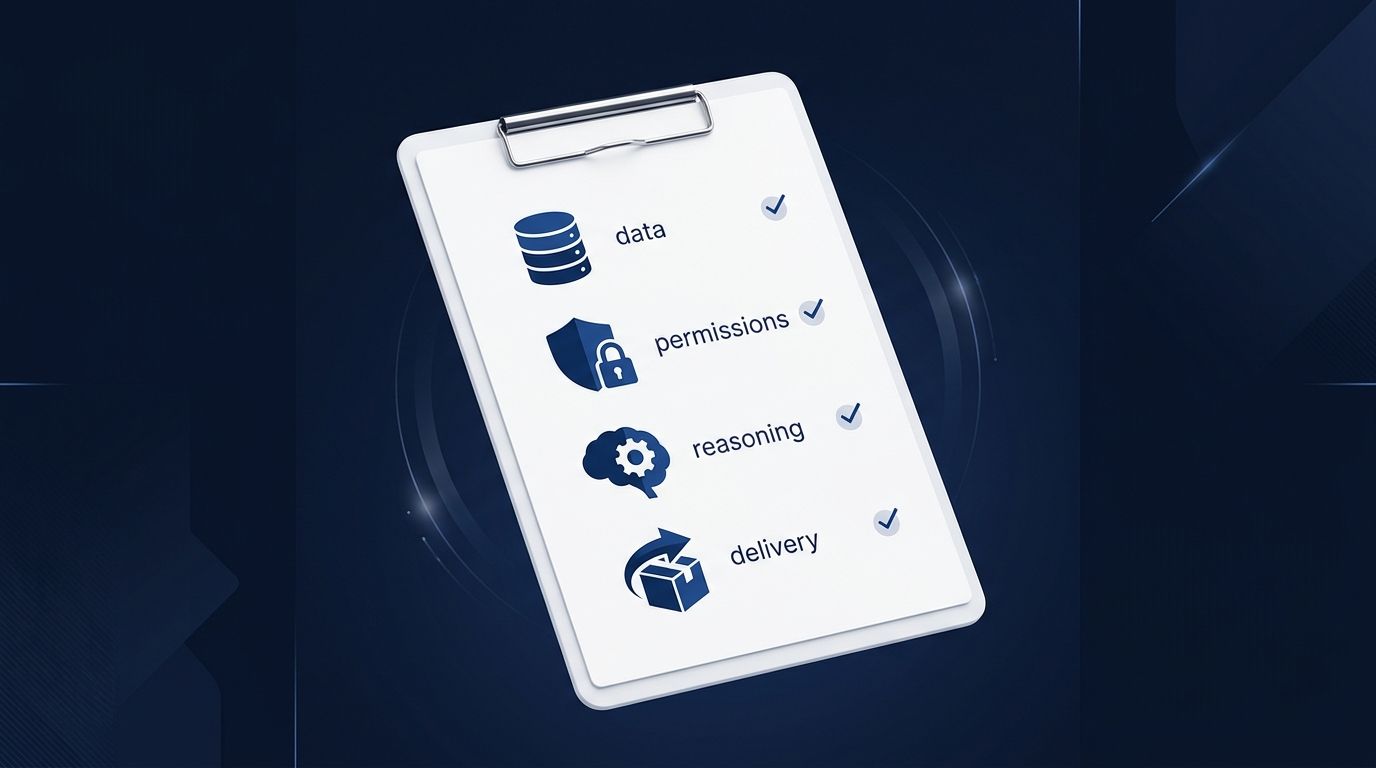
Key Takeaways
• A context engine must synthesize across sources, resolve conflicts, and enforce permissions, not just retrieve documents
• DORA 2025 found that teams with mature knowledge sharing deploy at twice the rate of low-maturity peers (DORA, 2025)
• Evaluate seven dimensions: data sources, conflict resolution, permissions, MCP delivery, retrieval-to-reasoning pipeline, freshness, and task-shaping
• Any engine that skips conflict resolution or permission enforcement is retrieval with a better label
• Ask for a live test against your own repos and tools during any vendor demo
How to Evaluate a Context Engine: The Buyer's Checklist
A context engine evaluation should answer one question: will this system give your agents and engineers decision-grade context, or just better search results? The category is new enough that most buyers don't have a framework for telling the difference. DORA's 2025 State of DevOps report found that teams with higher knowledge-sharing maturity deploy twice as frequently as their peers (DORA, 2025). Context engines exist to accelerate that knowledge flow. But not every product labeled "context engine" actually performs the job.
This checklist gives you seven evaluation criteria you can use in any vendor conversation. It's built from patterns we've seen across hundreds of engineering teams, not from theory. By the end, you'll know exactly what to test, what to ask, and what to watch for when the demo looks impressive but the architecture doesn't hold up.
For foundational definitions, see what is a context engine.
---
Why Does Evaluation Criteria Matter for Context Engines?#
The DORA 2025 report found that documentation quality and knowledge discoverability are statistically significant predictors of software delivery performance (DORA, 2025). Evaluation criteria matter because "context engine" has become an overloaded term. Without a structured framework, buyers end up comparing retrieval tools to reasoning systems.
DORA's 2025 State of DevOps report found documentation quality and knowledge discoverability are statistically significant predictors of delivery performance (DORA, 2025). Evaluation criteria must test conflict resolution, permission enforcement, and reasoning quality, not just retrieval speed.
Three vendors announced context engines in early 2026 alone. ServiceNow, Tabnine, and Unblocked each use the same label for architecturally different products. The category is moving fast enough that yesterday's RAG wrapper is today's "context engine" with a rebrand.
The cost of a wrong choice#
A bad context engine doesn't just waste license spend. It trains your team to distrust AI-assisted answers. Engineers who get burned by confidently wrong context stop querying the tool within weeks. You're left paying for shelfware while the knowledge silo problem stays untouched.
What good criteria look like#
Good evaluation criteria test the system's behavior, not its marketing claims. Can the engine prove it resolved a conflict between two contradictory sources? Can it show you which permissions it enforced on a specific query? Can it deliver that context to an AI coding agent through a standard protocol? Those are testable questions. "We use advanced AI" is not.
In evaluations we've observed, the single most revealing test is feeding the engine a question where two internal sources disagree. Does the engine surface the conflict, or does it silently pick one side?
Read more about decision-grade context as the standard to evaluate against.
---
What Data Sources Should a Context Engine Connect To?#
Stack Overflow's 2025 Developer Survey found that 84% of professional developers now use AI coding tools in some capacity (Stack Overflow, 2025). Those tools are only as useful as the context they receive. A context engine must connect to every system where engineering knowledge lives, not just the codebase.
Stack Overflow's 2025 survey reports 84% of professional developers use AI coding tools (Stack Overflow, 2025). A context engine must connect to six source categories, including code, PRs, chat, tickets, docs, and incidents, to ground answers in the full engineering knowledge base.
The minimum viable source set for an engineering context engine includes six categories.
The six source categories#
- Code and version control. Git history, branches, diffs, blame annotations. The engine needs to read not just current files but the change history that explains them.
- Pull requests and code review. Review comments capture the reasoning behind changes. They're often the only record of rejected approaches and architectural trade-offs.
- Chat and messaging. Slack, Teams, or Discord threads contain the informal decisions that never make it into docs. A context engine that skips chat misses the connective tissue.
- Issue trackers. Jira, Linear, GitHub Issues. These systems track intent: what was the goal, who owned it, and what blocked progress.
- Documentation. Notion, Confluence, Google Docs, internal wikis. These are often stale, which is exactly why the engine needs them. Staleness detection is a feature, not a limitation.
- Incident management. PagerDuty, Opsgenie, incident postmortems. Production failures generate some of the most valuable institutional knowledge.
Depth versus breadth#
Don't just count integrations. Ask how deep the connector goes. A shallow Slack integration that indexes messages but ignores threads, reactions, and file attachments misses the most important signals. A shallow Git integration that reads file contents but skips commit messages and diff hunks can't explain why code changed.
The most overlooked data source in context engine evaluations is code review commentary. PR discussions contain the highest density of architectural reasoning per word of any engineering artifact. Yet most RAG-based tools skip them entirely because review comments are hard to chunk and embed meaningfully.
For an architectural comparison, see context engine vs RAG.
---
Does It Resolve Conflicts Between Sources?#
Google DeepMind's 2025 research on retrieval-augmented generation found that naive RAG pipelines propagate source conflicts directly into model outputs, producing contradictory or fabricated answers (Google DeepMind, 2025). Conflict resolution is the single hardest job a context engine performs, and the one most often skipped.
Google DeepMind's 2025 research found naive RAG pipelines propagate source conflicts directly into model outputs (Google DeepMind, 2025). Conflict resolution is the hardest job a context engine performs and the capability most often missing from retrieval wrappers.
Engineering organizations generate contradictory knowledge constantly. The README says the service uses PostgreSQL. The migration script targets MySQL. The last Slack conversation says the team decided to move to DynamoDB next quarter. Which source is authoritative?
How conflict resolution should work#
A real conflict-resolution system does three things. First, it detects the contradiction. Second, it weighs each source by recency, authority, and proximity to the actual codebase. Third, it surfaces the conflict to the user with its reasoning visible, rather than quietly choosing a winner.
Ask the vendor: "If my wiki says one thing and my latest merged PR says the opposite, what does your engine return?" If the answer is "whichever the vector similarity score ranks higher," that's retrieval, not reasoning.
Testing conflict resolution in a demo#
Seed a contradiction before the demo. Update a Confluence page to state one architecture pattern. Merge a PR that implements a different one. Then ask the engine about that component. A strong engine will flag the disagreement. A weak one will confidently cite the wrong source.
---
How Does It Handle Permissions and Access Control?#
GitHub's 2025 Octoverse report found that the average enterprise organization has over 1,000 repositories with varied access levels (GitHub, 2025). A context engine that indexes private repos and restricted Slack channels must enforce source-level permissions on every query. Anything less is a data leak waiting to happen.
GitHub's 2025 Octoverse report shows the average enterprise manages over 1,000 repositories with varied access levels (GitHub, 2025). A context engine must enforce source-level permissions at retrieval time, before any content reaches the model, to prevent data leakage.
Permission enforcement isn't a nice-to-have. It's a hard requirement for any team operating in a regulated industry or any company with confidential project channels.
Identity-aware versus post-filter#
There are two architectural approaches. Identity-aware systems check the querying user's permissions at retrieval time, before any context reaches the model. Post-filter systems retrieve everything first and strip unauthorized results afterward. The difference matters because post-filter architectures risk leaking information through summarization. If the model saw the restricted content before the filter ran, traces of that content can appear in the output.
Ask the vendor: "Does the model ever see content the requesting user can't access?" If the answer is anything other than an unqualified no, probe deeper.
SSO and identity federation#
The engine should inherit identity from your existing SSO provider. Building a separate user-permission mapping is fragile and drifts immediately. Look for native integration with Okta, Azure AD, or Google Workspace identity, not a manual CSV import of user permissions.
For more on context engine architecture, see what is a context engine.
---
Can It Deliver Context to AI Coding Agents via MCP?#
Anthropic's Model Context Protocol specification saw adoption by over 1,000 tool integrations within its first year (Anthropic, 2025). MCP has become the standard transport layer for delivering external context to AI coding agents. If a context engine can't serve its output through MCP, it's locked out of the fastest-growing agent ecosystem.
Anthropic's Model Context Protocol saw adoption by over 1,000 tool integrations in its first year (Anthropic, 2025). A context engine must serve synthesized, decision-grade answers through MCP, not just raw search results wrapped in the protocol format.
MCP matters because AI coding agents, whether Claude Code, Cursor, Windsurf, or custom agent chains, need a standard interface for requesting and receiving context. Without it, every integration is bespoke glue code that breaks with each agent update.
What MCP delivery looks like#
A context engine with MCP support exposes its reasoning output as MCP tool calls. An agent asks a question. The MCP server routes it to the engine. The engine retrieves, resolves, and shapes the answer. The agent receives decision-grade context, not a list of raw documents.
The key test: does the engine return a synthesized answer through MCP, or does it just expose raw search results wrapped in the MCP protocol? The protocol is the delivery truck. What's inside the truck matters more.
Beyond MCP: IDE and workflow surfaces#
MCP isn't the only delivery surface. Evaluate whether the engine also delivers context inside your IDE, your CI/CD pipeline, and your incident response workflow. The best engines surface context wherever decisions happen, not just wherever an agent happens to be running.
But how do you know whether the answers the engine delivers are actually reliable? That depends on what happens between retrieval and response.
---
What Does the Retrieval-to-Reasoning Pipeline Look Like?#
JetBrains' 2025 Developer Ecosystem Survey found that 76% of developers using AI assistants still manually verify AI-generated output before committing it (JetBrains, 2025). That verification tax exists because most AI tools return retrieval, not reasoning. The pipeline between retrieval and response determines whether a context engine produces answers worth trusting.
JetBrains' 2025 survey found 76% of developers manually verify AI output before committing (JetBrains, 2025). A complete retrieval-to-reasoning pipeline includes ingestion, retrieval, conflict detection, permission enforcement, and task-shaped synthesis.
A complete retrieval-to-reasoning pipeline has five stages. Each one is testable.
The five pipeline stages#
- Ingestion and indexing. The engine continuously syncs with connected sources. Ask about latency: how quickly does a merged PR appear in the engine's index? Minutes matter.
- Retrieval. The engine finds candidate sources using semantic search, keyword matching, or graph traversal. This is the step most tools stop at.
- Conflict detection. The engine compares retrieved sources and flags contradictions. This is where reasoning begins.
- Permission enforcement. Retrieved candidates are filtered against the requesting user's identity before the model sees them.
- Synthesis and task-shaping. The engine composes a single answer tailored to the agent's current task, citing specific sources and surfacing confidence signals.
What to ask about each stage#
For ingestion, ask for the sync latency SLA. For retrieval, ask about recall benchmarks on your own data. For conflict detection, ask for an example of a surfaced contradiction. For permissions, ask which identity provider they integrate with natively. For synthesis, ask to see the citation trail on a real answer.
David Knell, Distinguished Platform Engineer at Drata, observed the difference a mature pipeline makes: "Unblocked has improved our productivity and consistency across the board. It gives our engineers context that used to require interrupting someone senior or digging through three different tools."
Read more about the decision-grade context pipeline.
---
The Evaluation Checklist#
Gartner predicts that 33% of enterprise software applications will include agentic AI by 2028 (Gartner, 2025). As agent adoption accelerates, context engine selection becomes a load-bearing architectural decision. Use this checklist in any evaluation.
Gartner predicts 33% of enterprise software applications will include agentic AI by 2028 (Gartner, 2025). Evaluate context engines across seven dimensions: source breadth, source depth, conflict resolution, permissions, MCP delivery, pipeline stages, and freshness SLA.
| # | Criterion | What to test | Red flag |
| 1 | Data source breadth | Connects to code, PRs, chat, tickets, docs, and incidents | Only supports docs and code |
| 2 | Data source depth | Indexes threads, diffs, review comments, not just top-level objects | Shallow metadata-only connectors |
| 3 | Conflict resolution | Surfaces contradictions between sources with visible reasoning | Silently picks the highest-similarity result |
| 4 | Permission enforcement | Identity-aware at retrieval time, integrated with your SSO | Post-filter or manual permission mapping |
| 5 | MCP delivery | Serves synthesized answers through MCP, not raw search results | MCP-labeled but returns unprocessed document lists |
| 6 | Retrieval-to-reasoning pipeline | Five-stage pipeline with measurable latency at each stage | No conflict detection or task-shaping stage |
| 7 | Freshness SLA | New content indexed within minutes, not hours or days | Batch re-indexing on a nightly schedule |
How to score each criterion#
Rate each dimension on a three-point scale. Pass means the vendor demonstrated the capability against your own data. Partial means the capability exists but with limitations you'd need to work around. Fail means the capability is missing or the vendor couldn't demonstrate it live.
Any engine that fails on conflict resolution or permission enforcement should be disqualified regardless of how polished the demo looks. Those aren't features. They're architectural requirements.
Using the checklist in a demo#
Bring your own test cases. Connect the engine to a staging instance of your actual tools. Ask a question that requires synthesis across at least three sources. Seed a contradiction and see if the engine catches it. Check that a restricted channel's content doesn't leak into an unprivileged user's answer.
Stanford HAI's 2025 AI Index report noted that AI systems continue to struggle with complex multi-step reasoning and factual grounding despite gains on standard benchmarks (Stanford HAI, 2025). Your evaluation should test for exactly those failure modes.
For a comparison of three context engines across these criteria, see ServiceNow vs Tabnine vs Unblocked.
---
FAQ#
How long should a context engine evaluation take?#
A thorough evaluation takes two to four weeks. The first week covers vendor demos and technical architecture review. Weeks two through four involve a proof-of-concept against your own data sources. Rushing past the POC phase is how teams end up with tools that demo well but fail on real queries. DORA 2025 data shows knowledge-sharing maturity takes deliberate investment (DORA, 2025).
What's the difference between a context engine and enterprise search?#
Enterprise search returns a ranked list of documents. A context engine reads those documents, resolves contradictions, enforces permissions, and returns a synthesized answer. The output format is different: links versus explanation. For a detailed comparison, see context engine vs enterprise search.
Can a context engine replace our internal documentation?#
No. A context engine makes existing documentation more accessible and useful, but it doesn't eliminate the need to write and maintain docs. It does reduce the cost of stale documentation by weighing fresher sources like recent PRs and Slack threads more heavily. Think of it as a reader of docs, not a replacement for writing them.
Should we build or buy a context engine?#
Most teams should buy. Building a production-grade context engine requires expertise in multi-source ingestion, conflict resolution, permission enforcement, and LLM orchestration. GitHub's Octoverse data showing 1,000+ repos per enterprise org (GitHub, 2025) gives a sense of the integration scope. The build path makes sense only if context delivery is your core product.
For foundational context, see what is a context engine.
---
What to Ask in Your First Demo#
Evaluating a context engine isn't about watching a polished demo. It's about stress-testing the system against the messy reality of your own engineering organization. The seven criteria in this checklist give you a structured way to separate reasoning systems from retrieval wrappers.
Start your evaluation with three concrete steps. First, connect the engine to your actual tools, not a sample dataset. Second, seed a contradiction between two sources and see if the engine catches it. Third, test permission enforcement by querying as a user who shouldn't have access to a specific repo or channel.
The JetBrains finding that 76% of developers still manually verify AI output (JetBrains, 2025) tells you where the bar sits today. The right context engine should measurably lower that verification rate for your team. If it doesn't, keep looking.
Start exploring with what is a context engine.