How to Scale from One Agent to Parallel Agents Without Losing Quality
Multi-agent coordination improves parallelizable tasks by 81% but degrades sequential ones by up to 70%. Here are the coordination patterns that preserve quality.

In Brief:
• Multi-agent coordination improves throughput by up to 81% on independent tasks but degrades quality by 39-70% on sequential ones (Google Research, 2026)
• The fix is matching coordination topology to task structure, not adding more agents
• Parallelizable work (test generation, documentation, independent files) scales well
• Sequential work (multi-step refactors, dependent migrations) degrades
• Teams using shared context report 20-30% productivity uplift because every agent starts with the same institutional knowledge
Multi-agent coordination improves performance by 81% on parallelizable tasks and degrades it by up to 70% on sequential ones (Google Research, 2026). That single finding explains why teams trying to scale parallel AI agents keep getting worse results, not better. The instinct is obvious: one agent works, so five should work five times faster. Quality doesn't scale that way. It collapses when coordination patterns don't match task structure. This post breaks down where parallel agents actually help, where they fail, and the four coordination patterns that preserve quality when you're ready to scale.
Why does adding more agents sometimes make things worse?#
Google Research evaluated 180 agent configurations and found that multi-agent scaling benefits depend critically on task structure, not team size (InfoQ, 2026). For debugging, feature implementation with dependencies, and any workflow where step N depends on step N-1, adding agents degraded output quality by 39-70%.
Once you see it, the problem is obvious. Parallel agents can't coordinate in real time. Each one makes decisions based on its own slice of context. When those decisions conflict, the merged output is worse than what a single agent would have produced alone.
At QCon London, I watched three different teams present variations of the same failure. They'd parallelized their agent workflows, seen throughput double, and then spent weeks debugging the integration failures that followed. Throughput doubled. Quality fell off a cliff.
The three coordination failure modes#
A three-agent pipeline consumes roughly 29,000 tokens compared to 10,000 for an equivalent single-agent approach (Beam AI, 2026). Coordination cost is not free, and it compounds with every agent you add. Three failure modes account for most multi-agent breakdowns.
Context fragmentation#
Each agent in a parallel workflow receives a different slice of context. Agent A knows about the database schema changes. Agent B knows about the API contract. Neither knows what the other is doing. The result: individually correct code that breaks when combined.
Coordination overhead#
A four-agent pipeline accumulates roughly 950ms of coordination overhead while actual processing takes only 500ms (Beam AI, 2026). You're spending more time coordinating than computing. Token costs follow the same pattern, nearly tripling in the three-agent case.
Output conflict#
Two agents editing related files simultaneously will produce merge conflicts, not in the git sense, but in the logical sense. One agent restructures a function signature while another adds calls to the old signature. Both changes pass individual review. Together, they break the build.
Which tasks actually parallelize well?#
Sixty-five percent of enterprise leaders cite agentic system complexity as the top barrier to scaling (KPMG, 2025). In my experience, most of that complexity comes from parallelizing the wrong tasks, not from parallelization itself.
Parallelizable tasks share one key property: independence. If two tasks don't read or write the same files, don't share state, and don't depend on each other's output, they'll scale well with additional agents. Here's what that looks like in practice.
Tasks that parallelize well#
- Test generation across independent modules
- Documentation updates for separate features
- Linting and formatting fixes across unrelated files
- Independent bug fixes in isolated components
Tasks that degrade when parallelized#
- Multi-step refactors where each step depends on the previous
- Database migrations with foreign key dependencies
- Cross-service API changes requiring coordinated updates
- Feature work that touches shared state or configuration
The decision isn't "should we run agents in parallel?" It's "which specific tasks in our workflow are truly independent?" Start there.
How does context fragmentation kill quality?#
The DORA 2025 report found that AI adoption correlated with 54% more bugs per developer and 91% more code review time (Faros AI / DORA, 2025). These numbers suggest that scaling agents without shared context amplifies existing quality problems rather than solving them.
Context fragmentation is the root cause, the same problem behind the agent doom loop and satisfaction of search failures. Here's how it works. When you run multiple agents simultaneously, each one needs context about your codebase, your conventions, your architecture decisions. You have two options, and both are bad.
Option one: pass the full context to every agent. This is expensive, and eventually the context exceeds the window size. For a three-agent pipeline, you're already at 29,000 tokens just in coordination overhead.
Option two: summarize the context. This is lossy. Each summarization step drops details. By the time the third agent receives a summary of a summary, critical architectural constraints have disappeared. The agent produces code that looks correct in isolation but violates patterns established elsewhere in the codebase.
We've found that context fragmentation is actually worse than no context at all. An agent with zero context will ask for help. An agent with partial context will confidently produce work that contradicts the parts of context it didn't receive. That false confidence is what makes multi-agent quality degradation so insidious.
Four coordination patterns that preserve quality#
Google Research tested 180 agent configurations and found that topology matters more than agent count (InfoQ, 2026). After observing dozens of enterprise teams scale their agent workflows, we've found four coordination patterns that consistently preserve quality when you scale parallel AI agents.
Fan-out/fan-in#
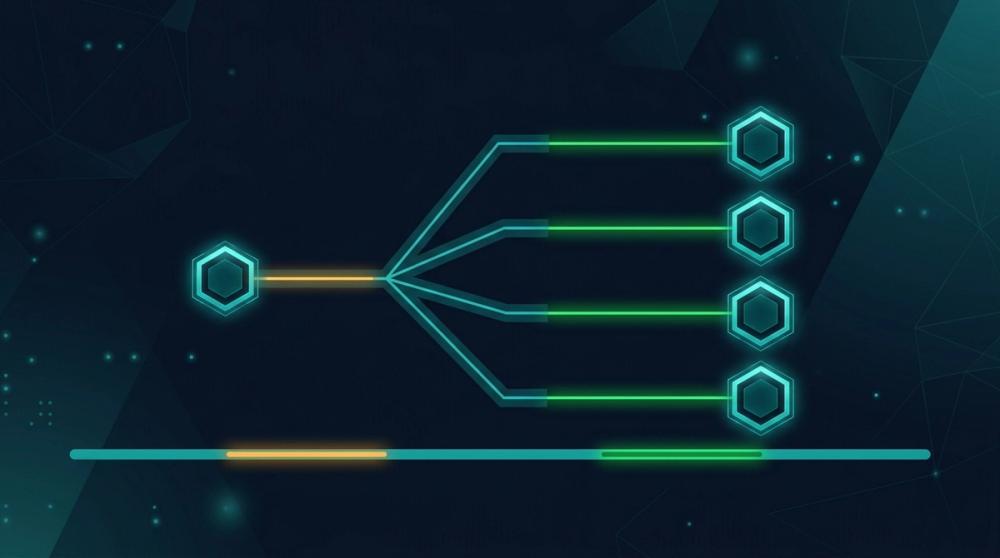
Best for independent tasks. One coordinator splits work into N parallel tasks, agents execute independently, and a merge step combines results. Works well for test generation, documentation, and linting across isolated modules.
Pipeline#
Best for sequential dependencies. Each agent completes its step before the next begins. Slower than fan-out, but preserves the dependency chain. Use this for multi-step refactors and migrations.
Supervisor#
Best for complex orchestration. One agent acts as coordinator, delegating tasks, validating intermediate outputs, and resolving conflicts. Higher overhead, but catches integration failures before they compound.
Shared-context#
Complementary to all other patterns. All agents query the same institutional knowledge layer instead of receiving pre-packaged context snippets. This doesn't replace the other patterns. It makes each one work better by ensuring every agent starts with the same understanding of your codebase, conventions, and architecture.
What are the most common questions about scaling parallel agents?#
How many agents should I run in parallel?#
Start with two or three. Google Research found diminishing returns beyond five agents on most task types. The coordination overhead increases faster than the throughput gains. Begin with a small number, measure quality metrics, and add agents only when the data supports it.
Does a larger context window fix the coordination problem?#
No. Context windows are per-agent. The problem isn't that individual agents lack space for context. It's that agents running in parallel each receive different slices of organizational knowledge. A larger window means each agent can hold more, but it doesn't ensure they all hold the same information.
What's the token overhead of multi-agent coordination?#
A three-agent pipeline consumes roughly 29,000 tokens versus 10,000 for a single-agent approach, nearly a 3x increase (Beam AI, 2026). A four-agent pipeline adds approximately 950ms of coordination latency on top of actual processing time. Budget for both cost and latency when planning your parallel workflows.
How does shared context change the scaling math?#
Tushar Kawsar, a software engineer at UserTesting, described his workflow this way: "My workflow is: here's the Jira ticket, here's the Confluence doc, here are the Slack threads - now build me a plan. Unblocked pulls all of that together so the agent starts with the full picture. Without it, I'd estimate I'm 20 to 30 percent less productive."
That 20-30% productivity uplift reflects what happens when you solve the context fragmentation problem at the source. Instead of packaging context into each agent's prompt, every agent queries the same context engine. Every agent gets the same picture, regardless of how many you run.
Across our enterprise customers running parallel agent workflows, the pattern is consistent. Teams that give every agent access to the same institutional context, covering code, documentation, conversation history, and decision records, see quality metrics hold steady as they scale from one agent to three or four. Teams that don't see quality drop within the first week.
A shared context layer is what makes scaling agents viable. When every agent starts with the same institutional knowledge, you eliminate the fragmentation that causes quality to collapse.
Is your workflow ready for parallel agents?#
With 65% of leaders citing agentic complexity as the top barrier (KPMG, 2025), readiness matters. Before you deploy parallel agents on any workflow, verify these four conditions. Missing even one will likely produce the quality degradation that turns a productivity gain into a debugging burden.
Tasks are truly independent#
If task B reads files that task A writes, they aren't independent. Map your file dependencies before splitting work across agents. When you're unsure, run sequentially for one sprint and track which files each task touches.
Context is shared, not copied#
Every agent should query the same source of institutional knowledge. Copying context into prompts creates divergence. A shared context layer ensures agents operate from the same understanding.
Output merge is defined#
Before agents start working, define how their outputs combine. Which agent's changes take priority in a conflict? What happens when two agents modify adjacent code? Answering these questions upfront prevents integration failures.
Quality gates exist#
Set up automated checks that run after parallel agent outputs merge. Test suites, type checking, and architectural linting catch the integration errors that individual agents can't see. If you haven't built quality gates yet, start with the patterns in stop babysitting your agents.
What to Parallelize This Week#
Start with test generation or documentation as your first multi-agent workflow. These tasks are naturally independent, file-isolated, and low-risk if quality dips during your initial learning period. Run two agents in parallel for the first two weeks, monitoring merge conflict rates, test pass rates, and review cycle time.
Once your metrics stabilize, expand to linting, formatting, and independent bug fixes. Save cross-file refactors and dependent feature work for later, after you've established shared context across your agents and validated your coordination patterns.
The teams I've seen scale successfully aren't the ones running the most agents. They picked coordination patterns that match their task structure, and they gave every agent the same institutional knowledge to work from.