Does a context tool pay for itself in token savings, and how do I prove it?

It can, but only a test on your own work proves it. Pick 20 real tasks, run each one twice with the same model and prompt, once with the context tool and once without. Compare the median priced token cost, wall-clock time and review rounds per task. If the median saving times your monthly task volume beats the tool's price, it pays for itself.
A context tool can pay for itself in tokens, but a vendor's number will not prove it for your engineers. Your own paired test will. A paired A/B test is a test where every task runs twice, once with the tool and once without, with everything else held constant, so each task is compared against itself. Run 20 real tasks that way and compare the medians of three measurements: what the tokens cost, how long the task took, and how many review rounds the result needed. Then multiply the saving per task by your monthly task volume and compare that figure with the tool's price. Priced token cost is the token count for a run, broken out by type (input, output, cache reads, cache writes) and multiplied by each type's published rate.
What "pays for itself" means in dollars#
Anthropic's Claude Code documentation puts the enterprise average at "around $13 per developer per active day and $150-250 per developer per month". It also warns that costs "vary widely based on model selection, codebase size, and usage patterns" (Claude Code docs). Your baseline is your own, not the industry average.
The payback calculation is simple. Take the median token cost saved per task, multiply by tasks per engineer per month, then multiply by the number of engineers. If the result is larger than the tool's monthly price, the token savings alone cover it. Time saved is a separate line on top, and it can be the larger one.
For example, with made-up numbers: say a typical agent task costs $1.50 in tokens, and the tool cuts the median by a third. That is $0.50 per task. At 100 tasks per engineer each month, it saves $50 per engineer before you count any time.
How to set up the test#
Pick 20 tasks from last month's merged tickets, spread across the repositories your engineers actually work in. Real tasks matter, because a context tool earns its keep on questions that need history, such as why a feature flag exists, which service owns an API call, or what an old incident changed. This test setup is your whole methodology, so write it down before the first run.
Then hold everything else fixed:
- Same model in both arms. Anthropic notes that Claude 4.7 and later models use a newer tokenizer that "produces approximately 30% more tokens for the same text" (Claude pricing). Switch models halfway through and the token counts are no longer comparable.
- Same prompt, same turn budget, and a fresh session for every run.
- Only one difference between arms: the context tool is attached or it is not.
- Alternate which arm runs first, and spread the runs across several days.
Anthropic's engineers found that infrastructure configuration alone moved one coding benchmark by 6 percentage points, and they suggest "running at multiple times and on multiple days would help average out the noise" (Anthropic Engineering, February 2026).
What to count for each run#
Raw token totals mislead, because different token types carry different prices. On Claude's API a cache read costs 0.1x the base input price, and 0.05x on Opus 5.5 and Sonnet 5.5. Output on Sonnet 5.5 costs $10 per million tokens, compared with $2 for input (Claude pricing). A run with more tokens can still cost less if most of them are cache reads. A 2026 study of coding agents also found that input tokens, not output, drive the overall cost (Bai et al., 2026). Record tokens by type and price each type separately.
In Claude Code, the /usage Session block lists input, output, cache read and cache write tokens per model, with an estimated cost and wall-clock duration. OpenTelemetry export streams per-user token and cost metrics if you want the collection automated. GitHub Copilot now uses usage-based billing, where "each token is priced based on the model used" and spend is counted in AI credits worth $0.01 each (GitHub Docs).
For each run, record five things:
- Priced token cost.
- Wall-clock time from prompt to finished change.
- Tool calls and turns.
- Whether the task finished inside the turn budget.
- Review rounds before the change was acceptable.
The last two keep the comparison honest, because a run that is cheap only because it gave up is not a saving. Tokens spent per accepted change is the number that matters, which is the idea behind token yield.
How to read the results#
Use the median, not the mean. For instance, one runaway task where the agent loops for 40 turns can drag an average almost anywhere, while the median still shows the typical task. Variation between runs is large: Bai et al. found that "runs on the same task can differ by up to 30x in total tokens." Also count how many of the 20 pairs the tool won outright. A modest median saving that holds on 16 of 20 tasks is stronger evidence than a large one driven by three.
Do not trust a single run in either direction. Invoca built a harness that ran each task twice in isolated agent runs, with and without Unblocked. Their first single run finished three times faster on wall clock but used slightly more tokens. Across 20 tasks in several repositories, median token spend came out 40% lower (Invoca customer story). Danny Peck, Principal Engineer at Invoca, summarized the result: "Median time was 30% faster with Unblocked, and median cost was 40% cheaper in total token spend. It was a cool experiment to see objectively that Unblocked not only gives you better context, it's faster and cheaper token-wise. A win-win across the board."
What a result looks like, and what to do with it#
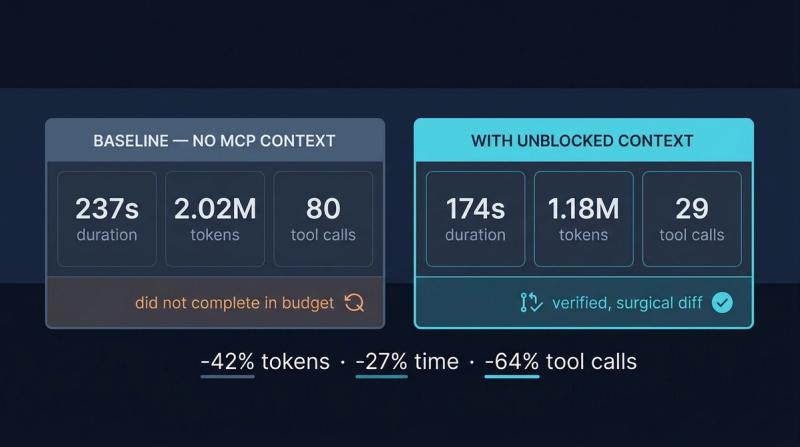
We measured the same kind of comparison on one production repository, with the same prompt, model and turn budget, with and without Unblocked attached. The Unblocked run used 42 percent fewer tokens and 64 percent fewer tool calls, and only the Unblocked run finished the task. The full method and the open-source harness are in same prompt, same model, different context. A context engine is a service that answers the agent's question in one cited response drawn from code, PRs, issues, docs, Slack and incidents, so the agent skips most of its own searching. Unblocked is one, and it reaches Claude Code, Cursor, GitHub Copilot and JetBrains through a single MCP connection.
With 20 pairs in hand, the decision is arithmetic. If priced token savings cover the price, you are done. If they cover half, add the time saved and the reduction in review rounds, and check whether those cover the remainder. To turn that into a cost-per-outcome figure your finance team will accept, see how to measure AI coding tool ROI. If the real problem is the bill itself, the guide to reducing AI coding spend across an organization covers caps and defaults first.