"Context" grew up at the World's Fair
Anthropic shipped two frontier models mid-conference to real excitement, but the AI Engineer World's Fair kept circling back to context. A founder's field notes on a category forming in real time.

Anthropic shipped two frontier models in the middle of the AI Engineer World's Fair last week, and the halls buzzed exactly the way you'd hope: packed launch sessions, benchmarks flying around group chats, genuine excitement. What struck me was how quickly the conversation kept circling back to something else.
Sonnet 5 landed on day two, and Fable 5 was reintroduced the same morning. People were fired up, but the buzz had a shorter half-life than I anticipated. The 6,000 engineers at Moscone West drifted back to what they'd been talking about since workshop day on Monday: everything that surrounds the model.
Model capability is now something people assume they have.
The open question, the one an entire conference just spent four days on, is context.
We have a unique take because that's the question Unblocked was founded four years ago to answer.
"Don't tell me, show me"#
In the decades I've attended conferences, I've learned to watch what conferences institutionalize, not what keynotes announce.
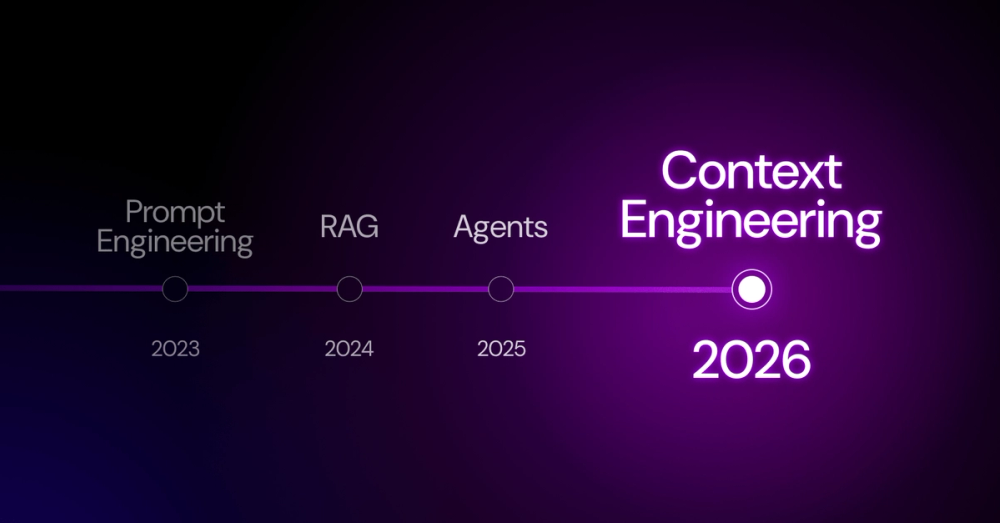
Three years ago the discipline everyone was hiring for was prompt engineering.
Two years ago it was RAG pipelines.
Last year, agents.
This year the World's Fair gave Context Engineering its own dedicated track, running alongside Memory & Continual Learning one day and a full Graphs track on another.
Job titles followed. One main stage speaker, PostHog's Sarah Sanders, presented under the title "Context Engineer", not "prompt engineer" and not "AI engineer".
A discipline gets real when it earns a conference track, a shared vocabulary and a title on someone’s business card. At that point, people are building careers around it, not just using it.
The term itself is barely a year old, and the AI Engineer organizers have since boiled the whole idea down to eight words: everything that makes agents good is context engineering.
RAG got demoted#
The most interesting thing about the context conversation was what's now considered old news.
Nobody was debating whether models need external information anymore.
That argument is over, and RAG, which was the whole conversation two years ago, is now treated as one component of a larger system rather than the system itself.
The workshop titles made the point bluntly. Neo4j argued that RAG needs a map. Elastic declared that vector isn't enough. Our own workshop was called Beyond RAG for a reason. The session was packed, and workshop attendees loved our Document Query Engine, available as an open source project. It is a structured query engine that turns natural language into validated MongoDB aggregation pipelines over GitHub PR and Issue data. It shows how semantic RAG is fine for finding similar documents, but it can't reason about time, traverse relationships, or apply precise filters.
Across the schedule the questions had moved up a level: how should organizational knowledge be represented, how do its pieces relate, how does it stay fresh, who is allowed to see it, and which source wins when two of them disagree?
Retrieval answers "find me something relevant." Production agents need answers to "what does this company know, and how do I know it's true?" Those are different problems, and the industry spent last week acknowledging it.
A category forming in real time#
You could also watch the vocabulary fragment, which is what tends to happen right before a category hardens.
Atlan's founder asked, on stage, "WTF is the context layer?"
Merge's CTO argued every company needs a context graph.
Monday.com framed the shift as moving from systems of record to systems of context.
Bright Data pitched context-as-a-service.
Neo4j's CEO closed with thinner agents on a smarter substrate.
"Layer", "graph", "system", "service", "substrate": five metaphors for one idea, which is that the lasting value in an AI stack isn't the model, it's the machinery that gives the model an accurate picture of your organization.
Here's the distinction I'd offer the people still sorting those metaphors.
Context engineering is what you do on every inference call: assembling, ordering, compacting, budgeting tokens. It's a per-request discipline, and the track at the fair was full of hard-won techniques for it.
A context engine is what you build or buy underneath that discipline, the system that continuously captures organizational knowledge, connects it across code, conversations, tickets, and documents, and serves the right slice to any agent that asks.
This is what Unblocked was built for, years before context engineering had a name or a track. We started from a plain observation: the most expensive question in software isn't "how do I write this code," it's "why is this code the way it is," and the answer almost never lives in the code. It lives in an old pull request, a Slack argument, a ticket somebody closed in a hurry.
The field arriving at this framing didn't surprise us, but the speed did.
Lessons from the booth#
We weren't only in the audience. We gave a main-stage talk, "Your agents lack context: Here's how to fix 'You're absolutely right!'", to a packed room, and the numbers on the screen behind me came from a customer: ~50% fewer tokens, faster triage, and answers that were actually better because they weren't buried in noise.
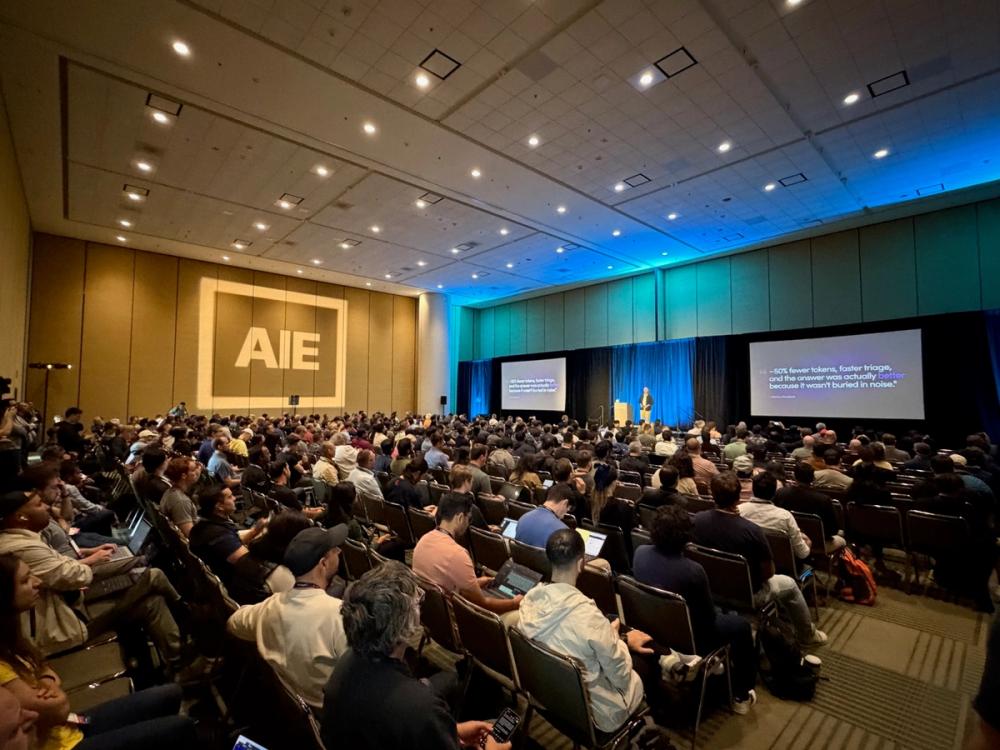
But the clearest signal at the fair wasn't on any stage. It was the four days our booth stayed slammed. We saw the same story hundreds of times. Engineers' agents write code that compiles, reads cleanly, and does the wrong thing, because the agent never knew about the constraint buried in a system of record it ignored. They didn't need convincing that context was the bottleneck but loved another one of our open source projects that shows how pre-gathered organizational context helps AI coding agents complete tasks faster, cheaper, and better.
Nobody asked "why would an agent need this?"
Two years ago every one of those conversations started with a whiteboard and a definition.
Last week they started with "we know, how does it work?"
Why this happened now#
The shift has a simple cause. Agents got good enough that their failures changed shape.
When an agent produces code that compiles, passes review at a glance, and is still wrong, the model usually isn't the culprit. The model reasoned correctly from an incomplete picture of your organization.
"Context debt" is what we've been calling the gap between what's in your systems of record and what your team actually knows, and every company that has shipped software for more than a year is carrying some.
Agents didn't create it. They industrialized the cost of it, because they act on incomplete pictures at machine speed and machine volume.
What next year's fair will look like#
My prediction is that context won't be a track at the 2027 World's Fair, for the same reason there's no track called Databases. Disciplines get tracks while they're being figured out. Then they become infrastructure and the conversation moves to what you build on top.
The teams that get there first won't be the ones with the cleverest per-call assembly tricks. They'll be the ones that treated organizational knowledge as a real system: captured continuously, connected relationally, permissioned properly, and available to every agent and every engineer who needs it.
That system is what we build. Unblocked is a context engine. It continuously captures the knowledge scattered across your pull requests, Slack threads, tickets, and docs, connects it into a coherent picture of why your software is the way it is, enforces who is allowed to see what, and serves the right slice to any agent or engineer that asks.
Point your coding agents at it and they stop reasoning from an incomplete picture of your organization.
Models get better on their own. Your context is the part that only improves if someone builds it, and building it is the whole reason Unblocked exists. We had a head start, and last week the rest of the industry started walking the same way.
Dennis — Founder & CEO